

They'd spent ten minutes trying to do a somersault on the mat. Every attempt ended up sideways, and every attempt ended in giggles. Then another kid showed up and did a whole one on the first try. So they sat down. And when you told them to keep going, they said they didn't feel like it anymore.
The somersault didn't get any harder in those ten minutes. What's different now is that there's someone standing right there who already knows how to do it.
Why they stop trying
What's startling is how fast they drop something that was fun a minute earlier.
From the inside it makes a lot of sense. As long as nobody could do it, every failed attempt was part of the game. The moment someone shows up who can, that same failed attempt starts to prove something. And then stopping isn't giving up anymore, it's protecting yourself: if I don't try, nobody gets to see that I can't.
That's why "come on, one more time, you can do it" bounces off so often. You're asking for exactly the thing they've just decided not to do, and for the very reason they decided it.
They're sitting down and they're not budging
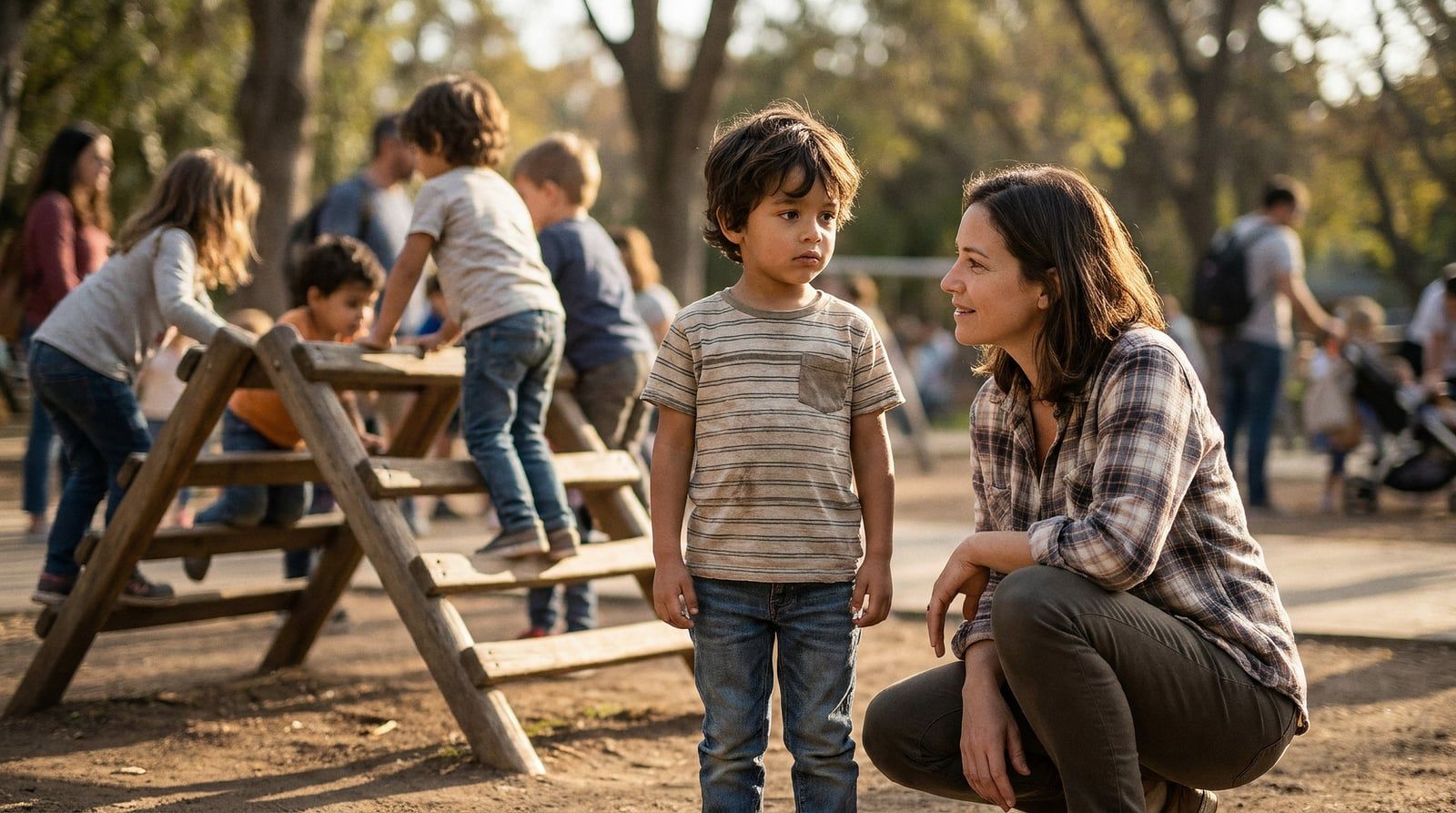
Let's start with the awkward part, because that's the one in front of you right now: they've sat down, there are people around, and you can't just take them home.
What works best there is one of the few things that cost nothing: let it go. A calm "okay", no disappointed face and no negotiating, and you carry on with what you were doing. If you insist, you confirm that it mattered and that they've been shown up. If you launch into a speech about effort, same thing.
And if they stay there watching the others, let them watch for as long as they want. At this age watching is a legitimate way of taking part, and it's fairly common for a child to spend a whole afternoon looking on and then, the following week, get it on the first try without any warning. Watching is part of the learning, not the opposite of it.
What is worth doing is not filing the whole thing away as closed. The retry doesn't belong there; it belongs somewhere else and without an audience, and we'll come back to that further down.
Three replies that usually make it worse
We all say them, and they come out at exactly the worst moment: with your other child pulling at your arm and half the playground watching. They're here so you can spot them, not to point fingers.
"You'll get there too." It's true and it helps very little. You're offering comfort that lives in a future they can't see, while the problem is right in front of them now. And along the way you confirm what they were afraid of: that today, yes, they are behind.
"Don't compare yourself." You're asking them to stop feeling something they're already feeling. It also teaches them that comparing is a bad thing to do, so next time it happens they'll keep it to themselves instead of telling you.
Comparing back. "Sure, but you run faster than he does." It comes out with the best intentions in the world and it reinforces exactly what we were trying to dismantle: the idea that what you're worth depends on where you land next to everyone else. Today they win. Tomorrow, with another child and another skill, they lose by that same measure.
Changing the yardstick
What does move something is changing who they measure themselves against. From "him and me" to "me now and me a little while ago."
It sounds abstract and it works in a very concrete way: by saying out loud what they've just managed, at the exact moment they manage it. "You stayed on your feet longer than before." "This time you got halfway." And without waiting for the whole thing to come out right.
A child who is learning something almost never sees their own progress, because they measure it against the final result and the final result is still far off. Someone on the outside has to tell them how much of the road they have already covered.
Take away the audience
There's one thing you can almost always change and that we tend to forget about: who's watching.
A child who dug their heels in in front of their cousins will try again in the living room at home when there's nobody around. That isn't stubbornness or manipulation: the cost of failing changes a lot depending on who's watching, and to them that cost is real.
So before you insist, try moving the setting. At home, with no spectators and with nobody waiting for their turn. Whatever they manage there, they take with them the next time there are people around.
And if the first step you suggest sits just below whatever scares them, better still. That is what My child is afraid to try new things is about.
Isn't it early for this to be happening?
It's the question that comes up almost every time, especially with the youngest ones.
Children compare amounts long before they compare abilities. Who has more cookies, or whose cup is the bigger one: that shows up as early as two or three. Comparing yourself asks for something harder, which is looking at yourself from the outside through someone else's eyes, and in typical development that settles in later, somewhere between five and seven.
Those ages are a rough guide, not a timetable. A four-year-old with an older sibling can reach that conclusion long before a six-year-old who has nobody to measure themselves against at home.
When it happens between siblings
Comparison between siblings deserves a section of its own, because it doesn't end when the swimming lesson ends. It lives at home, full time.
There, the comparisons we make out loud count for less than the one the child makes all by themselves, simply from having the reference right there all day. About that last part there is not much you can do, apart from two concrete things.
Don't use the older one as the unit of measurement. "Your brother was already sleeping on his own at your age" slips out easily, and it lands like a bad grade.
Look for stretches where no comparison is possible. You don't need an after-school activity or a free afternoon: ten minutes in the kitchen while the other one is in the shower will do, doing something that is theirs and that their sibling isn't doing better a few feet away.
And when what presses is the whole group rather than one particular child, the mechanism shifts a little: it goes from "he can and I can't" to "everyone does it except me." We talk about that in When everyone else is doing it.
A story where nobody promises they'll get there
In The Brave Butterfly, Alina comes out of her chrysalis with enormous new wings and stays perfectly still on the branch. All around her the whole garden is flying: the dragonflies shoot past like arrows, the bees go from flower to flower without hesitating once. She watches and reaches the usual conclusion: they know how to fly and I don't.
The one who comes over is Zumbi, a fuzzy bumblebee who flies in zigzags and lands frankly badly. The first thing he does is tell her that he doesn't fly like the others either. At no point does he promise her that one day she'll fly like the big butterflies; he tells her that her way of flying will be her own.
The small steps come afterward, and they work because by then nobody is measuring themselves against anybody. It's a good story to read with a child who has ended up sitting on the mat.

The Brave Butterfly
Discovering confidence step by step
Alina is a young butterfly who has just transformed and has beautiful new wings, but she feels afraid to use them for the first time. With the help of her friend Zumbi, a wise and patient bumblebee, Alina discovers that confidence is built step by step and that daring to try is the first great flight.
Read this children's story in the Semillita appNext post: the child who demands far more of themselves than anyone else demands of them.