

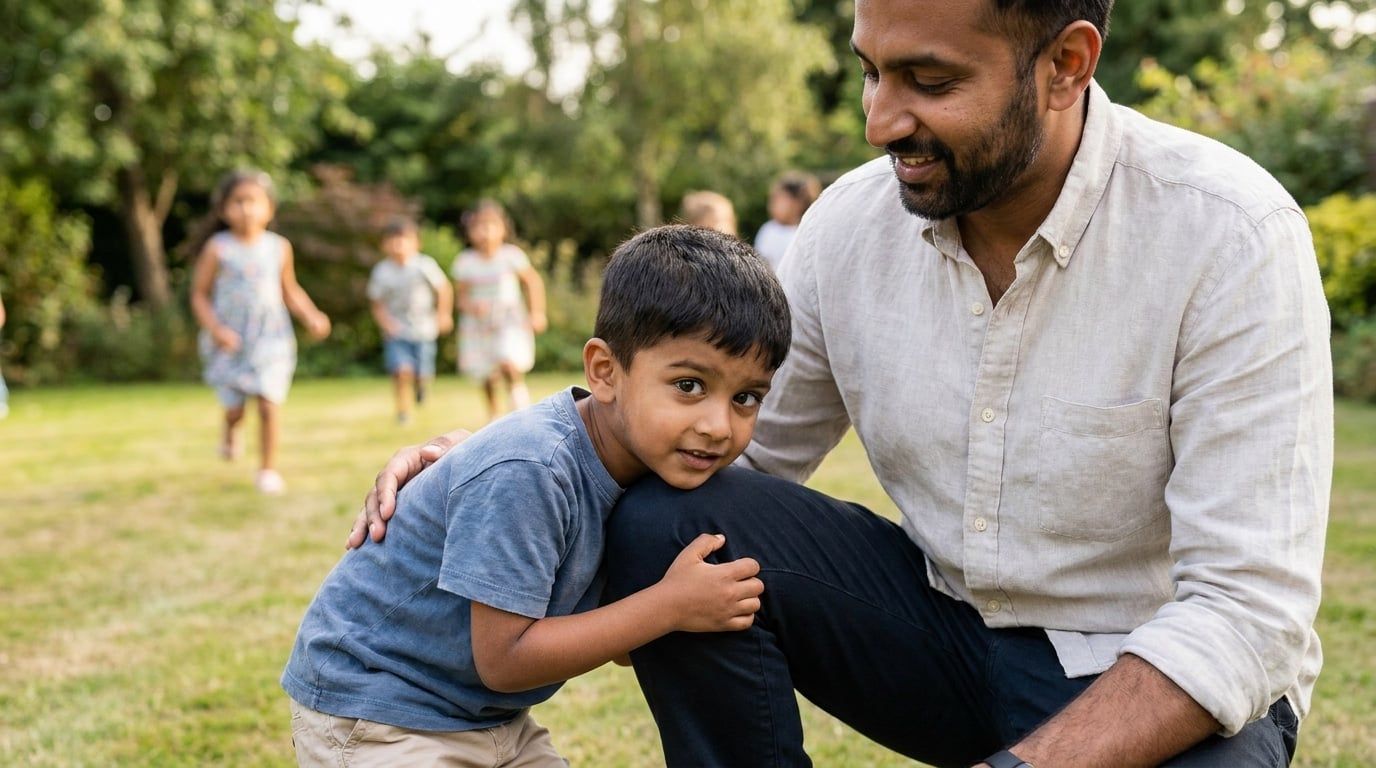
You arrive at the birthday party and your child stays glued to your leg. The other kids are already running across the lawn, and he watches from behind you without letting go. An aunt crouches down: “No hello for me? Someone’s shy!” And you, half feeling for him and half a little embarrassed, don’t know whether to encourage him to go or leave him where he is.
What’s normal
Shyness in childhood is very common. The American Academy of Pediatrics (AAP) notes that most shy children are born that way, though some become shy after difficult experiences. And that most get along fine with others once an initial adjustment period is over; what deserves more attention is a child who still finds it hard to make friends even after that (AAP, on shyness in children). In a new place, that period can last weeks.
For most, it’s part of their temperament: some children adjust slowly to new places and people, and open up once their surroundings become familiar. That’s why the same child who won’t let go of your leg at the birthday party may talk nonstop at their grandparents’ house. For these children, the AAP advises introducing new things gradually, telling them what’s coming ahead of time, and letting them go at their own pace (AAP, on temperament).
Will they grow out of it?
Many will, and others not completely. According to the AAP, many shy children learn over time to manage their shyness, even if they still feel shy inside, and others go on preferring not to be the center of attention. Both are fine.
The longest studies have been done with a minority of children with very marked shyness, measured in the lab. Even in that group, which has a higher risk of anxiety than average, more than half don’t go on to develop it (Fox et al., 2023). Everyday shyness isn’t that.
What helps and what doesn’t
In a study that followed 108 children from ages 2 to 4, those who were shyer with other children at 2 tended to still be shy at 4, especially when their mothers (the study only observed mothers) directed them or did things for them, or spoke to them mockingly (Rubin et al., 2002). These are association data, and a recent review warns that it runs both ways: a very fearful child also makes adults more protective.
In this research, overprotecting counts as part of that same control. Doing things for them or always sparing them what frightens them brings relief in the moment, but it helps keep the fear going. What the review proposes as protective, still as a hypothesis, is encouraging them gently and accepting them as they are.
In one trial, the parents of 146 very inhibited preschool children took a six-session group program in which, among other things, they learned not to overprotect them and to help them gradually face what they were afraid of. Three years later, those children had fewer anxiety disorders than the children whose parents didn’t take the program, although they weren’t any less shy (Rapee et al., 2010). It can’t be applied as is to just any shy child, but it points in the same direction as pediatricians: this isn’t about changing who they are.
How to support them
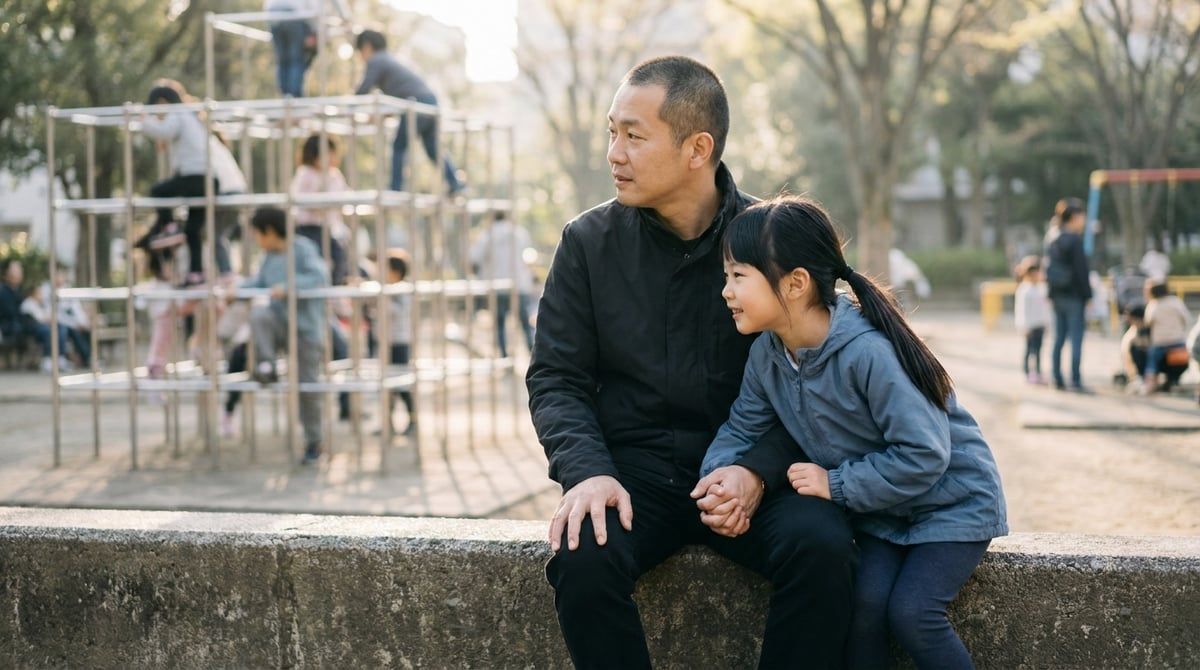
Arrive early and watch with them. A party with three children is less scary than one with thirty. ZERO TO THREE, an early childhood organization, suggests something similar for the playground: watch together for a while and, when they seem calmer, suggest something specific, like going on the swings (ZERO TO THREE, on shy children).
Tell them ahead of time what’s going to happen, and rehearse it together. Who’ll be there, what you’ll do, how long you’ll stay. The AAP also suggests practicing at home what they can say or do (AAP, on a girl who is very shy around strangers). A hello practiced with a stuffed animal comes out more easily at the door.
One small step, without excusing them from everything. Waving hello, playing just one thing for a few minutes, handing the birthday child the present. Always skipping birthday parties brings relief today and makes it harder next time; it’s better to go for a while, stay close by, and have an exit plan ready.
Don’t label them in front of them. ZERO TO THREE advises against introducing them as “the shy one.” No studies have measured this, but it’s easy to swap it for something that doesn’t box them in: “He likes to watch for a while before he joins in.”
When another adult pressures them, take their side. “Don’t I get a kiss?” is a lot to ask of a child who’s still watching. You can ask for time on their behalf: “He’s just watching right now. He’ll say hello when he’s ready.” If it’s a family member who keeps at it (“You’re no fun”), in the moment it’s enough to reframe it without arguing (“He likes to watch first; then he warms up”) and, later, in private, let that relative know what helps. We talk about how to let them choose how they say hello in “Teaching Kids to Ask Permission”.
At school, one friend at a time. Tell their teacher what your child is like and what helps, and ask how they’re doing in class: whether they talk, whether they play with anyone. You could try inviting a classmate over: on their own turf and one-on-one, it may be easier for them, and the next day on the playground they’ll already have a familiar face. The AAP points out that sharing an interest is sometimes just what children need to start talking with other kids.
Celebrate the specific. “You said hi to Lily even though it was hard at first. I saw that” tells them exactly what they did well. If they get embarrassed when it’s noticed, it’s better on the way home than in front of everyone. And if they also find it hard to try new things, there are more ideas in “My child is afraid to try new things”.
When to talk to the pediatrician
Bring it up if it doesn’t get better with time, if they get much more distressed than is usual for their age around strangers or when you’re not close by, or if they seem sad or anxious (AAP, on a girl who is very shy around strangers). Also if there has been a sudden change: they used to get along with others without any trouble and now they withdraw, even if you don’t know why. Bring it up as well if, after the adjustment period, they still aren’t interacting with anyone in class. And if shyness keeps them from doing things that are typical for their age, it’s a good idea to have them evaluated by a child mental health professional.
There’s one case that gets mistaken for shyness and isn’t: selective mutism. It’s an anxiety disorder in which a child speaks normally at home but can’t manage to speak in specific places, almost always school, for at least a month (two if the place is new), and it holds them back. It isn’t that they don’t want to talk: they can’t. Unlike shyness, it doesn’t go away as they get comfortable: weeks later they still can’t speak in class, even though they already know the teacher and their classmates. It usually begins in the early years and gets noticed when they start preschool or school, though sometimes it doesn’t show until elementary school, and it affects around 1 in 140 young children (NHS, on selective mutism). If you suspect it, talk to the pediatrician without waiting to see if it passes.
If they’re learning the language spoken at school, it’s normal for them to stay quiet there at first, and that alone isn’t mutism. But it shouldn’t be ruled out either, because it’s somewhat more common in children who have recently arrived from another country or who speak another language at home. What sets it apart is that they can’t manage to speak there in the language they know well either: for example, they don’t even talk to you, in your home language, when other people are around (ASHA, on selective mutism).
A firefly who dimmed her light
In A Retelling of Cinderella, a story for children ages 6 to 8, Ceni is a firefly with a big, warm light. She wasn’t born shy: she always keeps it turned way down because at home her stepmother and stepsisters keep telling her it’s blinding them. “Turn it down,” they tell her. At the ball she stays pressed against the wall, her light almost out, and when she lets it out without meaning to, the whole Fallen Log lights up and she goes dark out of embarrassment.
Then the whole log claps and calls for it to come back, and someone who has been dancing beside her in the dark all night holds out a hand: “Want to dance?” The next day, in her garden and with just one friend, playing hide-and-seek, Ceni lets her light shine without thinking about it.
The guide that comes with the story in the app suggests a question for afterward: “What could someone do to make it easier for you to join in?”

A Retelling of Cinderella
The Light You Carry Inside
Ceni is a firefly who looks after night-blooming flowers among the roots of an old tree. Her light is big and warm, but she keeps it low because at home she’s told that it bothers others and that nobody will want to be around her. When a ball is announced in the meadow, her wish to join in gets mixed up with her fear of drawing attention. This retelling of Cinderella explores what we feel when we try to take part while worrying about being rejected.
Read this children's story in the Semillita app