

Saturday morning. They've been playing nicely for ten minutes, and suddenly: “It's mine!”, a shout, a shove, and both of them running to you to tell their side of the story. It's the fourth time before lunch. And you don't know whether to step in or let them sort it out themselves.
Fighting is to be expected, but hitting still matters
The American Academy of Pediatrics (AAP) points out that no matter what you do, siblings are going to fight; what changes with age is what they fight about. Learning to disagree respectfully is part of learning to communicate, but children need help to do it, and their temperament, maturity, and age make a big difference (AAP, on sibling relationships).
Aggression between siblings is common too, which doesn't make it harmless. In a US national survey, about 45 out of every 100 children aged 2 to 9 had experienced some kind of aggression from a sibling at least once in the past year, whether physical, against their belongings, or with words (Tucker and colleagues, 2013). The researchers themselves point out that it tends to be played down. Further down, you'll find when it's worth being concerned.
Step in or let them handle it?
It depends mostly on age. According to the AAP, with little ones you need to step in more often and repeat simple rules, like no hitting, over and over; as children get older, parents can step back more. With a simple disagreement, you can give them the chance to work it out on their own, even if they need some time apart first. If they can't manage it, or if you're worried about how one of them is doing, it's time to step in calmly and listen to both of them before deciding anything, even if you think you know who's to blame.
A study that recorded sibling fights at home in 88 families whose younger child was 3 to 5 years old points in the same direction: when parents didn't step in, there tended to be more conflict afterward, especially between the youngest siblings. Among the older pairs in the sample, on the other hand (who were still school-age children), the mother stepping in was associated with the siblings being less close (Kramer and colleagues, 1999). These are associations, but they fit with what the AAP says.
How to step in without playing judge
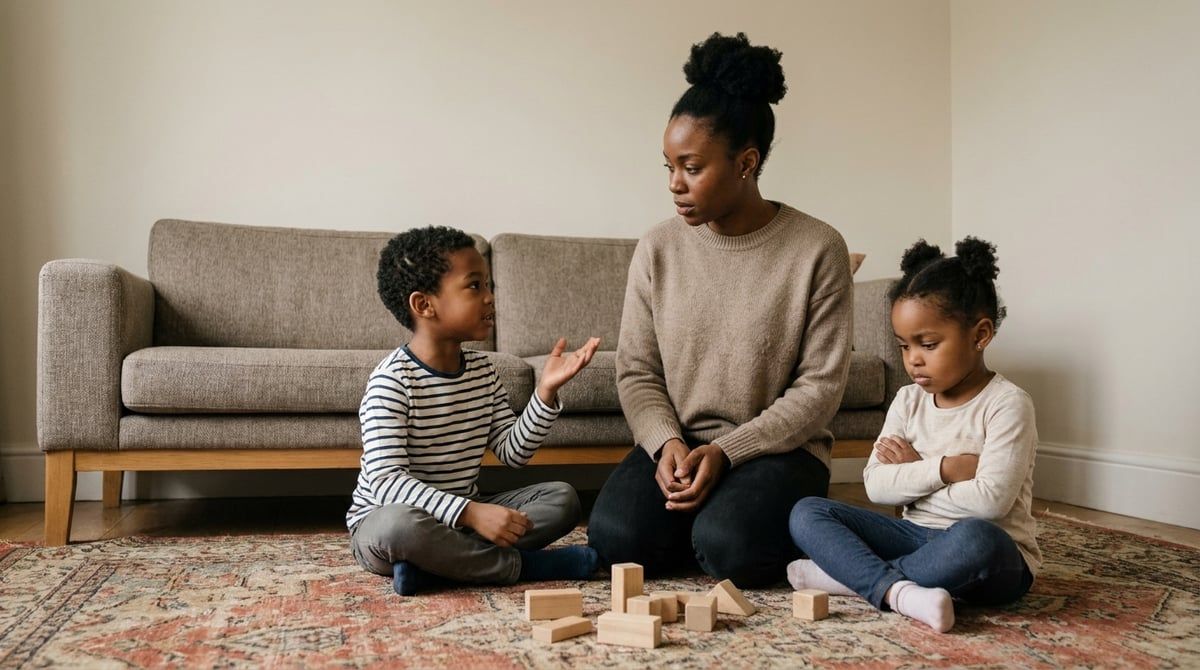
If someone got hit, the first thing is to stop it and take care of the child who was hit. Then, once they're calmer, it might sound like this: “You wanted the shovel because you were building the castle, and you wanted it too. You're both upset. What can you two come up with?” With 2- or 3-year-olds, you'll usually have to offer a couple of options yourself: “A turn each, or should we find another shovel?” From around age 4, try waiting first for them to suggest something, even if it's an odd idea. If there are several years between them, make sure the younger one also gets to say what they want.
Letting them come up with the solutions has some support, in children aged 5 to 10. In a trial with 48 families, some parents were taught to mediate fights instead of settling them themselves, and others weren't, chosen at random. According to the parents themselves, their children afterward used more constructive strategies, reached compromises more often, and more often decided for themselves how the fight ended; when the researchers watched them negotiating on their own, they treated each other with less hostility (Smith and Ross, 2007). It's a small study, and it doesn't say they fought less often.
In another similar study, with children aged 3 and a half to 11, the parents who mediated talked more about what each child was feeling, assigned less blame for what had happened earlier, and suggested fewer solutions; the children came up with them, and the younger siblings were the ones who benefited most (Ross and Lazinski, 2014). Even so, the evidence is still thin: a 2017 review found only five programs that had been evaluated, all with school-age children, and concludes that they are promising but more research is needed (Tucker and Finkelhor, 2017).
Ideas for every day
A few rules, and clear ones. No hitting. Ask before taking what belongs to the other one. With little ones, you'll need to repeat them many times. We talk about how hard sharing is at these ages in “My child won't share”.
In everyday squabbles, you don't need to figure out who started it. That question tends to turn the conversation into a trial. It's a different story if you see that it's almost always the same child doing the hitting, or the same one getting hit: that's no longer a squabble between equals, and it's worth looking into (more on that below).
Don't always give in to the younger one. The AAP warns that always giving in to the younger child because the older one “is old enough to understand” can breed resentment and keeps both of them from learning how to deal with each other. Taking turns choosing helps. With twins or siblings close in age, there's no “little one” to give in to, and any difference stands out more: in the studies, aggression was more common between siblings close in age, and unequal treatment weighed more heavily.
Some time alone with each child. The AAP suggests building it into your routine: a chat at bedtime, running an errand together, taking turns walking the dog.
Team games over competitive ones. If there's a lot of rivalry, the AAP suggests games where you win together or where no one keeps score, and shared projects: building something together puts them on the same side.
Adjusting to each child is unavoidable; one always losing out isn't. A meta-analysis found that being treated less favorably than a sibling, or a big difference in how the two were treated, was associated with more emotional and behavioral problems. These are associations, in children with an average age of 12, and the relationship can run both ways (Jensen and Thomsen, 2024). It hasn't been studied in young children, but explaining to them in simple words why the younger one needs more help costs nothing.
When to bring it up with your pediatrician
Arguing, yelling at each other, or fighting over a toy every day is within what's expected; with aggression, the bar is different. In a study of more than 1,500 Chicago families with children aged 3 to 5, more than half of parents said their child had been aggressive toward a sibling at some point in the past month. But hitting, pushing, or calling a sibling names four or more days a week already put a child among the most aggressive 5%, and talking about wanting to hurt their sibling was the rarest of all (Dirks and colleagues, 2019). It's a statistical reference point for those ages, not a diagnosis.
In another paper by the same authors as the survey, with 3,599 children and adolescents, those who had experienced aggression from a sibling had more psychological distress, and the authors ask that it not be played down (Tucker and colleagues, 2013). Talk to your pediatrician if it's almost always the same child doing the hitting and the same one on the receiving end; if the one on the receiving end is afraid of their sibling, avoids being alone with them, or seems sadder or more on edge; if one hits, pushes, or calls their sibling names four or more days a week; if either of them ends up with marks or injuries; or if one talks about wanting to hurt the other. With other children, the bar is lower, and if what worries you is that your child also hits outside the home, there are more ideas in “My child hits”.
Two siblings and a cardboard house
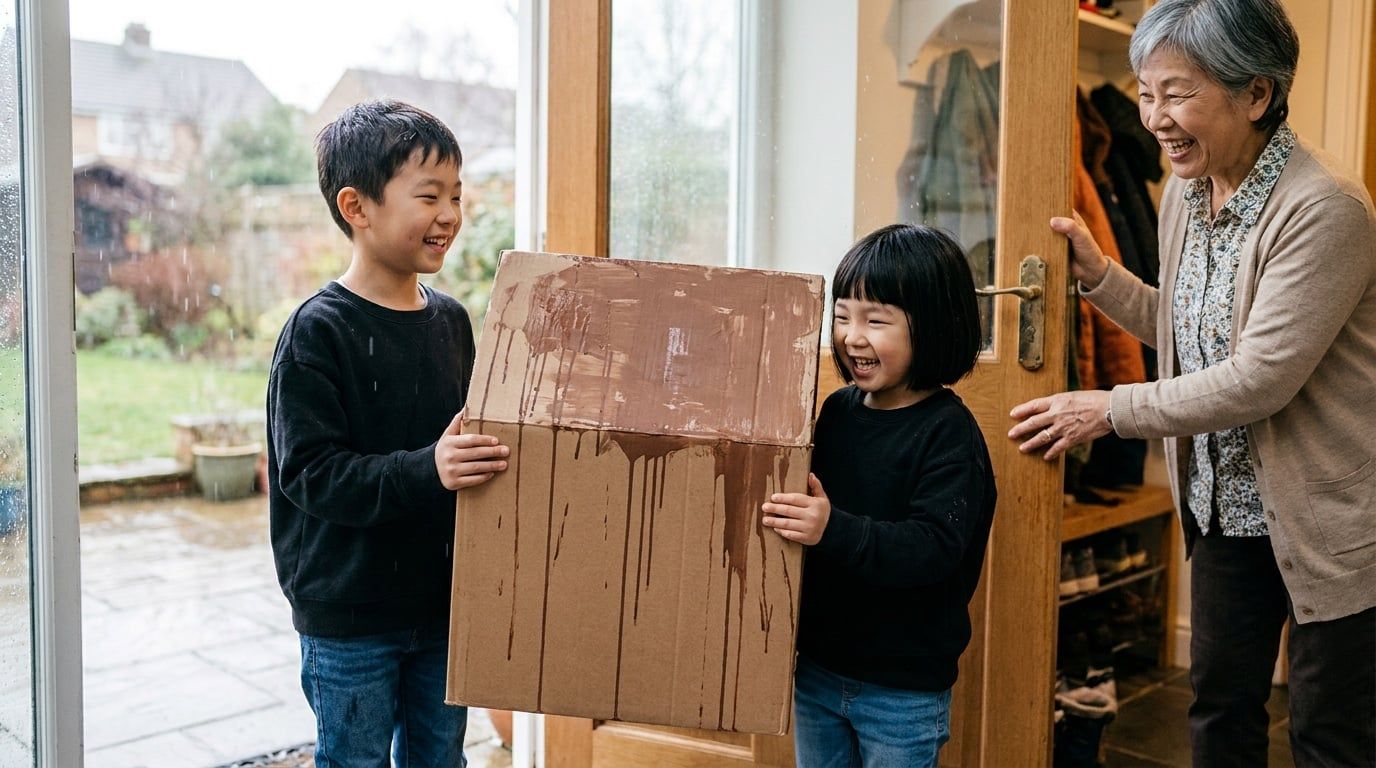
In Another Tale of Hansel and Gretel, a story for children aged 5 to 8, Ulises and Jacinta build a cardboard house painted to look like chocolate so they can act out the story with their grandma. They clash right away: they both want to be the one who does the rescuing, neither wants to be the one trapped and waiting, and the game grinds to a halt.
Then it starts to rain. Ulises tries to carry the house inside by himself, and the roof starts to bend; Jacinta tries to save all the paint jars at once and drops one. Then she realizes the paint is closed and won't get ruined, and suggests saving the house first. They each take one side, and this time the roof holds. No adult acts as a mediator here, and none is needed: it's an argument without any hitting between children aged 5 to 8, the kind of simple disagreement you can give them room to handle. The fight over the role melts away once they have a problem they can only solve together. Grandma doesn't tell them what to do: she lets them know the cardboard is getting wet, holds the door for them, and, at the end, plays with them again.
The guide that comes with the story in the app suggests a question for afterward: “What ideas can you come up with when two people want the same role in a game?”

Another Tale of Hansel and Gretel
The Chocolate House
Jacinta and Ulises build a cardboard house so they can act out Hansel and Gretel with their grandma. They have fun painting candy on it, but when it’s time to pick roles, both of them want to be the one who saves the other, and neither one wants to be stuck waiting. While they argue, the first raindrops start falling on the set they made together.
Read this children's story in the Semillita app