

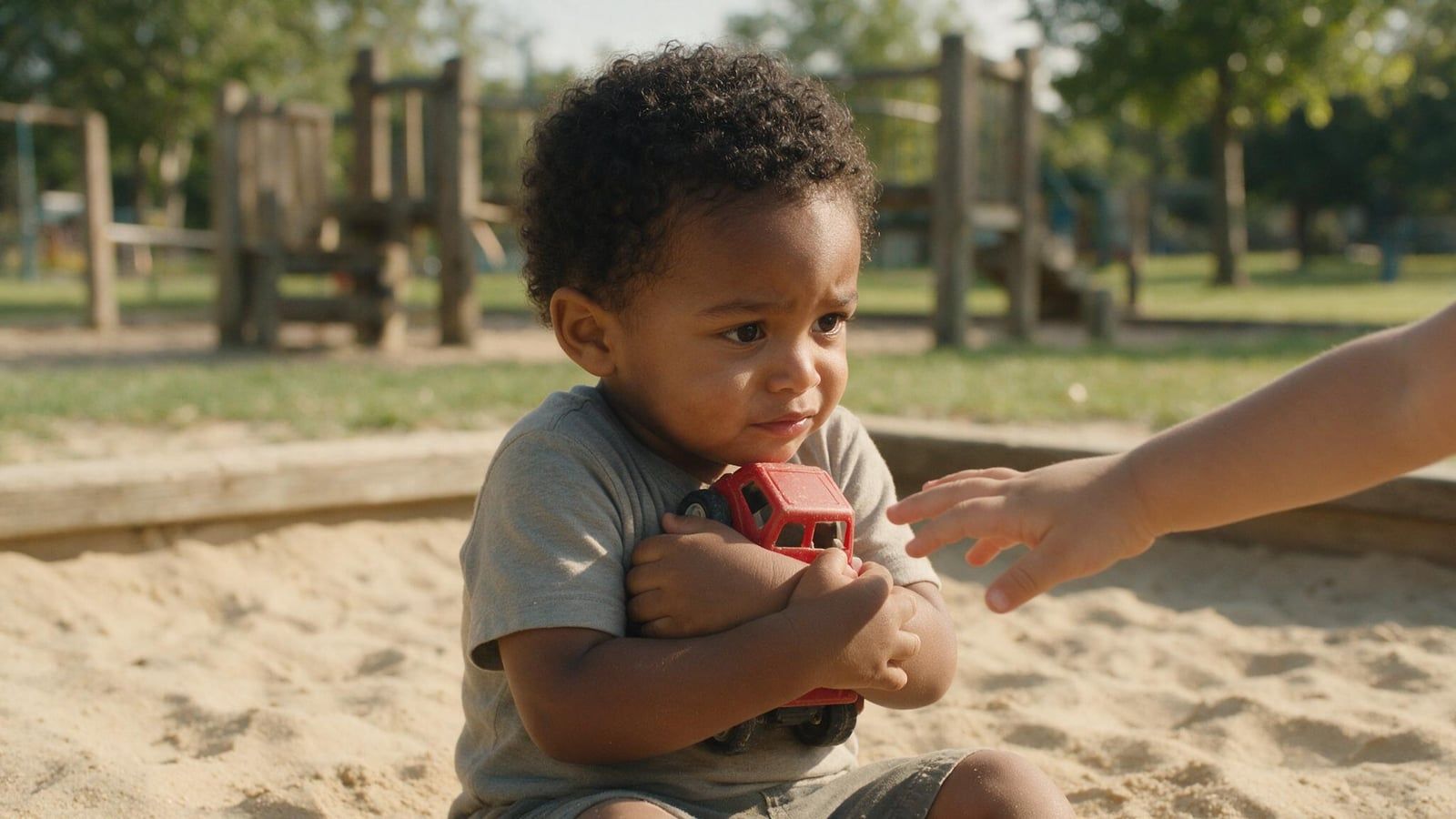
You're at the sandbox. Your child has been at it a while with his truck, off in his own world, hauling sand and tipping it out. Another little girl comes over and reaches out a hand, and before she can even touch it he has it clamped against his chest: “mine!”
And then two things happen at once: the girl stands there watching, and so does every other adult at the playground. What comes out of us in that moment is usually a “come on, share” said with a lot more urgency than the situation calls for.
What “mine” actually means
Around age two, children try out a brand-new idea: that some things belong to them. And they try it out pretty literally. For your child, handing over the truck is closer to handing over a finger than to lending you a pen. He behaves as if the truck were a piece of him, and at that age there is probably something to that.
That explains how big the reaction is. A two-year-old shouting “mine” isn't trying to give anyone a hard time: he's busy with something very close to what sits behind the “no” of that same age, which we wrote about in The “no” phase. The idea that something is his comes first. Being able to lend it takes a good while longer.
What to expect at each age
A child can run a year ahead of his bracket or a year behind it, or move around depending on the kind of day he's having, and be perfectly fine.
Before age 2. There's no stable idea of ownership yet, and taking something out of someone else's hand is usually exploring. Generous gestures do happen: plenty of children this age hand things over and help without being asked. Best not to read those as personality, because when “mine” arrives you'll think your child has gone backwards, and he won't have.
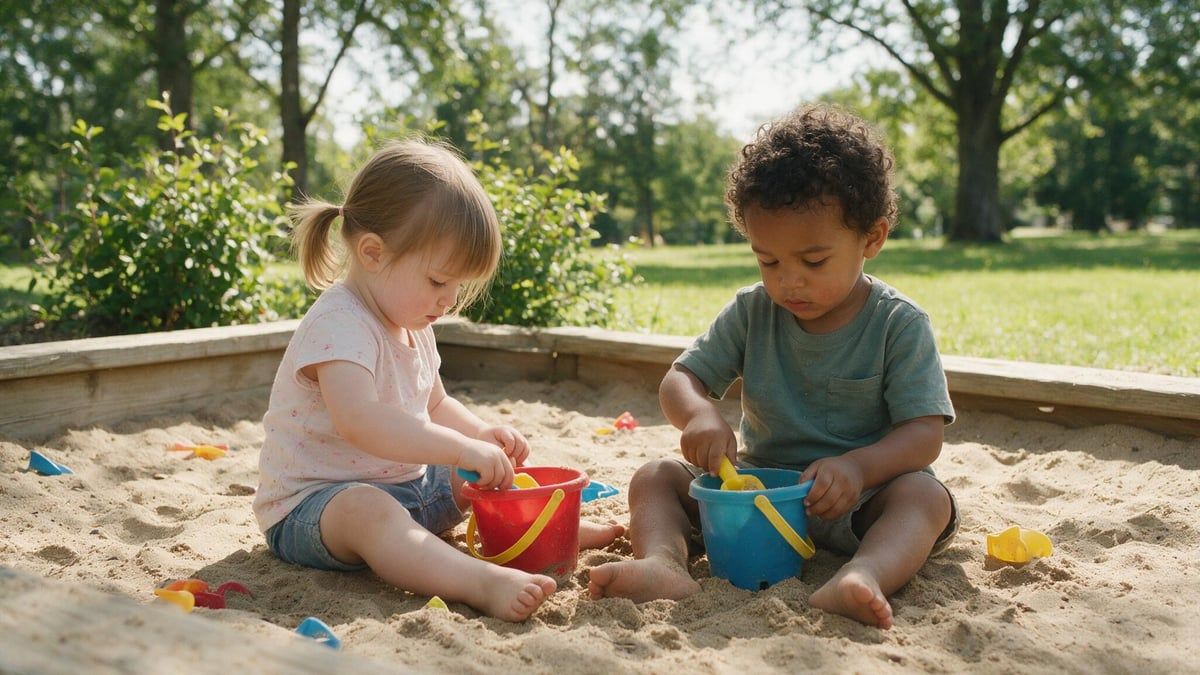
Ages 2 to 3. The age of “mine,” and the one with the most sandbox conflict. They mostly play in parallel: side by side, each with their own bucket, half an hour without a word between them. That already counts as company, and they're paying more attention to each other than it looks: they copy each other's gestures and sometimes try something right after watching the kid next to them do it. Sharing when asked is rare; offering something on their own happens now and then, and usually catches you off guard.
Ages 3 to 4. Many start to hold a turn, almost always with an adult nearby reminding everyone whose turn it is. The condition is usually trust: they'll let go of the toy if they're reasonably sure they'll get it back.
Ages 4 to 5. Sharing on their own initiative becomes common, though very unevenly: with the best friend yes, with the kid who just showed up at the playground much less.
From 5 on. They handle the idea of a fair split and defend it fiercely, especially when the split favors them.
These brackets come from watching children in classrooms and playgrounds in settings like ours, where every toy has an owner. In places where the toys belong to everyone, and those places exist, children get here by another route and at another pace.
What if mine is the only one who doesn't share?
It's almost never a sign of anything. In a group of two- and three-year-olds most of them don't share; what changes from one to the next is how much it shows and how much noise it makes.
What a pediatrician watches for at this age isn't about toys either. It's about whether the child plays at imagining things, whether he comes to show you what he found, how his language is coming along, and whether other children interest him at all. With that up and running, “mine” doesn't say much on its own.
It's worth bringing up with your pediatrician or with preschool if several of these three come together:
In both places at once. Clashes over objects repeat daily at home and at preschool, and preschool has already mentioned it to you.
The recovery doesn't come. After each clash the child takes a good half hour to be all right again, several times a week, and nothing you do helps him.
Other children don't matter to him. He doesn't look at them, doesn't imitate them, isn't interested in what they're doing. Not playing with them at age two is normal; not being interested in them, less so.
And there's one sign that doesn't wait to team up with any other: if your child has lost things he already had, words, gestures or eye contact, that gets a call on its own, without waiting for the next check-up.
Why “share” works so poorly
The word asks for something that isn't built yet at that age. And it asks at the worst possible moment, right when the child is in full defense of what's his.
There's also a problem with the word itself: at the playground, “share” almost always means “hand it over.” Hence the familiar scene: the child lets go of the toy looking utterly crushed, the adult breathes out in relief, and thirty seconds later there's a shove. The truck changed hands and what the child was feeling stayed exactly where it was.
And part of the hurry isn't the child's. The rush to fix it has a lot to do with who's watching, and at a playground someone always is. If you've spent two years saying “share” in front of other parents, you haven't broken anything: it's what we were taught to do and what nearly all of us do.
What does help
Duplicate rather than divide. This one gets solved before you leave the house, by putting two shovels and two buckets in the bag, and two similar cars if you have them. For two two-year-olds, having one each solves more than any explanation about generosity.
Put words to both without solving it for them. “You want the truck and you want it too. That's hard.” Name what's happening and make it clear that neither one is doing anything wrong. If that doesn't unstick it, and often it doesn't, take your child a few steps away with his truck and offer him something else over there, so the girl can go back to what she was doing. Separating them at this age is a perfectly reasonable answer.
A line for the audience. Half a dozen adults watching is part of the problem, and it helps to have something to say out loud without selling out your child or coming off as the clever one. This one works: “sorry, he's at the age where he won't let go of anything, I'll find him something else so your daughter can carry on.” It announces what you're going to do and doesn't apologize on anyone's behalf.
When yours is the one who wants somebody else's toy. That's the other half of the trouble at the playground, and it works in reverse. You tell him straight, “that truck is hers,” you hold whatever meltdown comes, and you find him something else. And if the other parent pries it out of their daughter's hands to calm the scene, you can turn that down: “thanks, but let her keep using it, this will pass.”
Taking a moment before you step in. The reflex is to intervene at second one. Some of these clashes sort themselves out without you, through a very odd negotiation that we almost always interrupt without meaning to. Step in when hands get involved or when one of the two is clearly overwhelmed. If it ends in a shove or a bite, stop the action without a lecture and start by calming both of them down, because an overwhelmed child hears very little of whatever you explain: there are five co-regulation techniques made for exactly that minute.
Put the untouchable ones away before company arrives. At home there are one or two toys a child this age is in no shape to lend, and that's fine. Having them out of sight before anyone walks in saves the whole conflict and spares him learning that his things vanish the moment people show up.
Turns that end when the game ends. For home too. “When your cousin is done, it's your turn” gives the one who's playing something a timer can't give, which is control over the ending. It sounds like the first one will never let go; what plenty of families report is that turns shorten on their own once the child checks a few times that nobody is going to yank anything out of his hands. The one waiting needs real occupying, with something else and with you next to him. And if after two weeks they're still just as endless, there's nothing wrong with going back to duplicating toys and leaving turns for later.
A story where nobody says “share”
In A Truck for Two, Pom-Pom is in the sandbox with his red truck when Yarena arrives without a sound and puts a hand on it. Pom-Pom squeezes it tight: “Mine!” The two of them go very serious.
The interesting part comes afterwards, and it's the adult who does it. Mommy Pig turns up, sets a yellow bucket down in front of Yarena and goes to sit a little further off. She doesn't ask for anything and doesn't divide anything up. From there on the two of them are in the same sandbox, each on their own thing, until the full bucket gets too heavy for Yarena and Pom-Pom comes up with something nobody taught him.
In the story that arrives sooner than it does in life, which is what stories are for. What it leaves you with is two names to reach for next Saturday in the sand.

A Truck for Two
Playing together, little by little
Pom-Pom is in the sandbox with his red truck, going vroom-vroom as he loads and dumps sand again and again. His is a whole, calm, happy kind of play. Then Yarena arrives, with her green eyes, and puts her hand on the truck. Pom-Pom holds it tight: “Mine!” Mommy Pig appears for a moment, sets something yellow down in the sand, and steps away. From there, the two little ones are in the same sandbox, each busy with their own thing, watching each other sideways — until something unexpected gets them both pushing the truck together.
Read this children's story in the Semillita appNext post: the child who hits, why he does it and what actually helps.