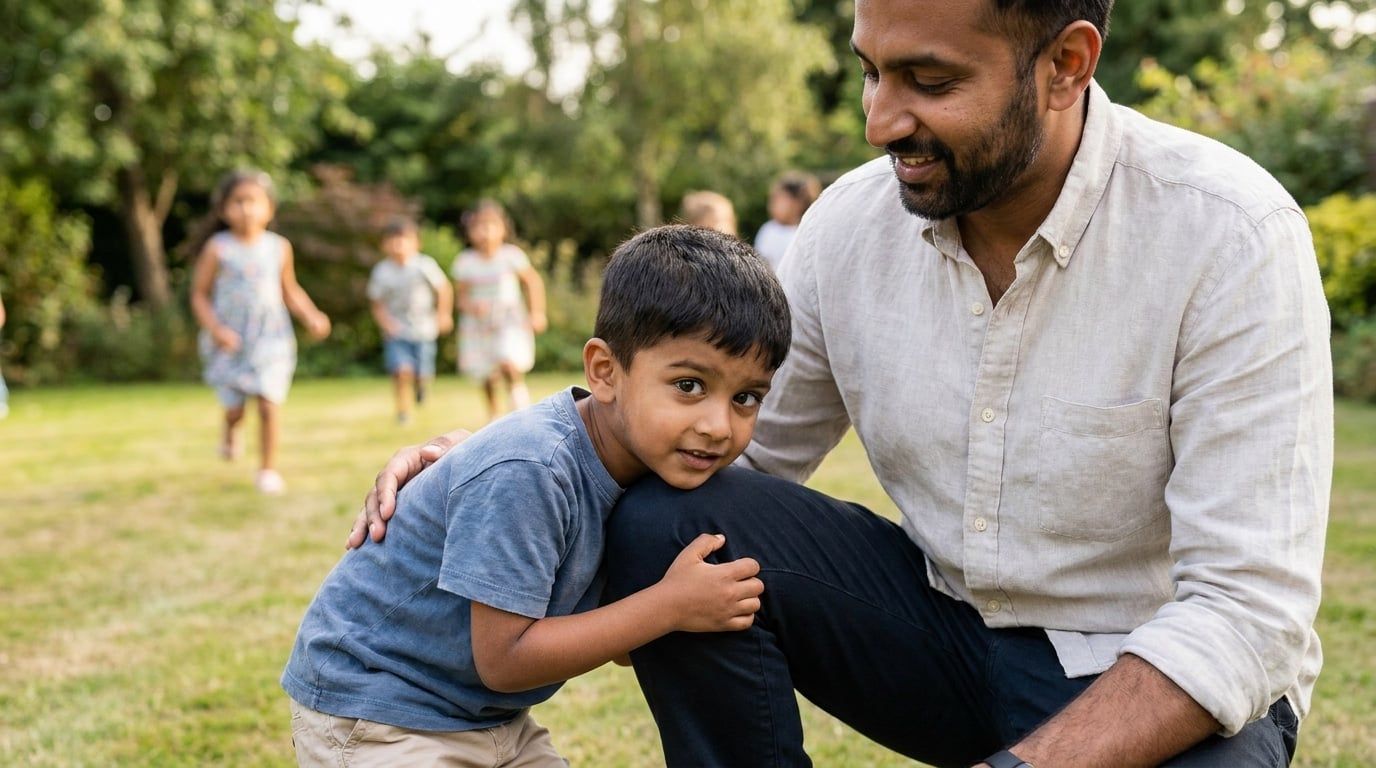


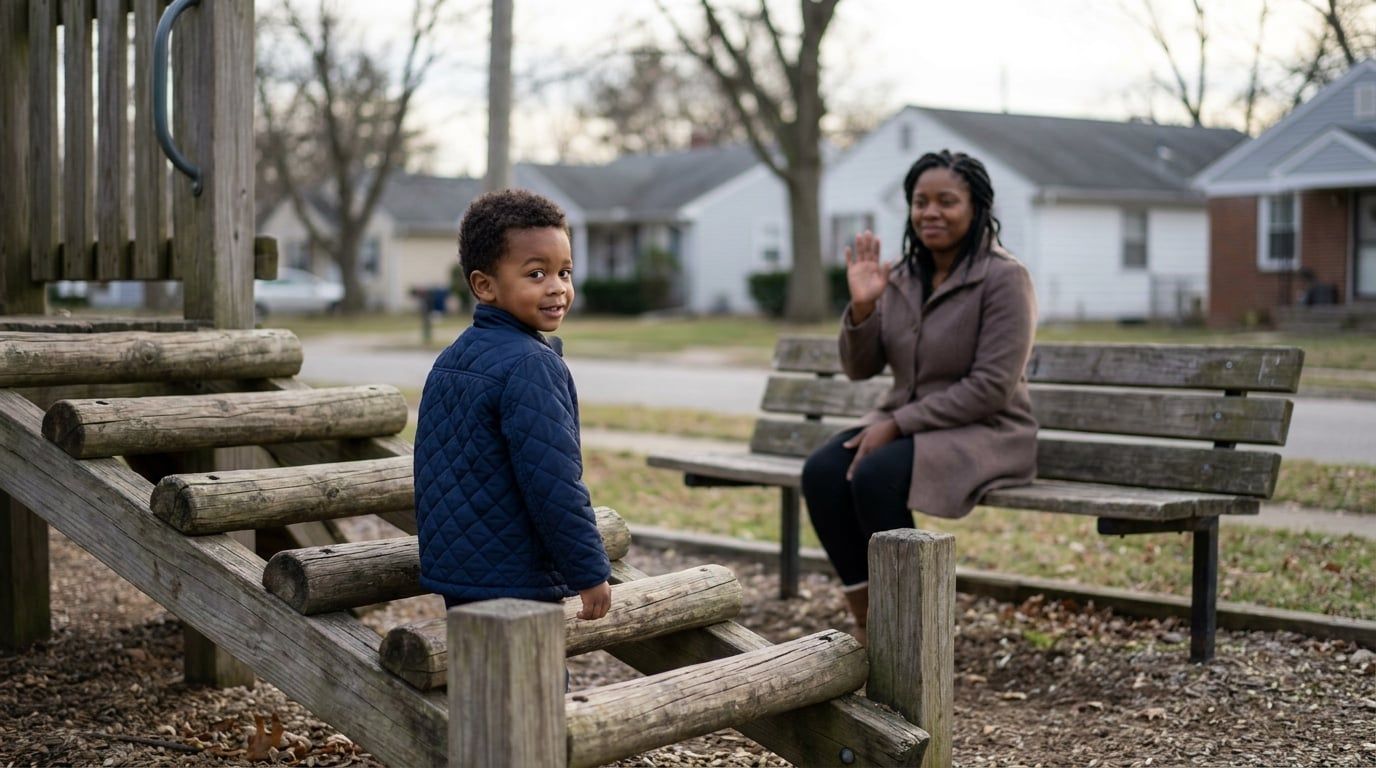
At the playground, your three-year-old takes off running toward the slide. Halfway there he stops, turns around and looks for you. You wave from the bench and he keeps going. When a big dog shows up, he runs back, holds on to your leg for a moment and, as soon as the dog leaves, sets off again. Researchers have a name for that going and coming back: the child uses their adult as a safe haven when something frightens them, and as a base to set out and explore from.
If you've landed here worried because you didn't co-sleep, didn't babywear, or your child has been in daycare since they were a baby, start with this: none of that, on its own, decides whether attachment is secure.
What secure attachment is
Almost all children develop attachment: a bond that leads them to seek out specific people when something scares them, hurts them, or when they're separated from those people. What varies is how secure that attachment is. Attachment is secure when the child expects their adult to be available when they need them. That's how a statement signed by 70 attachment researchers sums it up (Forslund and colleagues, 2022).
What it isn't
It isn't “attachment parenting.” That's the name of a popular parenting style that ties it to co-sleeping, babywearing and breastfeeding. Those practices can be ways of staying close and responding, and some studies find a link with them. But secure attachment isn't defined by any of them, and it doesn't need them. In a study of 152 mothers, what predicted attachment security at one year was the quality of interaction at six months, not breast or bottle. Still, the mothers who breastfed were somewhat more sensitive in the first months (Britton and colleagues, 2006).
It isn't being available around the clock. Even the most attentive adult switches off now and then to go to the bathroom, make dinner or leave the child with someone else they trust. What researchers ask of caregivers is “good enough” care, sustained over time. Not perfect care. And attachment security doesn't depend only on how you care for your child: the context and the child themselves can also play a part, so it can't be used to judge parents.
You can't see it in a single behavior. How much a child cries at goodbye depends a lot on temperament, and some securely attached children barely seek out their adult because they take for granted that the adult is there. If your daughter walks into daycare without looking back, that doesn't tell you anything on its own.
Daycare, work and fathers
In a study of 1,153 babies born in the United States in the 1990s, neither the hours in daycare, nor its quality, nor the age at which they started predicted on their own whether attachment to the mother was more or less secure at 15 months. What carried the most weight was how sensitive the mother was with her baby (NICHD Early Child Care Research Network, 1997). At age 3, they found the same thing. There was one nuance. At 15 months, when the mother showed low sensitivity, secure attachment was somewhat less likely if the baby also spent more than about 10 hours a week in daycare, if the daycare was poor quality, or if the baby went through more than one care setting or caregiver outside the home. At age 3, only the finding about hours showed up again, and more weakly (NICHD, summary of findings).
Almost all of these studies were done with mothers. There's less data on fathers, but in babies the share of secure attachment with the father is similar to that with the mother (Madigan and colleagues, 2023). And most children have more than one attachment figure: the father and the mother, a grandmother, the daycare teacher, as long as they spend a good amount of time together and that person comforts them when they need it. Having more than one steady safe haven is good for them. So if your daughter adores her daycare teacher, that takes nothing away from what you have with her. We talk about the morning goodbyes in “Separation anxiety at daycare”.
How it's built day to day
What has been studied most is what researchers call sensitivity: noticing what the child needs, reading it accurately, and responding promptly and appropriately. In studies of babies and their mothers, its link to secure attachment is moderate, and other aspects of care matter just as much (De Wolff and van IJzendoorn, 1997). Even so, when a program run by professionals helps parents respond more sensitively, their babies' attachment security improves somewhat (Bakermans-Kranenburg and colleagues, 2003). No one has measured the effect of each specific gesture. What follows are reasonable ways to bring that idea into everyday life, with some advice from the American Academy of Pediatrics (AAP).
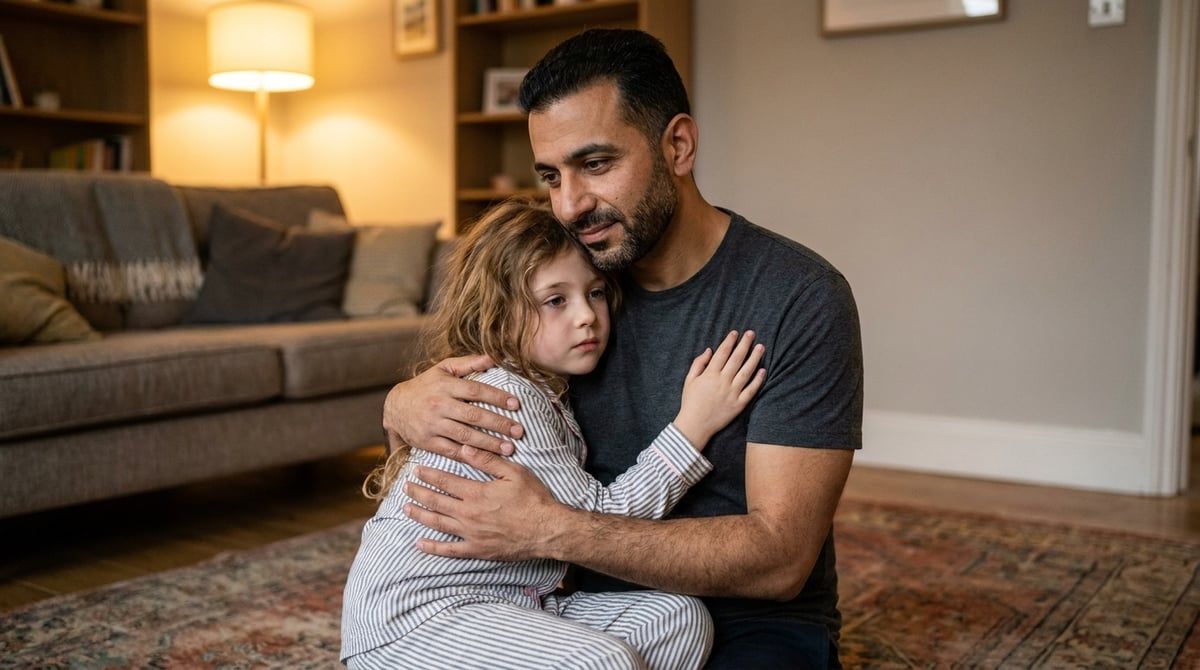
When your child gets scared, comfort comes first. The AAP puts it simply: “If they are afraid, provide security.” It also suggests putting a name to what they feel (AAP, on emotional development). In practice, that usually means getting down to their level, saying “That dog scared you,” letting them hold on to you, and saving the explanations for once they've calmed down.
Let them wander off, and let them come back. Stay where they can see you, without pushing them to go farther and without holding them back. If they come back to check on you five times, that's fine. If they hardly come back at all, that's fine too. At 5 or 6, that base is less about seeing you from the slide and more about knowing where you'll be, when you'll be back, and being able to tell you later what happened.
Clear goodbyes, and come back when you said you would. Short, loving and always the same. If you tell them you'll be back after afternoon snack, be back after afternoon snack (AAP, on separation anxiety).
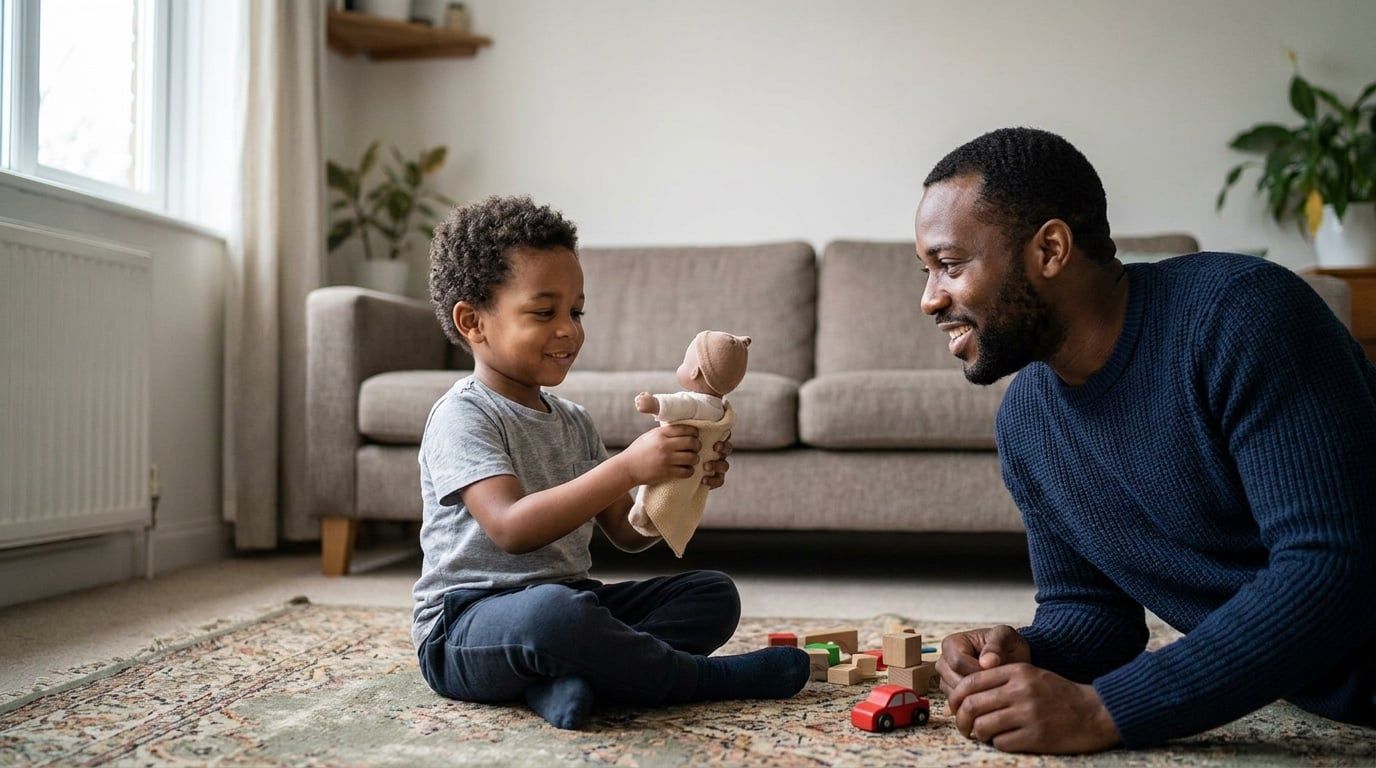
Make the most of pickup. If you work away from home all day, your time with your child is pickup and the evening, and the same things fit there: comfort if they come out upset, and attention to what they tell you. If they ignore you for a while when they see you, or melt down, don't read it as a sign. A single behavior doesn't tell you what attachment is like. To connect and have fun together, the AAP also suggests 10 to 15 minutes of play that your child chooses, with your phone put away, two or three times a week. It isn't much, and it fits into a working week.
One bad day doesn't break it. There will be days when you're late, when you can't work out what's going on, or when you lose your temper. What counts for attachment is what repeats over the months. And reaching out to your child again after a rough moment is part of that too.
When to seek help
There's no attachment test you can do at home. The best-known procedure, the “Strange Situation,” observes in a lab how a child reacts to brief separations from, and reunions with, a specific adult. It's scored by trained coders, it classifies that relationship and not the child, and it isn't validated to diagnose anyone (Madigan and colleagues, 2023). In studies of children aged 2 to 8, a little over half of relationships with the mother are classified as secure, in samples mostly from North America and Europe and from middle- and upper-class families (Deneault and colleagues, 2023). If one isn't, that doesn't mean it's broken or that the child is going to have problems.
Talk to your pediatrician if, past the preschool years (around 5 or 6), separation distress is still there every day, or if you're worried your child isn't adjusting to being without you. And also if you're the one dealing with depression, or with stress that keeps you from being available: getting help for yourself counts for your child too.
The story: a shadow on the wall
In Dancing Shadows, a story for children ages 2 to 4, Teddy sees the shadow of a branch moving on the wall just after his mother turns off the light, and he calls out to her, frightened. Mommabear crouches down by the bed: “I can see you're scared. And it's normal to feel that.” She hugs him for a good long while. Only then does she switch on a flashlight and turn her hands into a dog, a dove and a rabbit.
Teddy ends up trying with his own hands, first with help and then almost on his own, and falls asleep hugging the flashlight with his mother by his side. In a single night, it's what researchers call a safe haven and a secure base: comfort first and, from there, the urge to try. Attachment isn't won or lost in one night, but nights like this are the ones that repeat. We talk about fear of the dark in “Fear of the dark and imaginary monsters”. The guide that comes with the story in the app suggests a question for bedtime: “What animal would you make with your hands if you had a little flashlight?”

Dancing Shadows
Playing with the Dark
Teddy is a sensitive, curious little bear cub, one of those for whom new situations take a little more getting used to. Tonight, when Mommabear turns off the big light, a shadow moving on his bedroom wall gives him a real fright. Mommabear doesn't go anywhere: she stays right beside him and, with her hands and a small flashlight, shows him another way to look at what he sees on the wall. The story keeps company with that first fear of the dark and the moment when Teddy begins to do something with his own hands, not just watch.
Read this children's story in the Semillita app