

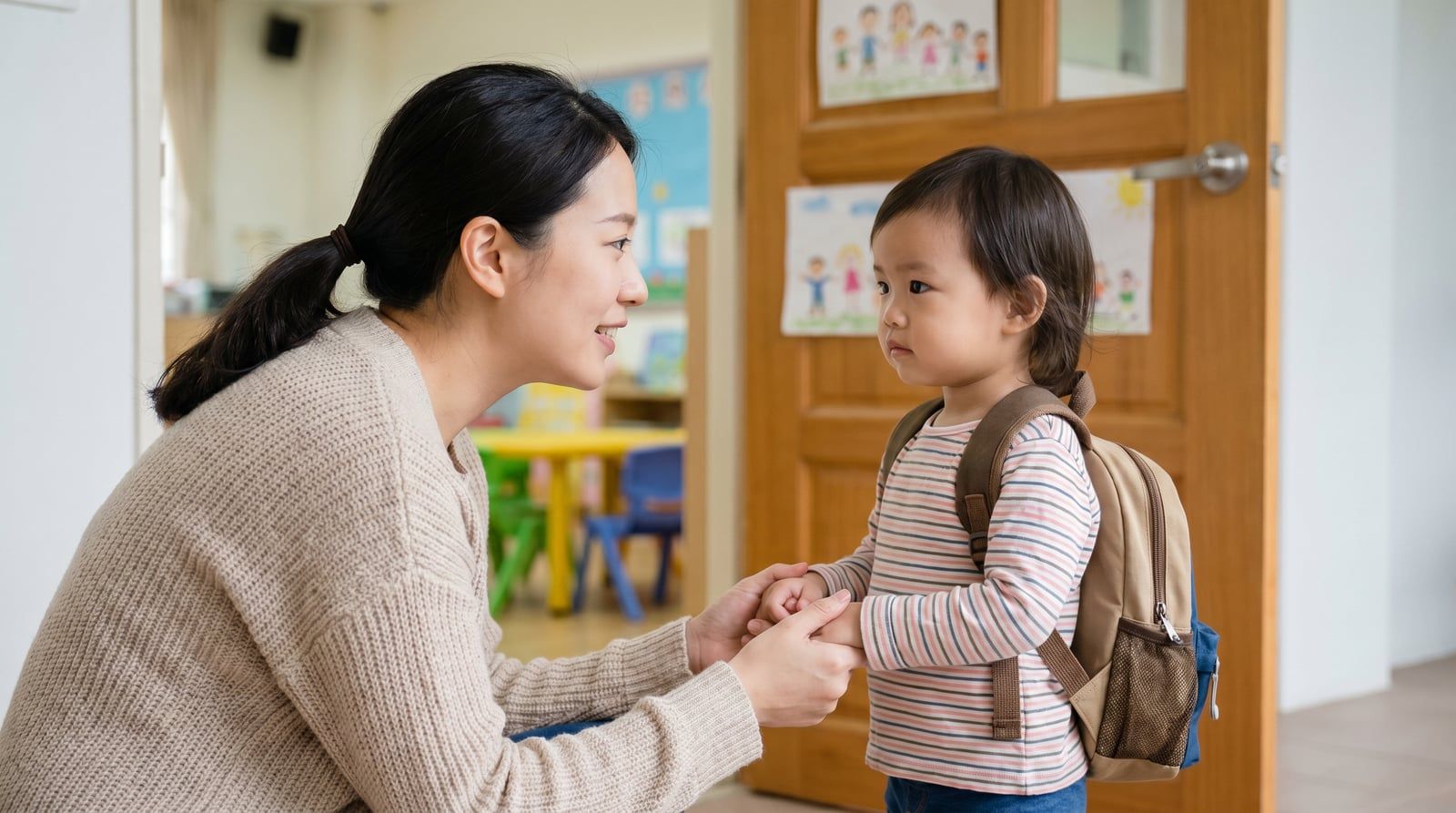
You arrive at the daycare door and, for a couple of seconds, all is well. Then something shifts. They cling to your leg, hide their face, won't let go. And this even though they've been going for weeks, even though yesterday they walked in without tears, even though they know their teacher by heart. The goodbye is hard again.
As with bath time, what you see at the door isn't always what's actually happening. For your child, those minutes are a real transition, and transitions, at this age, almost always cost more than walking through one door and out another.
What separation anxiety is, and why it shows up
It's an expected response in children between one and four years old, and a good sign that the bond with the person they rely on is working. They know they depend on you, they look for you when something steps outside the familiar, they notice your absence. All that searching is part of how they feel safe in the world.
The peak usually sits between twelve and eighteen months. After that it reappears at specific moments: starting daycare, switching classrooms, coming back from a long break, the arrival of a sibling. Up to three or four years old those resurgences are common, and they sometimes return later in different forms. It's not worth reading them as a setback. They're usually the system doing its work in moments when that work costs more.
Worth keeping in mind: the child crying at the door isn't manipulating or "putting on a show". Their emotional brain, which at this age runs ahead of the rational one, is telling them that something important is ending. Your argument ("you're going to have fun, I'll come pick you up after lunch") is correct, but it's arriving at a conversation that's already happening in another language.
What falls within normal
At this age, it's expected that they may:
- Cry or go quiet during goodbye, even if they play happily inside afterwards. The teacher tells you "they settle as soon as you leave", and that's true.
- Have strange streaks. Two weeks walking in fine, then three days where it's incredibly hard, with no clear reason. Sometimes there's a trigger (a cold, a schedule change, a visit), sometimes not.
- The adjustment takes longer than the brochure suggests. Two weeks is a guideline. Some children need three weeks, others a month, and that doesn't mean the centre or you are doing something wrong.
- Ask about you during the day, even when the teacher tells you they're generally fine. Both can be true at the same time.
- Bring back behaviours they had outgrown: asking to be held more, waking at night, not wanting to eat on their own, asking to sleep again with a stuffed animal that had been forgotten for months. These regressions last a few weeks and disappear on their own once they've settled.
None of these things, on its own, means something is wrong. They're more about a child processing a big change with the tools they have at their age, which are the ones they have.
How to prepare the goodbye before the door
The goodbye doesn't begin at the centre. It begins earlier, at home, and is built through repetition.
It helps a lot to name what's going to happen, in clear and short words. "Now we have breakfast, then we get dressed, we go to daycare, you play, you eat, and I come to pick you up." It doesn't spare them the hard moment, but it gives them a map. At this age a small map, even if you repeat it every morning, calms more than any long explanation.
Alongside that map it helps to have your own goodbye ritual. A kiss on the hand and another on the cheek, a short phrase ("see you at pickup"), a gesture that's always the same. What turns the gesture into a place to hold on to isn't how clever it is, but that it repeats. It doesn't matter if it's elaborate or silly. What matters is that it's yours and that it happens the same way every time, on good days too.
The hardest part is always saying goodbye, even when there's crying. Slipping away while they're distracted avoids the scene in the moment, but it teaches them that you can disappear without warning. The next time, instead of playing peacefully, they'll be on alert that you don't leave without them seeing. The crying at goodbye is short and settles sooner than that vigilance, which can last days.
And at pickup, another scene that matters
Almost all the focus of daycare advice sits on the goodbye, but the reunion weighs just as much. The way that moment unfolds each afternoon is what decides whether daycare is lived as a place where they get left, or as a place where they also get picked back up. The second version is what holds everything else.
If you arrive at pickup and the first thing that comes out is the list of questions ("what did you eat?, who did you play with?, did you cry?"), they'll most likely shut down. In that specific moment, what they need isn't to tell, it's to reconnect. A hug, a couple of minutes doing nothing, letting them choose the rhythm of the exit. The questions can come later, on the way home or at dinner, when they're settled with you again.
Another thing worth caring for: even if you're in a rush, don't leave the daycare at a run. The walk from the classroom to the door, however short, is the first stretch of the day they spend with you again. How they live those minutes stays in their memory of the day more than almost anything that happened inside.
What helps during the day
Most of the work, during the morning, isn't done by the adult who left the child at the door. It's done by them from the inside, with whatever they were able to bring along. That's why what accompanies them matters so much.
A bridge object (a stuffed animal, a piece of cloth, a bracelet that belongs to the mother or father) works as a physical reminder that the bond is still there even when you're out of sight. We'll go into these objects in depth in the next article, because there are ways of using them that help and others that get in the way, and it's worth telling them apart.
Sometimes a gesture on the body is enough and no object is needed. A small heart drawn on the palm in the morning, that they can look at when they need to. A kiss "kept" in the pocket, taken out and given back at pickup. A tiny mark, repeated every day, with a shared meaning that only the two of you understand. What matters isn't how pretty the gesture is, but that they know it and can activate it on their own, without asking permission.
There's something else that seems minor but weighs a lot: a predictable routine inside the centre. The better they know what comes next (yard, lunch, nap, someone comes to get me), the less energy they spend keeping watch over what they don't know. That part you don't decide from home, but you do decide it when you choose a centre. It's one of the things worth asking about before enrolling, even if it sounds like a small detail next to price or hours.
When it's worth paying more attention
Most episodes of separation anxiety resolve on their own with time, repetition, and a steady goodbye ritual. But there are signals worth not normalising:
- Crying at goodbye doesn't ease at all after four or six weeks, and the teacher reports it takes a long time to settle, or doesn't fully settle, during the morning.
- Physical symptoms appear that repeat on daycare days and not on weekends: stomach aches, vomiting, headaches, sleep disturbances that weren't there before.
- The distress spreads beyond the goodbye moment. Refusal to stay with any other familiar adult (a grandparent, an uncle who used to be a fine babysitter), intense fear of being in different rooms from you at home, no longer being able to sleep alone when before they could.
- The centre or the teacher pick up something that doesn't fit what's expected for their age, or that hasn't shifted for a while.
On their own these say almost nothing. What weighs is when they come together, when they're intense, and above all when they last: what persists beyond the initial adjustment calls for a conversation with the teacher, and if needed with the paediatrician or a child mental health professional. Asking for help early almost always prevents a one-off episode from settling in.
And when you do talk to the teacher, set aside "have they been good today?" and go to the concrete: how long did it take them to settle after the goodbye, how do they look mid-morning when you've been gone a while, what do they notice that's different from when they started. Those three questions together give a truer picture than twenty scattered details, and at the same time help the centre's team observe better in the days that follow.
What Teddy's mom does
In The Heart Mama Drew for Me, Teddy arrives at school on a cold day. The classroom is different, there are new faces, the noise and the light are different too. He clings to his mom's coat, Mommabear, and won't let go.
Mommabear doesn't tell him it's nothing. She doesn't promise it will pass soon, and she doesn't explain everything he's going to do during the morning. She crouches down to his height, takes his hand, and draws a small red heart on his palm. She kisses it. She leaves him, in a place he can look at whenever he wants, something that's his and that comes from her.
Throughout the morning, when something overwhelms him or he feels far, Teddy looks at that heart. He looks at it while hanging up his coat. He looks at it before sitting at the table. He looks at it when the teacher puts on a song he doesn't know. And each time he finds a little more calm to go back to play.
What Mommabear does doesn't solve the hard moment on its own. It gives him a concrete, simple tool that he can activate when he needs it, without having to ask anyone for it. That's what most of the things that work at this age are like: the hard moment isn't taken away, it's accompanied by something concrete he can use.

The Heart Mama Drew for Me
A gift that fits in your hand
Teddy and Mommabear arrive at preschool on a cold day. The noise and the new surroundings feel overwhelming for Teddy, who becomes anxious at the separation and clings tight to Mommabear's soft coat. With great tenderness, Mommabear draws a red heart on the palm of his hand and gives it a gentle kiss. That small gesture becomes a tool that Teddy uses throughout the day to find calm and feel ready to play.
Read this children's story in the Semillita appThe heart on Teddy's hand is what some psychologists call a bridge object: something concrete that holds the bond when the adult isn't there. In the next article we look closely at these objects (stuffed animals, blankets, pacifiers, bracelets), what the ones that work well have in common, and how to accompany the moment when they're no longer needed.