

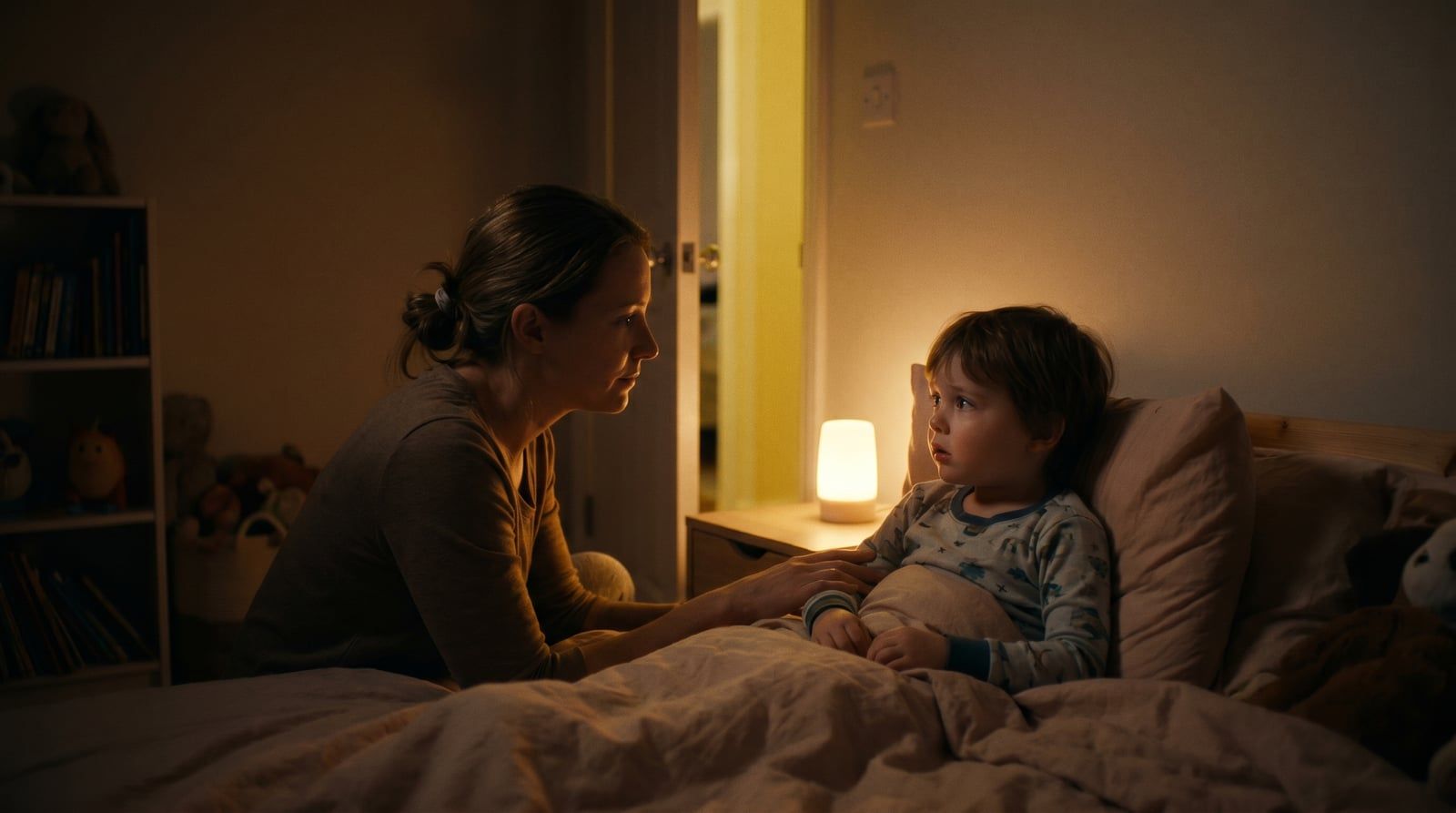
It's eleven at night and a small voice comes from the bedroom: "I'm scared… can you come?". You go, sit on the edge of the bed, look underneath, open the wardrobe. Nothing, of course. And often your child knows it perfectly well: if you ask, they'll tell you they already know there are no monsters. Even so, they call you again ten minutes later, because knowing it doesn't take the fear away.
Fear of the dark, and of the monsters that imagination places in it, is one of the most universal and most exhausting stages of early childhood. And, almost always, a sign that your child is growing exactly as they should.
Why these fears appear
They tend to show up between ages 2 and 3 and grip hardest until 5 or 6. They coincide with the moment a child's imagination takes off. They start to picture things that aren't in front of them, and that same ability that lets them pretend a stick is a sword also lets them fill the darkness with creatures.
The dark, on top of that, takes away the information the brain relies on most to feel safe: sight. Without clear images confirming the room is the same as it was with the light on, the brain fills in the gaps, and at this age it fills them with whatever is closest to hand, which is often frightening.
That's why the same child can cross the living room in the dark without blinking at 18 months and, at 3, not even want to peek into the hallway. They haven't learned to be afraid: they've learned to imagine.
Why denying the fear doesn't help
The most natural reaction in the world is to reassure with a "there's nothing, it's fine". The trouble is that fear isn't switched off by arguments. Your child isn't calculating the odds of monsters; they're feeling something in the body, and that something doesn't go out because you tell them it isn't real.
In fact, many children already know. They tell you "I know there's nothing" and still can't fall asleep, because the part of the head that knows the monster doesn't exist loses control when the body switches on at night. Repeating "there's nothing" confirms something they already had clear and leaves untouched what's really going on.
When you keep telling them there's nothing, you also send two messages at once without meaning to: that what they feel doesn't count, and that you haven't grasped how big it is for them. Neither helps them fall asleep.
Validating isn't agreeing with the monster. It's recognizing the emotion underneath: "I can see you're scared; it's horrible to feel like this in the dark; I'm here". From there, with the child a little calmer, you can work on the rest.
What really helps
The fear isn't going to leave overnight, so the aim is to accompany your child while they learn to handle it. Some things that work:
Put the fear into words and give it shape. Asking what the monster is like, what color it is, whether it's big or small, helps something vague and enormous become concrete and manageable. What can be described is less frightening than what has no outline.
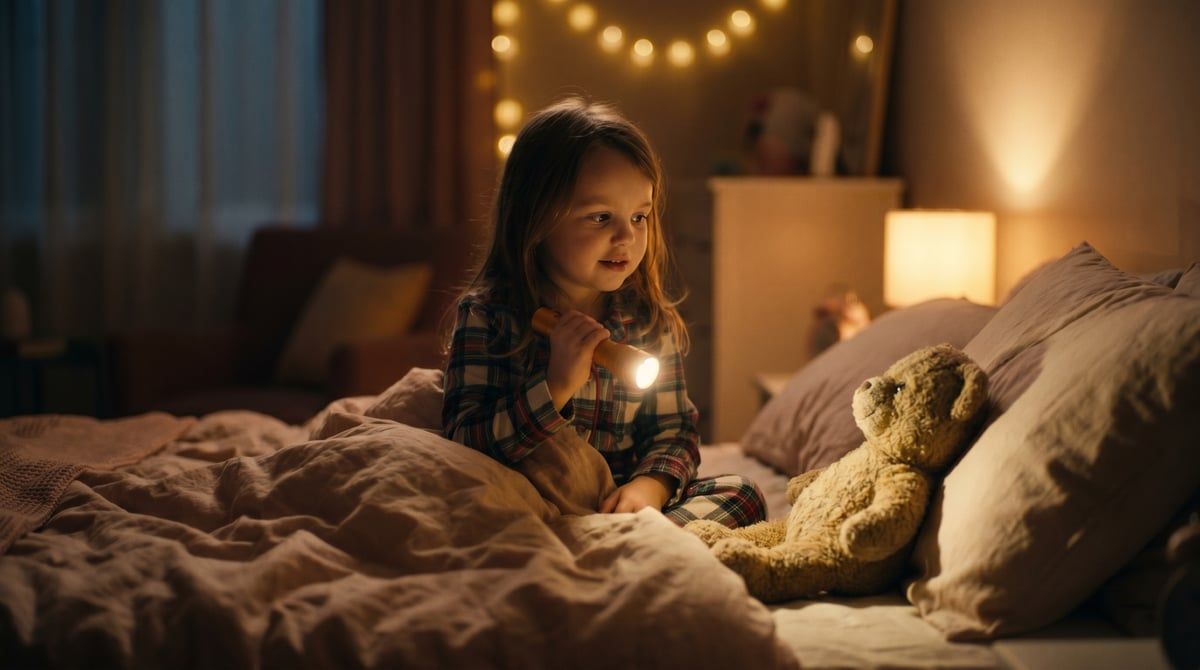
Give them tools of control. At this age it works very well to give them something they can do themselves: a flashlight on the nightstand to switch on whenever they want, a "guardian" stuffed toy that keeps watch while they sleep, the door left ajar with a little hallway light. They don't make the fear disappear, though they give back the sense of control the fear takes away.
About the "monster spray", an honest caveat. Many families use a bottle of water as "monster spray" or check the wardrobe together every night, and for some children it works wonderfully. For others, those same rituals confirm the opposite: that if you have to scare the monster off, there must be something to it. There's no single answer. If spraying the room calms your child, go ahead; if you notice they're more focused on the creature every night, try shifting the focus from the monster to how safe they are with you nearby.
Take care of the entry into the night. A predictable sleep ritual lowers the level of arousal your child arrives at bed with, and a less wound-up child has less fuel for fear. If the dark room is the problem, a soft warm light for a while is a perfectly reasonable help. We tell it more calmly in the bedtime ritual and in what to do when that ritual breaks.
Teach them to listen to their body. What will serve them most over time is learning to tell a real alarm from a false one. You can help them notice what their body does when it gets scared, and check, step by step and with you alongside, that the radiator's noise wasn't a creature. Reading their own body is a skill that will serve them far beyond the dark.
When it's more than a stage
Almost all of these fears dissolve on their own as the child grows and their ability to separate the real from the imagined matures. But it's worth knowing where the line is. If the fear becomes so intense that it prevents sleep almost every night for weeks, if it also invades the daylight hours, if your child avoids things they used to enjoy or it appears alongside other signs of distress, it's worth a conversation with the pediatrician. Not to be alarmed: to rule things out and to have someone alongside you if needed.
What Nutzie learns
In Nutzie and the Forest Sounds, a little squirrel can't get to sleep because the sounds of the forest scare her. Her mother doesn't tell her it's nothing, nor push her to be brave all at once. She teaches her to use her body and her heart to tell which sounds warn of real danger and which are just the forest living at night. Little by little, Nutzie discovers that her fear is a signal that sometimes gets it right and sometimes gets it wrong, and that she can learn to read it.
It's a story meant to accompany exactly these nights: it validates the fear instead of scolding it and leaves the child a tool they carry with them to bed.

Nutzie and the Forest Sounds
Learning to listen to our heart
Nutzie is a little squirrel who can't sleep because the forest sounds frighten her. With her mom's help, she learns to distinguish between dangerous and safe sounds using her heart and her body as guides. The story teaches that our emotions and physical sensations are valuable tools for understanding the world.
Read this children's story in the Semillita appFear of the dark is one more of the many stimuli that some children experience with a special intensity, by night and by day. In the next article we talk about children who feel noise, lights and textures more strongly than others, and how to accompany that sensitivity without treating it as a problem.