

There's an entire industry built around children's sleep. Star projectors, white noise machines, stuffed animals with built-in heartbeats, apps with lullabies in six languages. If your child doesn't sleep well, the market's implicit answer is always the same: you're missing the right product.
But research on children's sleep — and the best stories ever written about it — point in a completely different direction.
The real problem isn't sleep
Before the age of six or seven, children can't regulate their nervous system on their own. Going from a state of activation — games, screens, conversations, laughter — to the calm needed for sleep is a neurological leap that their still-immature prefrontal cortex simply can't make without help.
It's not a whim. It's not manipulation. It's biology.
What a child needs at that threshold isn't a perfect object: they need a signal that the world is predictable and that they are safe. And that signal comes from people, not products.
What happens in the brain during a good bedtime ritual
When a child experiences the same sequence of actions every night — in the same order, with the same person, in the same tone of voice — their brain begins to recognize the pattern before it's even over. Cortisol levels (the stress hormone) drop in anticipation. The nervous system doesn't wait for sleep to arrive before calming down: it calms down while the ritual is happening.
Researchers call this co-regulation: the adult's calm, present nervous system acts as an anchor for the child's. It's not magic. It's emotional contagion at its most useful.
And here's the key that changes everything: what produces this effect isn't the lamp, the stuffed animal, or the app. It's the predictable presence of an unhurried adult.
The three ingredients that actually matter
After reviewing decades of research on children's sleep hygiene, the pattern is consistent. A bedtime ritual works when it has three things:
1. A recognizable sequence
It doesn't have to be long or elaborate. It can be: bath → pajamas → story → lights off. What matters is that the child knows what comes next. That predictability is, quite literally, emotional security in the form of routine.
2. Real presence, not just physical presence
Being in the room while scrolling your phone doesn't count. Children perceive the difference with an accuracy that makes us uncomfortable. Ten minutes of genuine attention — eyes on them, a calm voice, a relaxed body — are worth more than forty-five minutes of distracted company.
3. Saying goodbye to the day, not just to the child
This is the most underestimated detail. Young children don't just need to go to bed: they need to close the day. Saying goodnight to the stuffed animal, to the window, to the toys left out. This small farewell ritual helps them release the day's activation and cross the threshold of sleep without resistance.
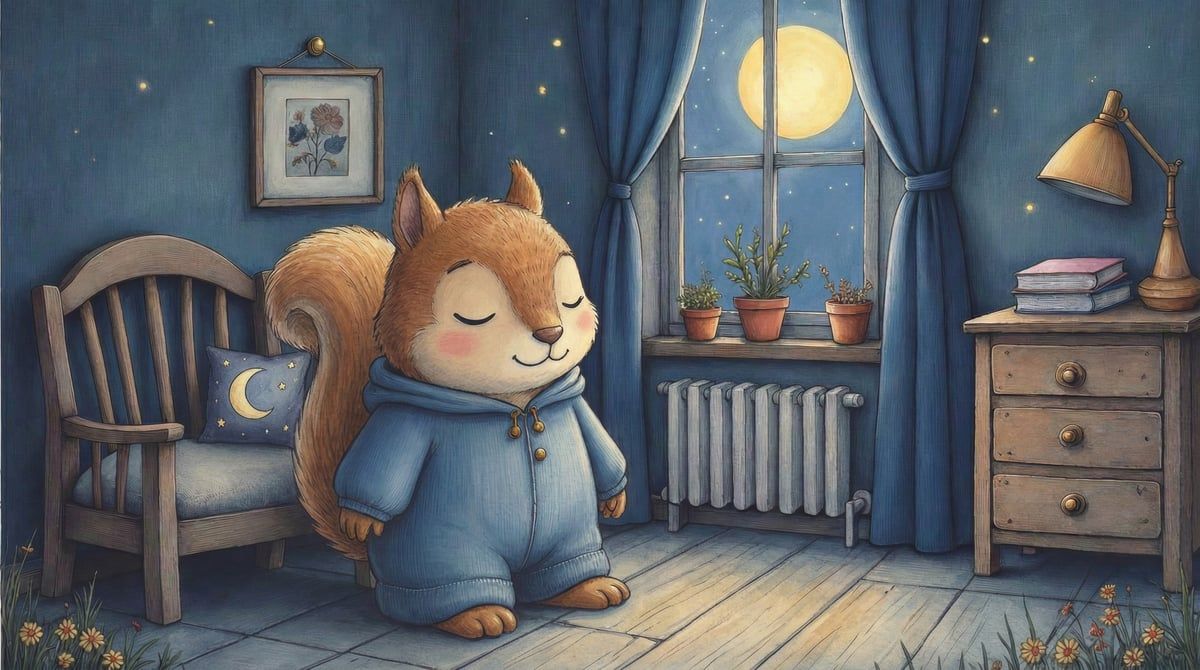
In Thank You for Today, the little squirrel who doesn't want to sleep doesn't manage it through willpower: she succeeds because her grandmother proposes a game of goodbyes. They turn off the world, object by object, until the body no longer needs to resist. It's one of those stories that works just as well read aloud as used as a ritual in itself.

Thank You for Today
A Bedtime Story
Acorn is a little squirrel bursting with energy who, at bedtime, feels that his toys still need him to keep playing. Instead of telling him to stop, Grandma Squirrel suggests a special agreement: say goodnight to each toy, remembering all the fun they had together during the day. Little by little, Acorn discovers that taking care of his toys is also a way of taking care of himself.
Read this children's story in the Semillita appWhat doesn't matter as much
If you've been feeling guilty about any of this, take note:
- The exact order doesn't matter — if sometimes the story comes before the pajamas, the ritual doesn't break.
- Skipping a day doesn't matter — one unusual night doesn't undo weeks of consistency.
- Not having forty-five minutes doesn't matter — fifteen minutes of real presence are enough.
- Not having the "right" objects doesn't matter — research finds no evidence that children's sleep products improve sleep quality in the long run.
What does matter is coming back. That the ritual exists most nights, even if it's never perfect.
The magic was never in the wand
In The Star Fairy, Estrellita loses her wand and panics: without it, she can't light the stars or gather the forest animals for the nightly story. The ritual is going to break. Everything is going to go wrong.
But it doesn't go wrong. The animals gather anyway. The story happens anyway. And Estrellita discovers something she already knew but hadn't seen: the magic was never in the object. It was always in the act of being there, night after night, with the same words and the same love.
It's a story designed for children ages three to six, but the message speaks to the adults who accompany them too: you don't need to do it perfectly. You just need to be present.

The Star Fairy
The Magic of Being Together
Starla is a young fairy who gathers the forest animals each night to tell them a bedtime story. When she loses her magic wand and cannot light the stars, she discovers that the true magic was never in an object, but in the ritual of being together each night, in her words, and in the love she shares with her community.
Read this children's story in the Semillita appAt Semillita, we design each story to accompany specific everyday moments. If bedtime is difficult territory in your home, both Thank You for Today and The Star Fairy can become part of the ritual itself.
What happens when the ritual is interrupted?
Travel, illness, house moves, stressful family weeks. In our next article we discuss how to maintain nighttime emotional safety when conditions aren't ideal — and why flexibility is also part of a good ritual.