


You've been three weeks with the diaper half off. In the morning, everything seems to click: two pees in the potty, a smile, a photo for the family group. In the afternoon, the first accident happens. The next day, two. And the doubt begins: are we doing it wrong? Are we forcing it? Should we go back?
That doubt is the piece that most deserves to be heard. Because stopping diapers is not an exam to be passed or failed. It is a skill your child's body is learning to read. As we saw when discussing how to support body awareness in young children, internal signals need calm to reach consciousness. Pressure, no matter how well-intentioned, does the opposite: it turns them off.
Why pressure has the opposite effect
Sphincter control is not a voluntary decision made upon waking. It is a fine coordination between the maturation of the sphincter, the ability to detect the internal signal ('I'll need the bathroom soon'), and the ability to act on it before it's urgent. This coordination depends on brain regions that connect at their own pace.
When an adult introduces pressure—a deadline, a comment from a grandparent, the start of school, the frustration of an accident—the child's body responds with a stress activation. Stress has a very specific physical effect on the digestive system: it tenses the muscles, retains urine, and makes it harder to read subtle signals. In other words, pressure activates exactly the mechanisms that prevent what you want to achieve.
What we experience as 'regression' is often this: a body that has begun to distrust its own signals because the adult anticipated them too many times. It's not disobedience or a whim. It's protection.
When the body is ready (not your calendar)
Age guidelines are useful to remember this takes time, but they don't serve to decide when to start with a specific child. Real signs come from the child themselves:
- Stays dry for several hours in a row. This indicates the bladder already has the capacity to hold.
- Recognizes they are doing or just did it. This indicates the internal signal is reaching consciousness.
- Shows interest in the potty or bathroom. Asking, watching, wanting to try, imitating you. Intrinsic motivation is decisive.
Creating conditions for the body to express itself
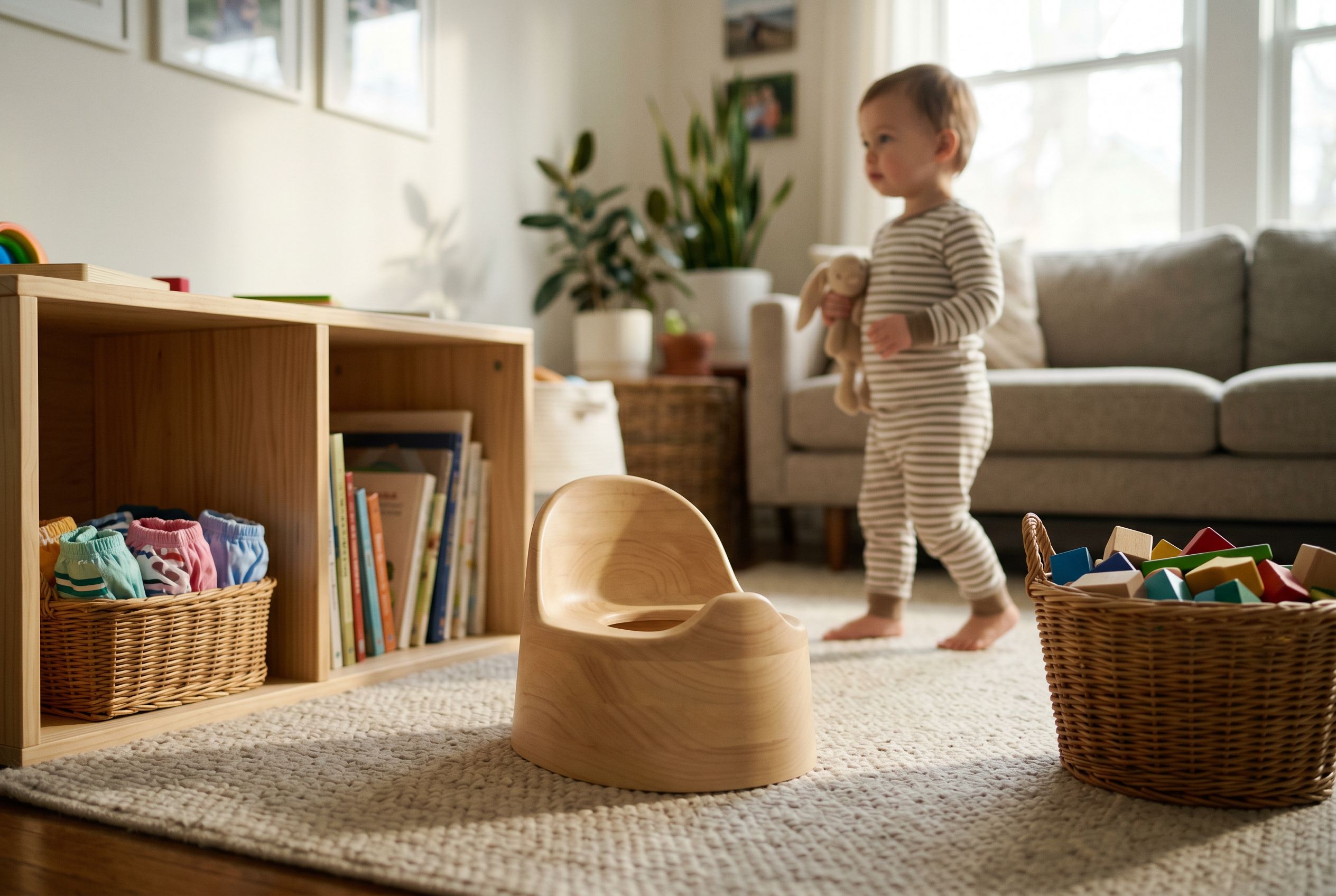
Easy access to the potty or bathroom. The potty in the living room, not in a far-off room. Comfortable pants the child can pull down alone. The less effort it takes to respond to the signal, the more likely the child is to attend to it.
No constant questions. Each question substitutes the child's body signal with the adult's foresight. An open invitation—'the potty is here if you need it'—is usually more useful.
No dramatic reaction to accidents. No exaggerated reward for success, nor reproach for failure. An accident is cleaned without heavy comments, using neutral phrases: 'it slipped out, let's clean it up'.
What happens when there are regressions
Almost all children have setbacks. They can appear after an illness, a move, the arrival of a sibling, or for no identifiable reason. The most useful thing when this happens is not to read the regression as a failure. It's a message from the body: 'right now I don't have the capacity to handle this, I need some space'.
Putting the diaper back on for a few days, without drama, usually resolves much faster than insisting. It's not 'we're putting it on because you're not capable', but 'we're going to use the diaper while your body feels more ready'.
What does deserve a consultation with the pediatrician are setbacks accompanied by pain when urinating, stool retention for several days, or persistent discomfort. Most regressions are emotional and developmental; some, less common, have a medical cause and resolve much sooner if identified early.
Adult guilt matters too
There is a component we talk less about: the guilt we feel when our child goes to school with a diaper and others don't. That guilt ends up leaking into how we respond to an accident. Don't transfer that rush to the child. Saying it out loud helps: 'this is my rush, not theirs'.
What Fanti learns
In What Is My Tummy Saying?, Fanti notices strange noises in her tummy. The most important thing is not that she reaches the potty, but what Papa Elephant does not do: he doesn't pressure her, doesn't follow her, gives her space. Fanti learns that her body has things to tell her and that she can listen.

What Is My Tummy Saying?
Learning to Listen to My Body
Fanti is a little elephant right in the middle of a fascinating game when she begins to feel strange sounds and movements in her tummy. Quite scared, she looks for a private corner behind the big sofa at home to try to figure out what is happening and what her body is trying to tell her, while patient Papa Elephant stays close with respect, giving Fanti all the space and time she needs without any interruptions.
Read this children's story in the Semillita appBath time is another of those everyday situations where the child's and adult's rhythms clash. In the next article, we tell you how to make bath time an enjoyable moment, without battles.