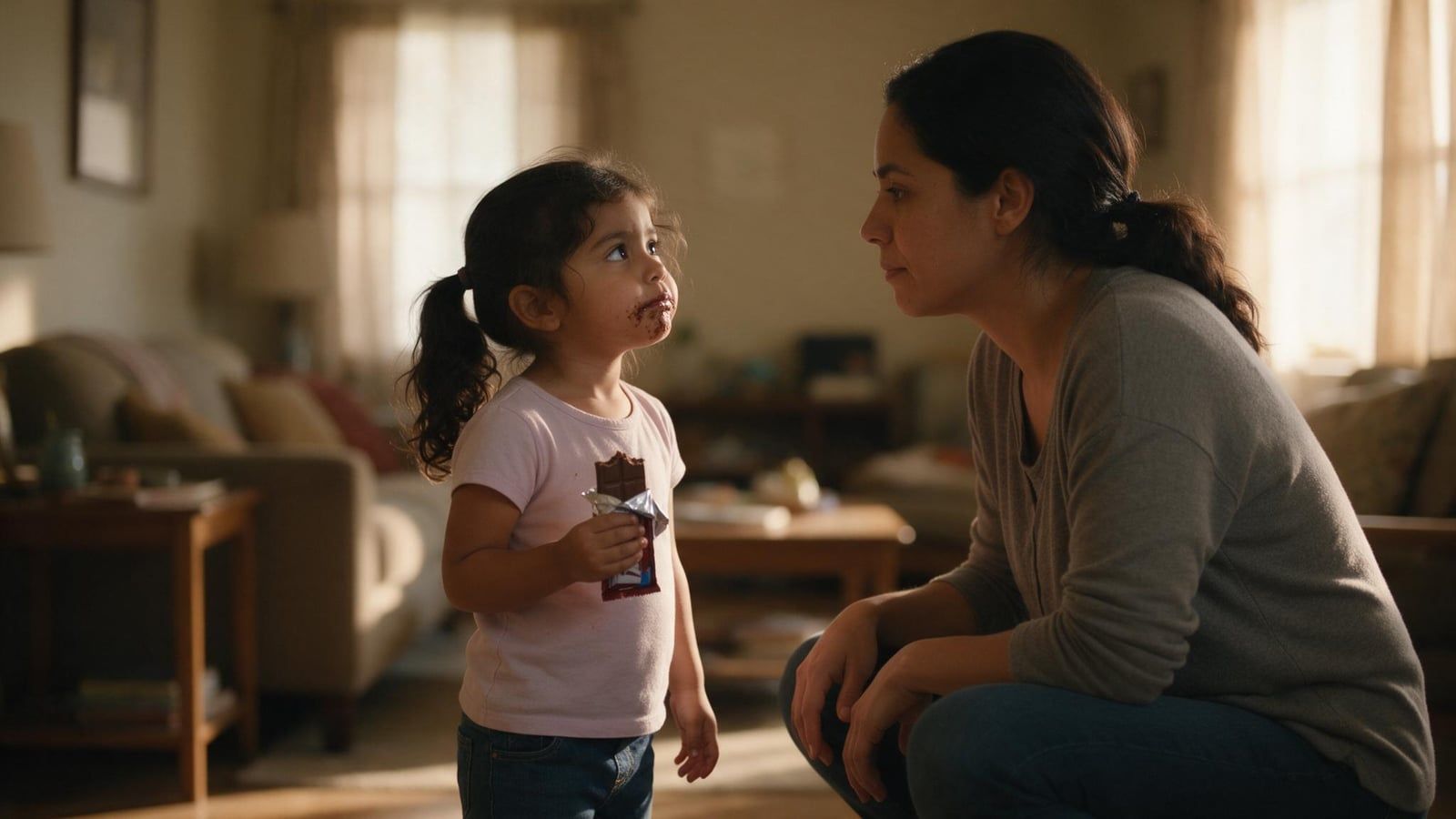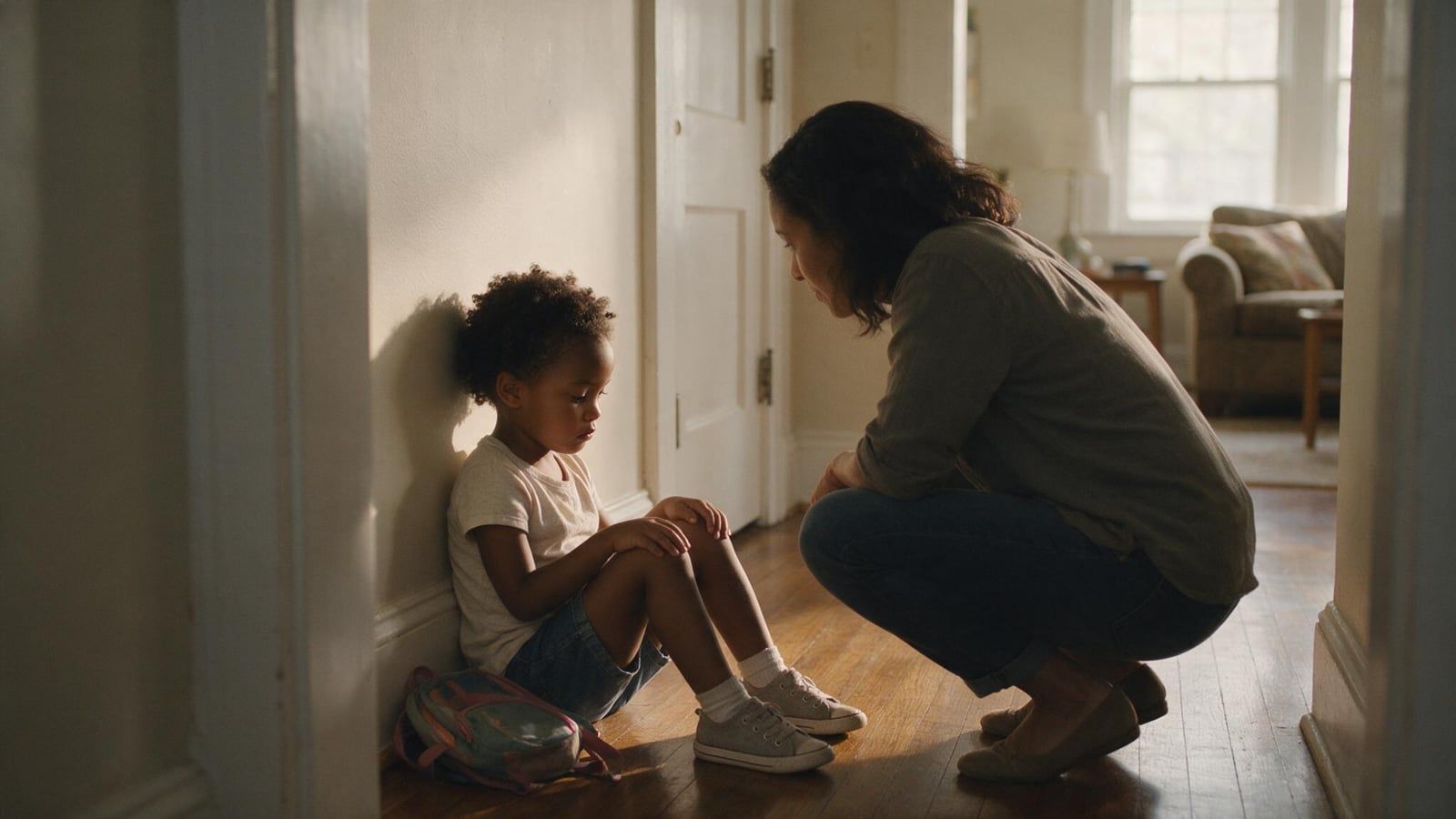


Your child drops their backpack in the hallway and, while taking off their shoes, mentions it as casually as if they were talking about the weather: “Today I asked if I could play and they said no.” Then off they go to get a snack.
Something tightens inside you, and two impulses arrive at once: fix it (talk to the teacher, find out who it was) or play it down (“They’ll play with you tomorrow”). What’s usually needed first is shorter than either: a sentence like “Oh, that sounds tough. I’m here if you want to tell me more,” said at their pace. The details are further down. First, a story that has this very scene.
It comes early on in A Retelling of The Ugly Duckling, our story for children ages 5 to 7.
A goose who doesn’t turn into a swan
In Andersen’s tale, the duckling turns out to be a swan and finds its place when it discovers what it was all along. In ours, Ona is a small round goose with gray feathers who lives among three young swans (Lirio, Brisa, and Alba), and she is still a goose on the last page. The ones who change are the swans.
Ona walks slowly, smiles the whole time, and doesn’t look at her reflection. She looks at everything else: a blue dragonfly lands on her beak and she stays so still she doesn’t even blink. One day she paddles over to the swans and asks if she can play. Lirio lifts his neck and answers: “No. You’re way too clumsy.”
Ona doesn’t get mad, but she smiles a little less. The story doesn’t make her be okay: it lets it hurt. Then she swims over to a lily pad and hums a tiny song to a frog, in case it’s sad. One day Alba flies by, sees the heart of twigs Ona has made on the shore, and says: “What an odd little goose she is.” Ona smiles at her and goes back to what she was doing.
Over the course of the story, each swan has a bad moment: Lirio gets tangled in some reeds, Brisa falls into the mud, and Alba ends up hiding, frightened, in the forest. Ona helps all three without holding anything against them. Lirio leaves her a flower, Brisa makes room for her in the circle, and Alba whispers: “Sorry.”
The reading we hope won’t stick
Ona joins the circle after helping all three. Is the story saying you have to earn your place by taking care of the ones who leave you out? It’s one possible reading, and it’s the one we’d least like your child to take away. On the page, Ona was already looking after others before anyone needed her (the frog), she never asks to play again, and it’s the swans who come to her.
Even so, in real life there isn’t always a moment when the group needs you, or a “sorry” at the end. That’s why the conversation afterward matters.
You can ask them whether Ona had to help the swans to be let into the circle. If they say yes, don’t correct them right away: ask what would have happened if she hadn’t helped. At that age, a bare “why?” usually just gets an “I don’t know,” and a concrete situation gives them something to hold on to. Once you’ve listened, tell them what you think: that nobody has to help someone else to deserve their place in the circle.
What you can do if your child is the one left out
These are ideas from common practice. Where we cite the American Academy of Pediatrics (AAP), those are its information pages for families, not studies.
Be on their side, without overreacting. The AAP points out, on its page about children ages 5 to 12, that most children end up feeling rejected by their peers at some point, and it recommends making it clear that you’re on your child’s side (AAP, on problems with peers). If your child mentions it in passing, like the one in the opening scene, follow their tone: the short sentence from above in the moment, and the longer conversation whenever they want it. If a day or two goes by and they don’t bring it up again, open the door yourself with something gentle (“Who did you play with today?”), without turning it into a daily interrogation. And if they tell you in tears, the sentence is the same: stay by their side for a while before asking anything.
Ask what they wanted. “Did you want to play that, or did you not really mind?” and “How did you ask?” help you tell three situations apart. If they’d rather have done something else, there’s nothing to fix: take an interest in what they like and help them find someone to share it with. If they wanted to join in and didn’t know how, it’s time to practice. And if they asked nicely and still got a no, there’s nothing to practice: a “no” doesn’t mean they did it wrong, and what’s called for is to stay alongside them and, if it keeps happening, to look into it with the teacher.
Practice with your child how to join in. Asking “Can I play?”, as Ona did, sometimes works and sometimes gets a no. Other approaches that are often suggested are watching for a while to see what the others are playing and adding something that fits (if they’re playing store, showing up with a bag to go shopping), or starting to play right next to them until the play comes together on its own. These are easier to try out at home, with toys, than in the middle of recess.
Look for just one child. Inviting a classmate over or to the park, one at a time, is usually more manageable than joining a group that has already formed, and it lets you see how your child plays with others. The AAP notes that, although children sometimes manage on their own, it’s unusual to learn how to make friends without support or the example of healthy friendships (AAP, on supporting friendships).
And if yours is the one leaving others out. Every class has children who say “no” to another child, and the story doesn’t treat them as villains: Lirio, Brisa, and Alba end up learning something. An “I don’t want to play that right now” is normal. What deserves attention is a “Not you, because you’re clumsy” or always leaving out the same child, and in that case the AAP advises acting early and figuring out with your child what’s behind it (AAP, on bullying). Ask what happened without labeling them, put into words how the other child felt, and offer them a way to make it right, as in the story: a flower, a place in the circle, a “sorry.”
When to look more closely
A “they wouldn’t let me play today” isn’t bullying. The AAP calls it social bullying when two or more children go after another child and try to shame or isolate them, for example by leaving them out of activities. There’s no exact rule for telling it apart from a bad day, but it helps to look at whether it’s always the same children, whether they do it on purpose, whether there’s teasing or name-calling, whether one leads and the others follow, and whether it goes on for weeks. If there’s hitting, threats, or broken belongings, don’t wait weeks.
The AAP adds that rejection can be the group’s reaction to someone they see as different, or it can come from a behavior that needs addressing. That behavior might be, for example, wanting to run the game, having a hard time waiting their turn, or playing very rough. It’s worth looking at both possibilities without assuming the problem lies with the other children or with your child. If it’s the first, what needs to change is the group, not the child, and that’s a job for the teacher and the school.
A first time doesn’t call for a meeting: mentioning it to the teacher in passing is enough. If it looks like a pattern, the AAP advises asking for a meeting with the teacher, and with the principal or school counselor if needed, and having someone who supervises recess and lunch tell you what goes on there.
The signs of bullying the AAP lists include stomachaches or headaches, hating or avoiding school, nightmares, belongings going missing or getting broken, and shying away from social situations, and it makes clear that some of them can come from other problems. If you see them, talk with your child without judging, and tell the teacher and the pediatrician without waiting until you have all the information. Also tell your child that it isn’t their fault and that telling an adult isn’t tattling. As for the aches, have the pediatrician look at those first, because they can have a medical cause. If, on top of that, your child seems down most of the time, or their sleep or appetite changes, ask the pediatrician or a child psychologist for help.
Sometimes what makes your child feel different is something specific, like a strong sensitivity to noise or to crowded places (we take a calmer look at that in “My child is very sensitive to noise”). And if they find it very hard to understand other children’s games or to talk with them, bring it up with their pediatrician or with the school.
How to read it at home
Besides the question about Ona and the circle, the guide that comes with the story in the app suggests two more: “Have you ever felt different from the other kids at school or on the playground? What was that like?” and “What are some things that make you happy even if your friends don’t care about them as much?” The second one is Ona’s: before any swan looked her way, she was already happy with a dragonfly on her beak.

A Retelling of The Ugly Duckling
The Heart of the Flock · Your Difference Is Your Superpower
Ona is a small, round goose who lives on the shore of White Lake among three very elegant young swans. While they worry about looking perfect, Ona watches dragonflies, hums quietly, and enjoys the little things. When something goes wrong at the lake, she responds with tenderness, asking for nothing in return. A story about the kind of difference that stays without asking permission.
Read this children's story in the Semillita app