

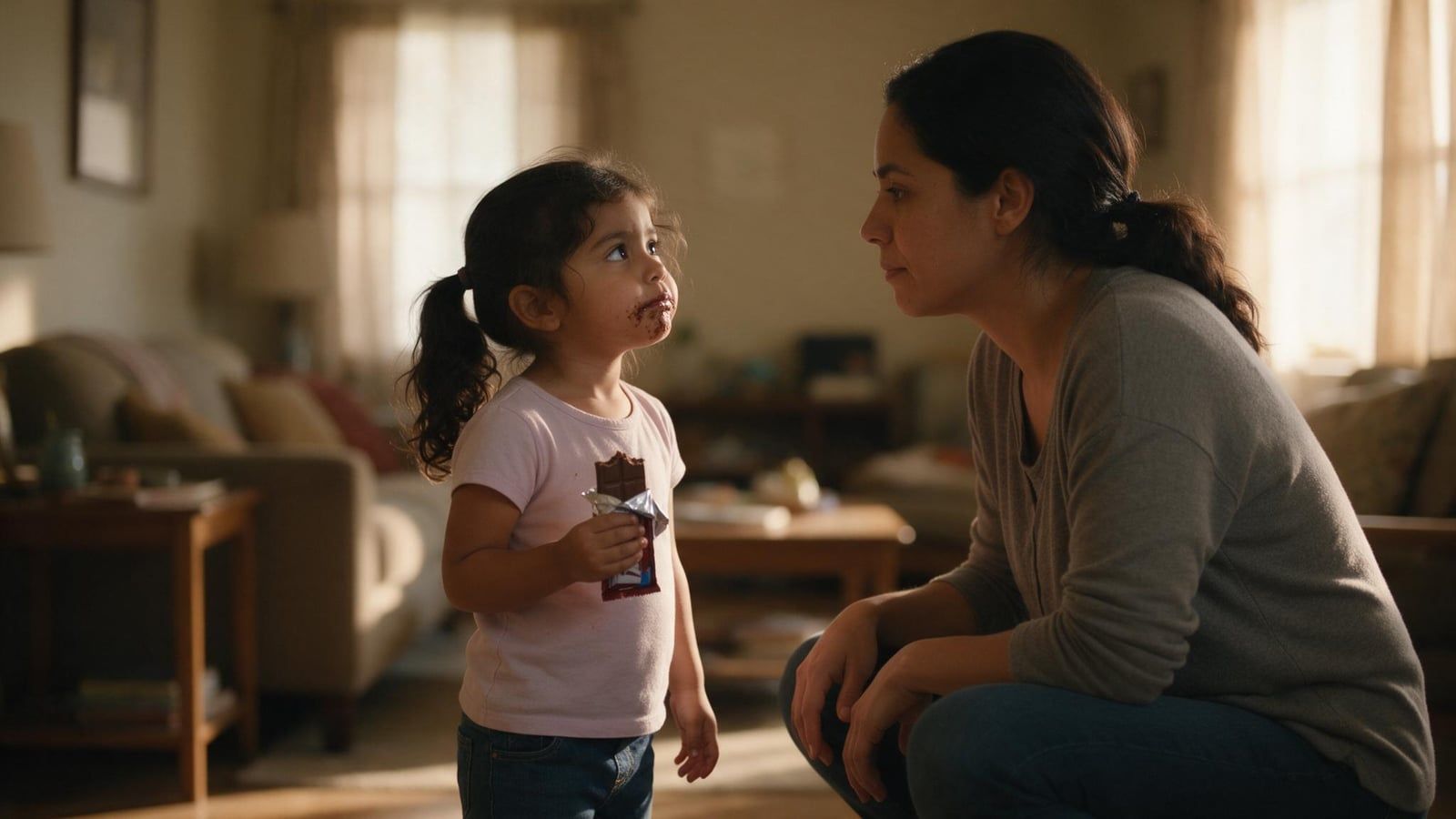
They're three years old, the wrapper in one hand and chocolate all over their face. You ask if they ate it and they say no, looking you straight in the eye, with a calm that's a little unnerving.
And two things hit you at once. The urge to laugh, because it's absurd. And a thought underneath that isn't funny at all: they're lying to my face and they didn't even bother to wipe it off.
The question that manufactures the lie
I'll start with what changes things the most, because it takes one second.
You walk in, you see the glass on the floor and you ask: “who knocked the glass over?” Or worse: “did you knock the glass over?” You're standing right in front of the glass, they were alone in the room, and you both know it. That question isn't looking for information. It's looking for a confession.
And it puts them in an impossible spot: tell the truth and carry whatever comes next, or try their luck. Plenty of children try their luck, and they do it because the question has just opened that door for them.
The fix is not asking what you already know. Say what you see and move on to the next thing: “the glass spilled, let's dry it up.” Same with the chocolate: “you ate it; let's get you cleaned up.” No verdict and no interrogation. You take away the chance to lie, and that usually works better than catching them in one.
The same principle works for the most common lie of all, the one that gets you out of a chore. Instead of “did you brush your teeth?”, which is a trick question when you weren't there to see it, say “let's go brush our teeth.” There's no gap left to slip an “I already did” into.
What actually happens at each age
There's one fact here that surprises almost everyone, and it runs exactly backwards to what people assume: lying goes up with age, not down.
In the studies that leave a child alone with the temptation to peek at a forbidden toy and then ask whether they peeked, most two- and three-year-olds own up, and from four or five on most of them lie. Your child starting to lie around four isn't a sign that something is going wrong. It's what most children do.
The other thing that changes with age is the quality. Little ones give themselves away: they deny it, and on the very next question they let slip the detail they could only know if they had looked. Holding a lie together means remembering the false version, not contradicting it later and keeping a straight face, and that is a lot to juggle for a four-year-old head.
At three, on top of that, things blur together that look very different to us: what happened and what they wish had happened. If they say the dog knocked the glass over, they may not be deceiving you; they may just like that version so much that it settles on top of what really happened.
And at four the two live side by side. The same child can give you an automatic “it wasn't me” in the morning and build you a carefully worked version in the afternoon. You don't need to work out which one it was: what you do next is the same either way.
What decides whether they tell you next time
It isn't what happens when you catch them. It's what happens when they come and tell you.
If they own up to something and what they get back is the full scolding, they learn a reasonable lesson: telling you is expensive. Next time they'll calculate better. The scolding may well cut down on the mischief too, but what they will certainly learn is to cover it up better.
That doesn't mean nothing happens. It means separating two things we usually serve up together:
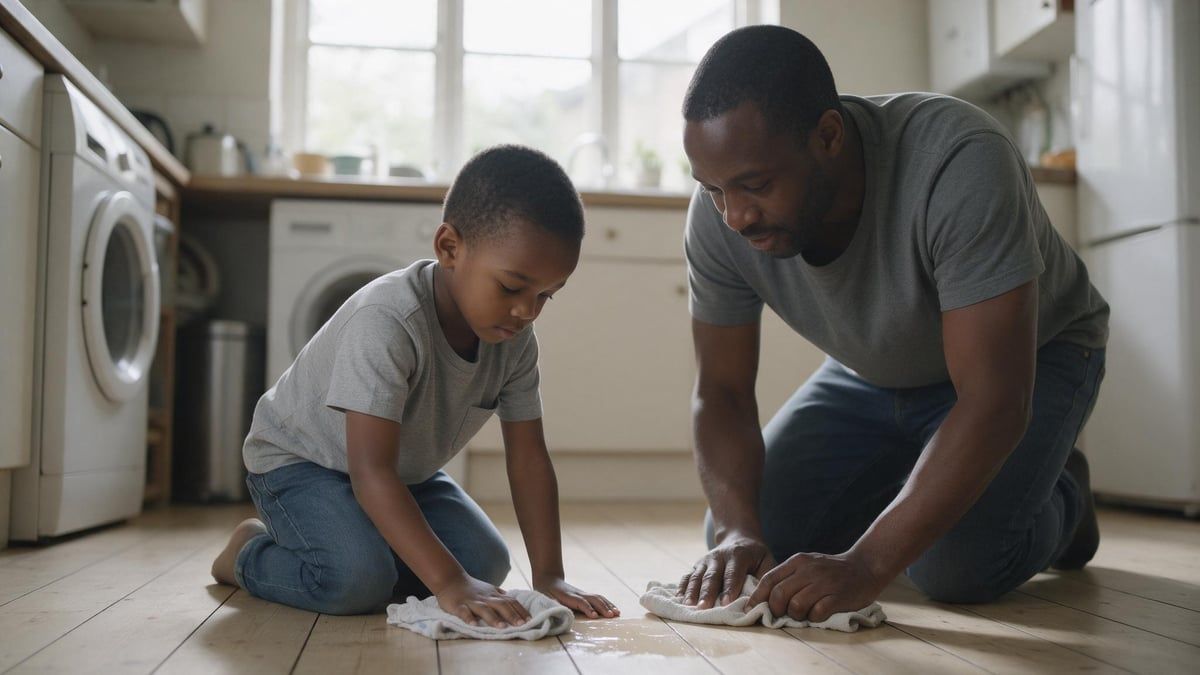
- What they did has a consequence: it gets cleaned up, fixed, given back. Concrete and within their reach, along the lines of repairing by doing something instead of reciting an apology.
- That they came and told you gets acknowledged, always, even if it comes late and even if they lied first. One sentence is enough: “I'm glad you told me.”
The second part is the hard one, because it lands right when you're angry. If you can't manage it in the moment, it still works that night: “I snapped at you earlier, but I'm glad you told me.” It arrives late and it counts.
When the lie lands on someone else
This is the one that worries you most, and it deserves its own section: they say it was their sibling, or that a kid at school hit them, and that isn't what happened.
First, the uncomfortable part: a lot of the time you're not going to be able to tell who is telling the truth. Two versions, no witnesses, and an investigation that's going nowhere. Holding the trial usually ends with both of them crying and you picking a guilty party on a coin toss.
It works better to step out of the who and stay with the what. “It's broken and it needs fixing, and the two of you are going to fix it.” No verdict. Most of the time, at these ages, pointing at a sibling isn't cruelty: it's wanting the scolding to land somewhere else, and for switching the scolding off it works just as well as being right does.
What is worth doing is looking after the one who took the accusation, in front of the other. Not to punish anybody, but to make it clear that in this house a false accusation also has a cost for the one on the receiving end, and that you saw it.
When the lie is about not disappointing you
There's another kind that asks for something different. It isn't trying to get out of a punishment: it's trying not to drop in your eyes.
The child who says they won the race, that they did the drawing without help, that the school play didn't scare them one bit. What's going on there is a child measuring the distance between what they did and what they think you were expecting.
Taking those apart doesn't help, because taking them apart confirms exactly what they're afraid of. What helps is lowering the bar out loud, at some other point in the day and without tying it to their thing: “I burned dinner today and it made me so annoyed.” The more times they see you get things wrong without any drama, the less they need to invent a better version of themselves.
If your child is also very caught up in comparing themselves, we covered that in my child compares themselves to other children.
When to take a closer look
A child between three and six lying is to be expected, and a bad patch doesn't mean much. What you look at isn't the isolated episodes, but a pattern that holds for weeks and doesn't ease off even after you've taken punishments out of the picture at home.
It's worth mentioning it to your pediatrician if you see any of these:
- They lie almost every day for weeks, even when telling the truth would have cost them nothing.
- They repeatedly say that other children have hurt them, or accuse others of serious things.
- They struggle to understand what you're asking or to tell you what happened, and what looks like a lie may be a tangle of comprehension or memory.
- It comes with a general shift: they sleep worse, they withdraw, they've stopped doing things they used to enjoy.
None of that means there's a problem. It means you can't tell the difference from home, and telling that difference is exactly what a professional does.
A story where the lie slips out before he can think
In The Truth That Trembles, the Pinocho retelling, the puppet accidentally breaks Geppetto's blue vase, hides the pieces and, when Geppetto asks him whether everything is all right, out comes an “it wasn't me” that, as the story puts it, slips out before he can think.
The interesting part is what Geppetto does: nothing. He ruffles his hair and suggests a snack, in his usual voice. And even so Pinocho can't play, his towers keep falling and he can't manage to look him in the eye, until he goes and tells him everything at once. Geppetto crouches down and tells him he did the right thing, coming to him. Then they mend the vase together with a gleaming glue, and the cracks stay in plain sight, shining golden.
That ending is the whole post: what broke gets mended and you can still tell it was broken, and the vase goes back on the shelf anyway.
It's for children aged five to seven.

A Retelling of Pinocchio
The Truth That Trembles · The courage to tell the truth
Pinocho lives with Geppetto in a warm workshop filled with wood and golden light. One afternoon, Pinocho tries to make the blue vase his father loves even more beautiful, but something doesn't go as planned. What happens next teaches him something about the weight of secrets and the strength of shared trust.
Read this children's story in the Semillita appNext post: how to talk to your child about their body, about secrets and about their limits, without scaring them.