

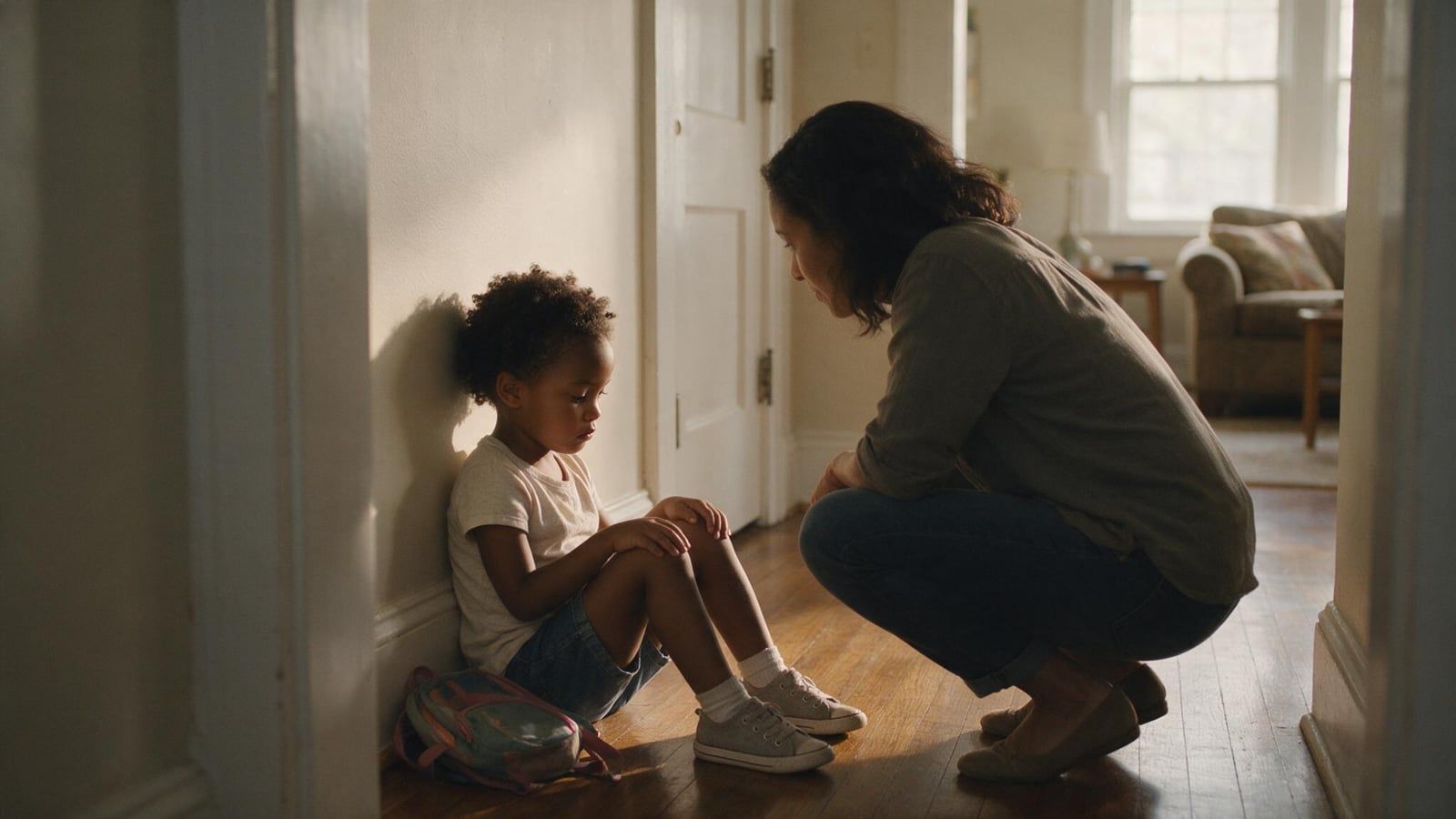
They come back from the park without a word. They drop the backpack in the middle of the hallway, sit down on the floor with their back against the wall, and stay there. You ask what happened and they say "nothing." You try again, more gently, and they say "I don't know."
The second answer is usually the true one. At four there is a lot of distance between feeling something and being able to say what it is.
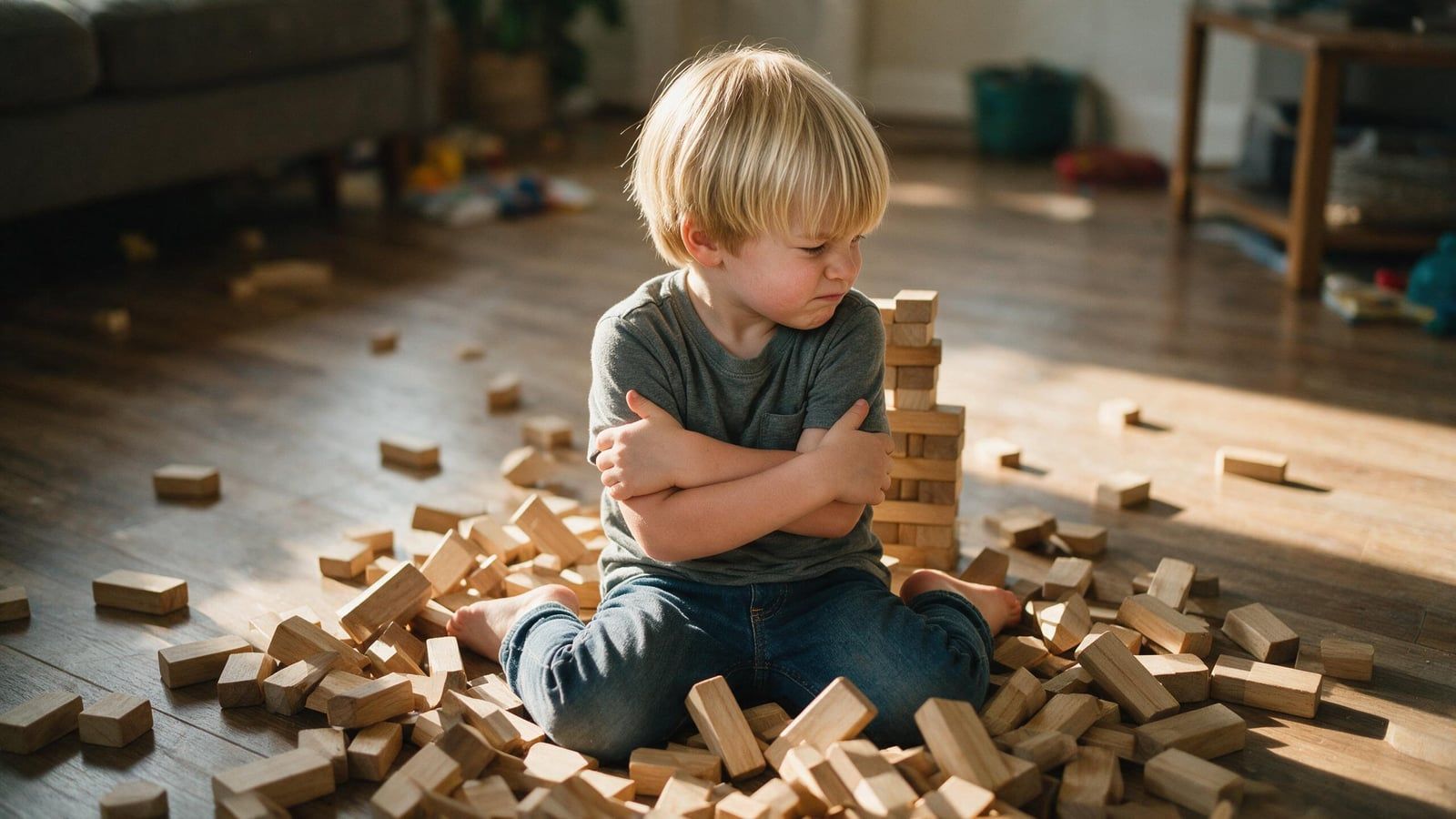
When what they feel comes out, we all recognize it, exhausting as it is: the tower falls and they sweep it all away, and there is nothing to interpret there. The hard one is the child in the hallway, the one who sits still with something heavy inside and nothing to get it out with.
First it's a sensation, and it takes a while to become a word
At this age what a child notices first is the body. Heat rising up the face. A knot in the throat. Hands that close on their own. A chest that suddenly feels heavy. None of it comes with a label on it.
The word arrives later, and it arrives from outside: someone puts a name on what they are noticing, and with enough repetition the name and the sensation end up traveling together. That's why "are you sad?" sometimes gets answered with a shrug. The question asks them to recognize a name that isn't stuck to anything yet.
Something similar happens to adults, we just forget it: you've spent the whole morning with tight shoulders, snapping at people, and only when you sit down in the afternoon does it land that you were worried about a phone call.
What to do tonight, in the hallway
Start with the thing that almost never gets said: maybe nothing happened. At that hour they arrive sleepy, hungry and with five hours of noise on top of them, and that alone explains the little heap in the hallway. If you suspect something specific did happen, that's another conversation: you ask about the facts, and you ask at another time.
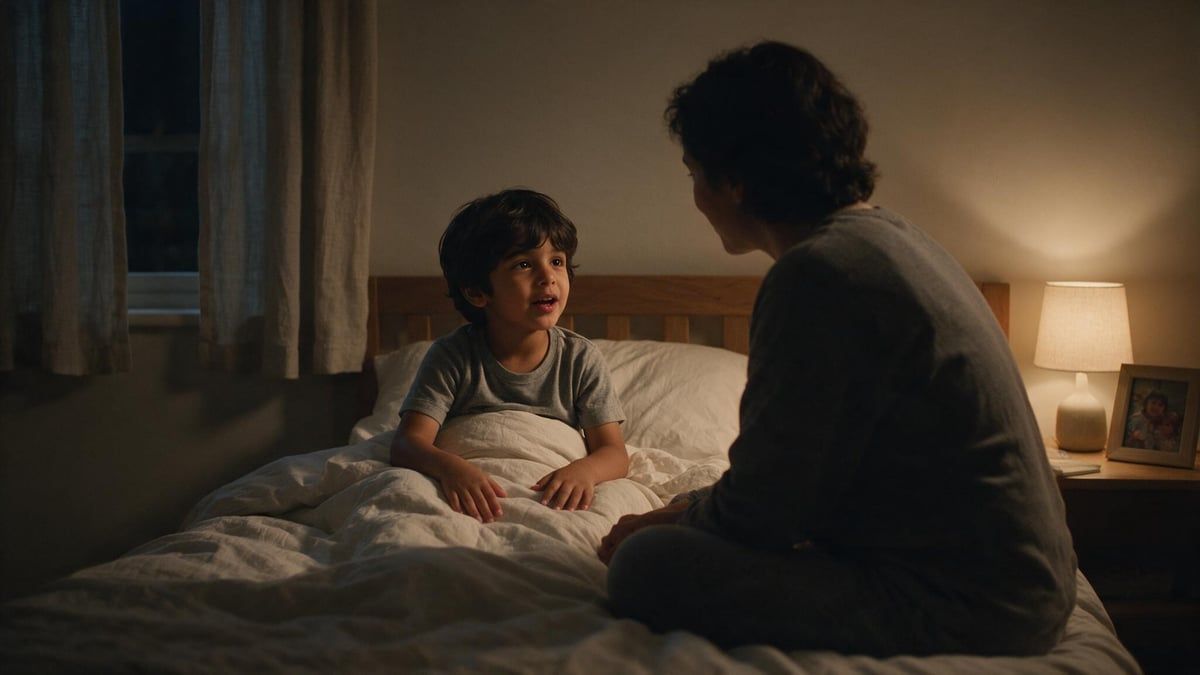
For all the other times, which is nearly all of them, sit down close, at their level, without asking anything of them. Name the body once, not the emotion: "your fists are clenched", "you've had your head down for a while". And then be quiet.
Being quiet is the hard part, and it's worth saying so: silence on a hallway floor gets very long. But the second question erases the first, because it teaches them that if they hold out a moment you'll keep talking and they won't have to. If nothing comes out after a few minutes, dinner goes ahead as usual and nothing has failed.
And when you offer them an emotion word, offer two. "I don't know if it's anger or if you're just tired" gives them something to think about; "you're angry" is a statement about them that they can only accept or reject.
Where the words are really learned
"Tell me what you're feeling" doesn't land in the middle of a meltdown. Right then they seem to have less access to language than at any ordinary moment, and the question ends up being one more demand. What helps there is for you to do the naming, asking nothing in return, and then to go quiet: it's laid out in five co-regulation techniques.
The vocabulary gets built somewhere else: in the dead time of the day. In the car, in the bath, in the five minutes before sleep, in the line at the supermarket. Four ways to slip it in there without it costing you any time:
- When it happens to someone else. The child crying at the park because it's time to leave. Mention it in passing, with no moral attached: "that one wanted to stay and it made him really angry".
- When it happens to you. Your own small version, said out loud: "the traffic got on my nerves and I talked louder than I meant to; it's passing now". There goes the name and, above all, the ending, which is the part that reassures most.
- A while afterwards. Once it's gone cold, and the next day counts too: "yesterday, when you couldn't find your shoe, what did you notice?". In the heat of it that question is a trap; cold, it's a conversation.
- In stories. Anything at all can happen to a character without anyone asking your child to account for it. That's why words get tried out in a story before they get tried out on yourself.
Size matters more than the adjective
Happy, sad, angry and scared cover the basics, and that's what nearly every child has by around four. The temptation then is to teach finer words, "frustrated" or "disappointed". They're useful, even if they aren't what's missing first.
What they need before that is size: being able to say whether it's a little or a whole lot. "I'm a bit angry" and "I'm very angry" ask different things of you, and in practice that scale solves more situations for them than a new adjective.
Feeling two things at once and knowing it comes later. Being happy about going to Grandma's and at the same time not wanting to leave you is a mixture most children don't name until quite a bit later, and it isn't worth hammering away at.
Don't correct their word
They say "I'm sad" and it seems obvious to you that what they've got is fury. The temptation is to adjust it for them: "that's not sadness, you're angry".
Two reasons not to. You might be wrong, because from outside what you see is the face and the volume. And if every time they say what they feel someone revises it, they learn that saying it comes with a test attached, and they already have their fill of things with tests.
What you can do is add without taking away. "Okay, you're sad. I saw some anger in there too, but you're the one who feels it." Your word stays there on the table and they decide whether to pick it up.
What changes once they have the word
Naming an emotion doesn't switch it off: a four-year-old who can say "I'm angry" is exactly as angry a second after saying it.
What changes is what can happen next. With the word they can give warning before they reach the limit, and they can ask for something specific instead of waiting for you to guess. They can also come back to what happened once it's gone cold, which is when there's anything at all to learn from a tantrum.
On the mechanism there's more enthusiasm than certainty. The idea that naming an emotion turns down its intensity comes from one very specific experiment: adults in a lab putting labels on faces or on unpleasant photographs. The effect measured there is small and doesn't always replicate, and that adult bears little resemblance to a four-year-old in a hallway. In children what shows up is something else: those who handle more words for what they feel tend to have fewer conflicts, though they also tend to be children from homes where emotions get talked about a lot, and separating out how much each thing contributes isn't easy.
And part of the effect isn't theirs at all, it's yours: when they say what's going on, you stop guessing, and an adult who has understood answers differently.
Having the word isn't knowing how to use it
There are five-year-olds who name things beautifully and still lash out the moment something gets taken away from them. Parents tell it like they've been short-changed: if they know how to say it, why don't they say it instead of biting?
Because saying it and holding it in are two different abilities, and they don't mature at the same time. The first is learned early, and in the cold. The second is inhibitory control, putting the brakes on the body with the emotion already at full height, and that one goes much more slowly.
So it's better not to hang a result on the word that the word can't deliver. What it gives you in the meantime is a conversation: the one afterwards, once it's over, which without words doesn't exist.
When to look more closely
That a four- or five-year-old finds it hard to say what they feel is exactly what you'd expect, and most of the children in the hallway have nothing wrong with them. One sign is worth raising early, without waiting for the next check-up: that they've lost words or ways of communicating they already had. Losing something already acquired gets looked at sooner than being slow to acquire it.
It's worth mentioning at the next visit if you see any of these:
- They're short of words for everything, not just for emotions, and they struggle to make themselves understood day to day.
- As a rule they don't seem to register other people's emotions: if someone nearby is crying, they neither pick up on it nor pay it any attention.
- They've been flat for weeks, with no appetite for anything they used to enjoy.
Depending on where you live, the way in is the pediatrician, the preschool, or the early intervention service. Asking is useful above all for ruling out what can't be seen from home.
A story where nobody asks what's wrong
In A Cloud Comes to Visit, Wolfie loses a blue felt cloth he took everywhere with him. He looks in all the usual places and it doesn't turn up. He stands still in the middle of the clearing and his chest goes heavy, without knowing why.
Then a cloud appears above his head. Gray and soft, small at first and then a little bigger. It looks like it weighs nothing, but it weighs. His friends arrive, one by one. Nina sits down beside him without saying anything. Cotton lays a blanket over his shoulders, and only then does Wolfie realize he was cold. Not one of them asks him what's wrong.
It is, basically, the hallway. And for a four- or five-year-old who doesn't have the word yet, that cloud is a way of pointing: "I've got a cloud today" comes long before "I'm sad". It doesn't replace the vocabulary, but it does the job while the vocabulary is on its way.

A Cloud Comes to Visit
Letting the tears come out
Wolfie has a blue felt cloth he carries everywhere. One morning he wakes up and the cloth is gone. Something turns heavy inside him, and a cloud appears above his head. His friends arrive one by one, slowly, each in their own way.
Read this children's story in the Semillita appIn the next post: first words, and how to support a child's language without turning it into a test.