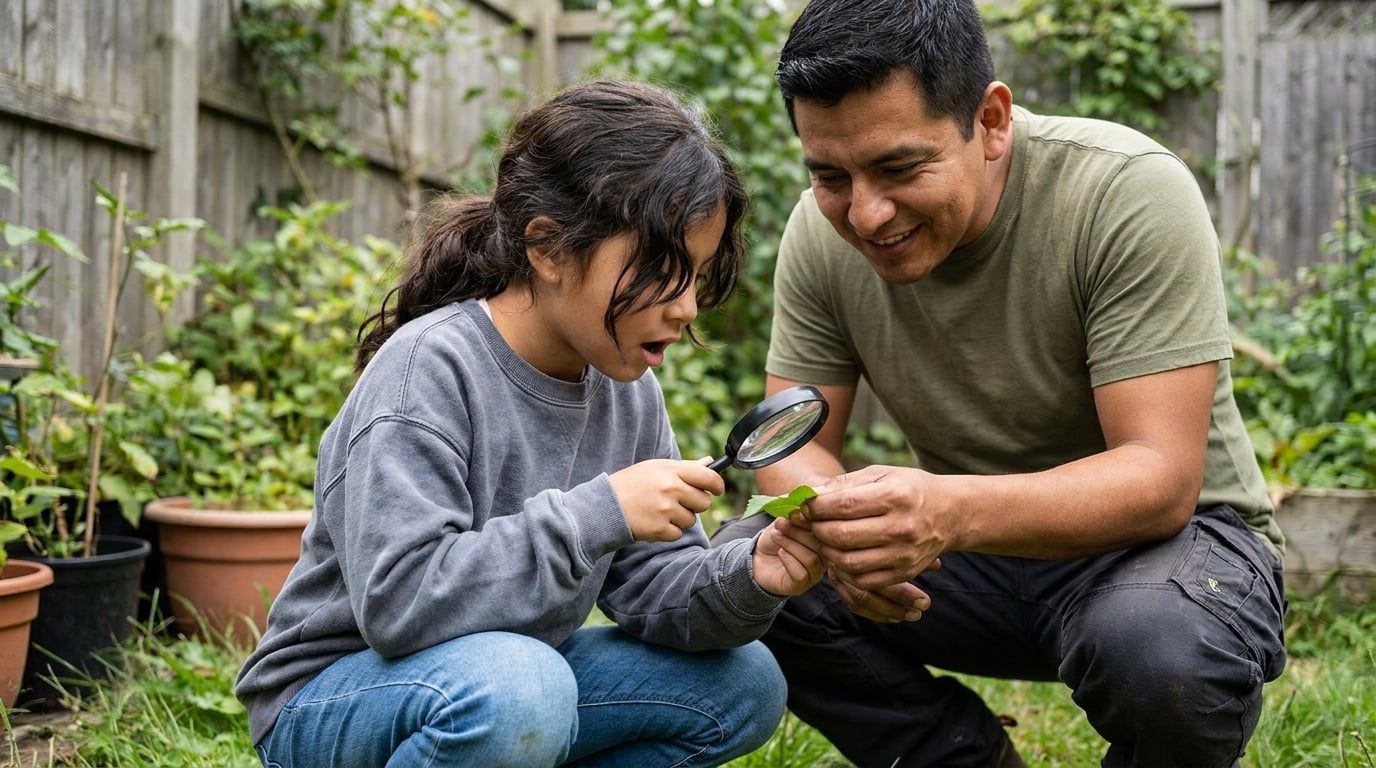



You're in the car and your daughter asks why the moon keeps following you. You tell her it's very far away. “And why is it far away?” Because it's in the sky. “And why is it in the sky?” By the fifth one, you say “just because,” and she starts all over again: “But why is it following us?”
First, some reassurance: in a study of thousands of recorded questions from six children aged 2 to 4, adults gave an explanation a little over a third of the time (Frazier and colleagues, 2009). Nobody answers every why well, and you don't need to.
What your child is after with all those “whys”
Often, an explanation. In those recordings, after an explanation, the child was more likely to be satisfied or to follow up with a new question about what they'd been told. After an answer that didn't explain anything, the child was more likely to repeat the same question or offer their own explanation. This happened as early as age 2.
So notice what kind of why comes next. If they ask about what you just told them (“And why is it far away?”), your answer worked and they want more. If they repeat the same question or go back to the start, as after the “just because,” you probably haven't explained anything. And sometimes they ask just for fun, or to spend a little more time with you, and that's fine too.
There's another kind of why that isn't about curiosity: “Why do I have to go to bed?” Here a short reason is enough (“because there's school tomorrow and your body needs to sleep”), and then you stick to what you said. You don't have to win the argument.
How to answer without running out of steam
One or two sentences with real content are enough. For the moon: “It isn't following us. It's so, so far away that even when the car goes a long way, it hardly moves in the window. The trees are close, and they get left behind right away. Not the moon. That's why it looks like it's coming with us.” In an experiment where a researcher explained surprising things about some toys to 69 children aged 4 and 5, a short explanation was already enough: they asked the same thing again less often and remembered it a while later, which hardly ever happened with answers that didn't explain anything. With a little more detail they were somewhat more satisfied; adding even more didn't help any further (Frazier and colleagues, 2016).
“Just because” doesn't explain anything. Neither does “that's just how it is.” In home recordings of 37 children between four and a half and five, the children kept asking much more when the adult gave them no explanation at all than when they gave one (Kurkul and Corriveau, 2018). And in an experiment, 5-year-olds preferred to learn from someone who gave real explanations rather than from someone who answered in circles (Corriveau and Kurkul, 2014).
If you don't know, say so, and ask what they think. “I don't know. What do you think?” In the home recordings study this happened only a few times, but in a third of them the child jumped in with their own explanation. Then you can check it together, as we explain in “My child believes everything”.
You don't have to answer every one. If you're exhausted, save one for later: “That's a really good question, and my brain is too tired for it right now. I'll save it for dinner.” Then at dinner, bring it up yourself. If you never come back to it, it's only natural that they'll come to hear “later” as a no.
Before you answer something sensitive, ask what they already know. Sometimes the question is smaller than it seems. The pediatricians of the American Academy of Pediatrics (AAP) advise this for questions about the body: first find out what your child knows and what they want to know.
The hard questions
Death. In its guide for when someone close dies, the AAP calls for simple, honest explanations: that the person has died, that their body has stopped working, that they no longer feel any pain and that they won't come back. It also says to explain the cause in simple words, so your child doesn't think it happened because of something they did, said or thought. Avoid “gone to sleep” or “gone away on a trip”: a young child takes these literally and may end up afraid of falling asleep, or of going on a trip and never coming back. Before age 5, a child may well think death is temporary, so don't be surprised if they ask again and again when the person is coming back. If they ask whether you're going to die too, the AAP suggests telling them something along these lines: “I'm feeling well, and I take care of myself so I can stay that way. I hope to be with you for a very, very long time. But like everything that's alive, one day I will die. If it ever scares you, we can talk about it.” Only say the part about feeling well if it's true (AAP, on how children understand death). If they already asked and your mind went blank, you can bring it up yourself another day. As the AAP itself points out, listening to them matters more than finding the perfect words.
The body, and where babies come from. Short, honest answers, with the real names for body parts, and no laughing, even if the question is funny. An example of our own for 3- or 4-year-olds: “Babies grow inside the mother's body, in a special place called the uterus. It's not the stomach, where food goes.” If they follow up (“And where does it come out?”), the same again, short and with real names: “When it's ready, it comes out through the vagina. Sometimes doctors take it out through a cut in the belly.” When you're done, the AAP suggests asking “Does that answer your question?” and being ready to go over it again another day. If a topic makes you uncomfortable, you can also tell them so, honestly (AAP, on talking to children about sex). We cover how to talk to them about their body and their boundaries in “How to talk to your child about their body, secrets and boundaries”.
“Why is that man like that?” At the supermarket checkout, at the top of their voice. Noticing differences is normal at this age. The only AAP guidance we've found is about skin color: for preschoolers, a simple, positive answer (“Isn't it great that we're all so different!”), and even comparing your arms (AAP, on how to talk about racial differences). If what they're asking is why, you can add a fact (this part is ours): “Everyone has something in their skin called melanin, and it gives skin its color. Some people have more and some have less.” For other differences, like a wheelchair or a scar, we haven't found any AAP guidance. What follows is common sense: don't hush them as if they'd said something bad, give them a short, concrete fact right then (“He uses a wheelchair because he can't walk, or walking is very hard for him”), and save the longer conversation for later.
The story: a robot who knew everything
In The Curious Robot, a story for children aged 4 to 7, Chip is a robot who knows every manual in the lab by heart and isn't curious about anything. Until a hungry mouse talks him into making chocolate chip cookies. With the flour and the dough in his hands, Chip starts asking things that weren't in his memory: “Why is it so stretchy?”
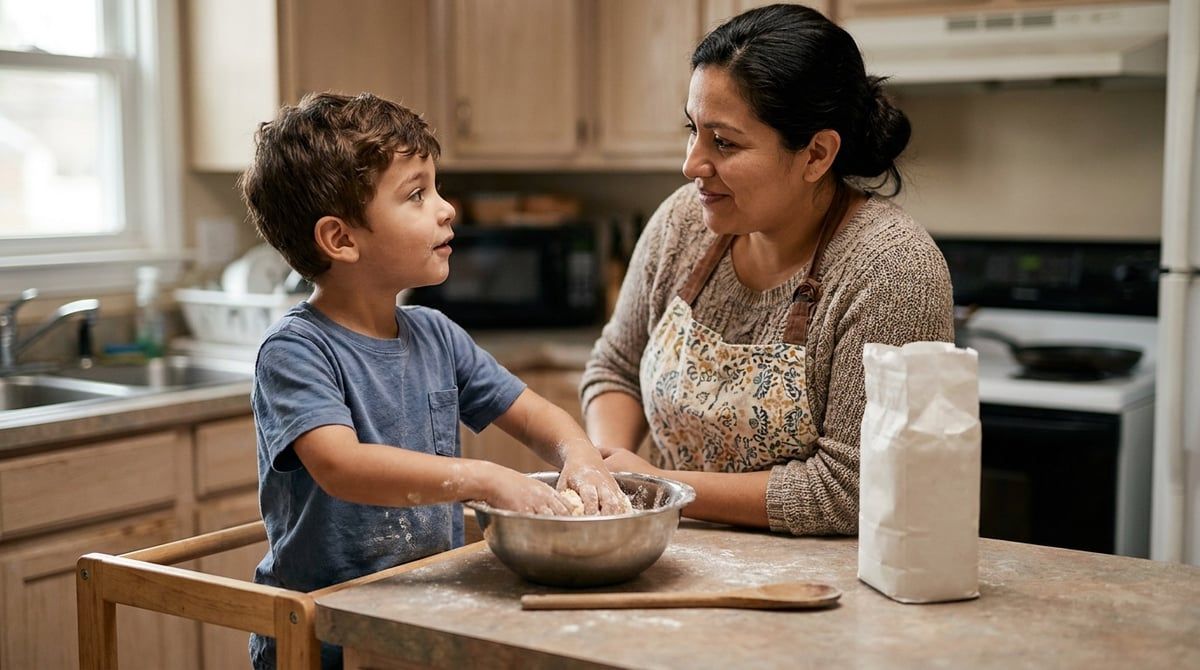
Chip's questions come from having things right in front of him, not from reading about them. Something similar showed up in a study at zoos: children aged 2 to 4 asked fewer in-depth questions in front of drawings or replicas than in front of the real animal (Chouinard, 2007). In the story, nobody answers Chip, and that leaves room for you: if your child asks why the dough stretches, you can try the one-sentence answer, or the “I don't know, what do you think?”, and find out by kneading dough together. We talk about why it's worth letting them do things, not just explaining them, in “My child learns by doing”.

The Curious Robot
Discovering the world through metal eyes
Chip is a young robot who lives in a laboratory full of books and tools. He has access to all the knowledge in the world and can remember thousands of facts without forgetting anything, but he has never felt true curiosity to experiment with his own hands. One day, Spark, a hungry and tremendously curious mouse, asks him for help making chocolate chip cookies. Although Chip knows the recipe by heart, he has never cooked. Together they discover that knowing the theory is not the same as living the experience, and that the most interesting questions arise when you touch, mix, and observe the world with your own senses. Through this culinary experiment, Chip learns that curiosity is not about having answers, but about daring to ask “why?” and “how?” while you do things.
Read this children's story in the Semillita app