

Your two-year-old daughter wants to help you load the washing machine. She puts the clean socks in with the dirty ones, takes half of them out only to put them back in, and what takes you two minutes ends up taking ten. You say, “Just leave it, I'll do it,” and she walks off angry.
The urge to help shows up very early, long before that help saves you any work. Here are chores that suit each age, how to ask with less of a fight, and what to try if your older child now only helps when there's something in it for them.
What they can do at each age
- Ages 2 and 3 (our ideas): putting clothes in the washing machine and pressing the button, taking their dirty clothes to the laundry basket, putting toys away in a big toy box, setting out the napkins, watering a plant, stirring cake batter, or sweeping with a small broom.
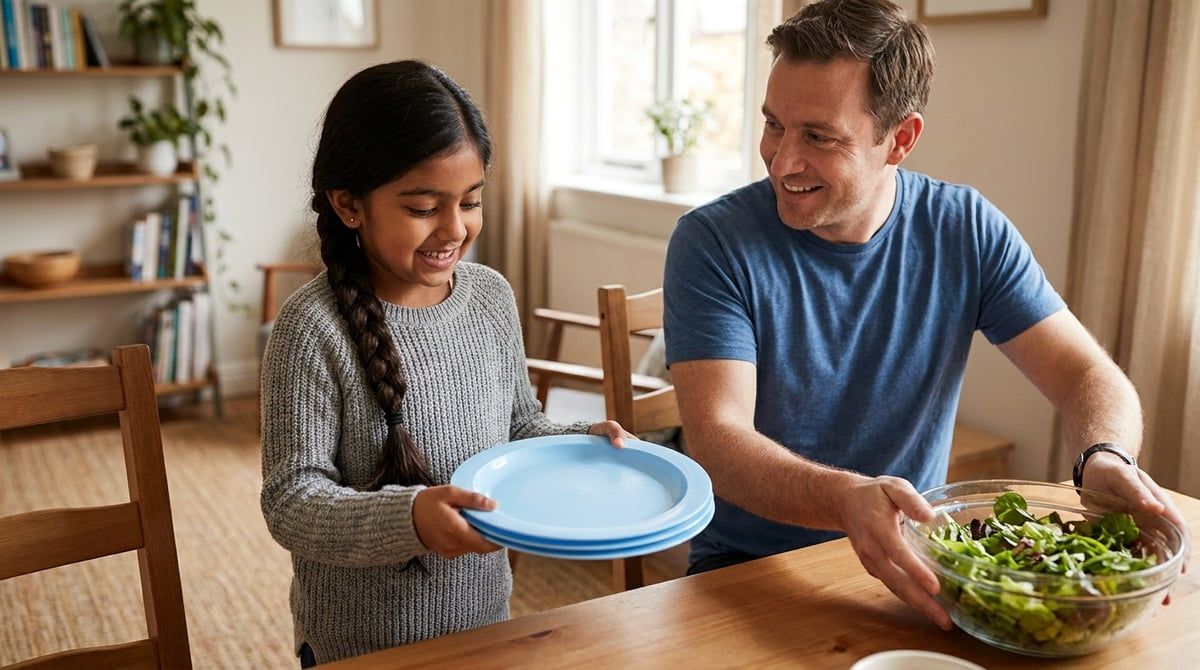
- Age 4 (our ideas): putting plates that won't break on the table, matching socks, washing fruit, helping put the groceries away, or feeding the pet.
- Ages 5 to 7: among other chores, the American Academy of Pediatrics (AAP) suggests making their bed, setting and clearing the table, putting toys away, putting dirty clothes in the laundry basket, emptying wastebaskets, sweeping, sorting laundry, watering plants, or washing plastic dishes.
- Ages 8 to 10: everything above, plus vacuuming, helping with dinner, making themselves a snack, and putting away their clothes and the groceries (AAP, on chores by age).
The AAP gives no list for children under 5. You'll notice that some chores repeat: at 2 or 3, your child does them with you and in their own way, while the AAP list has in mind children who already handle them on their own. The same page asks you not to expect a perfect job and to praise the effort, not the result. It also warns that a child who is asked for too much, or criticized for how they do it, may end up resisting.
And if their help sometimes gets in the way, that's normal: in a survey of 528 US families with children aged 1 to 4, three out of four reported it (Hammond and Brownell, 2018).
How to ask
Let them help for real, even if the result is worse. It's easy to end up giving your child a pretend job, like a dry cloth while you do the dishes, just to keep them busy. Some researchers who study how children help suspect, though they haven't proven it, that keeping children away from the real task like this slowly dampens their wish to help (Coppens and colleagues, 2020). Our own idea is to give them a real part of the job: let them put the socks in the drum and press the button.
When you're in a hurry, do it yourself. Mornings when you're rushing out the door are not the time for them to learn to button up. Save chores for when you don't have to be anywhere, like a Saturday morning, and on days when there's no time, just do it yourself. That goes for chores, not for a child who has dug in their heels. With a child like that, stopping for a minute is sometimes quicker than forcing it (that's our own experience, not a study), as Leo's father finds out in the story at the end.
Describe the problem instead of giving orders. “There are still blocks in the corner” instead of “Clean up now.” It also helps to explain why it needs doing, to let them decide how, or to sing it. A Montreal study observed about a hundred 2-year-olds in the lab and saw them again a year and a half later (85 stayed to the end). The more their parents did these things when asking them to tidy up, the more willingly the children cooperated later on. Threats, criticism, physically forcing them, or promising something in return for tidying up were linked to somewhat poorer cooperation (Laurin and Joussemet, 2017). Everything was measured together, so it's not known which matters most, or whether one thing causes the other.
Let them decide what's theirs to decide. “Do you want to wear the blue t-shirt or the red one?” “Should we pick up the cars first, or the animals?” On its page about discipline, the AAP advises letting preschoolers choose between a few options that are fine with you (AAP, on discipline). We haven't found any study that tests this at this age, but it costs very little.
With little ones, say thank you instead of giving a reward. In one experiment, a researcher the children didn't know dropped things in front of 20-month-olds, and they picked them up for her. Later, when nobody was giving anything in return, the ones who had been getting a toy for each item helped a little over half the time, and those who had received only thanks or nothing, 8 or 9 times out of 10 (Warneken and Tomasello, 2008). It was a single session, with 12 children per group, and the authors themselves note that a reward might help when a child has very little wish to help. With a young child who already wants to pitch in, a simple “Thank you, you were a big help” is enough.
If your older child now only helps for something in return
In interviews with mothers living in the United States, most 2- and 3-year-olds helped on their own initiative. Among families with 6- or 7-year-olds, children from Mexican-heritage families tended to help on their own (these were different families, not the same children as before), while in white middle-class families it was more usual to help when told to or in exchange for something. The authors believe that each community's ways of raising children explain this, at least in part. But these are interviews with different families at each age (12 per group at 6 or 7), and that kind of data can't prove it (Coppens and Rogoff, 2021).
None of this is proven, so there's no reason to think you've messed things up, either. On its chores page, the AAP puts sincere praise first and leaves an allowance or stickers as something that can be considered if your child still doesn't do their chores despite reminders. In our view, that fits with what the authors of the 20-month-olds experiment suggested: a reward may make sense when the willingness isn't there. If you already give something in return, there's no need to stop all at once. Our suggestion, with no promises: one real chore that's theirs, like setting the table every night. Ask for it by describing what's needed, and thank them when they do it, even if there's still a reward for now.
Does it pay off in the long run?
There isn't much data. In a study of nearly 10,000 US children, those who did chores regularly at 5 or 6 felt somewhat more capable at 8 or 9 than those who hardly ever did them (White and colleagues, 2019). The difference is small, and it may simply be that more capable children are given more chores.
The story: winter clothes in the middle of summer
In Not Without My Sweater, a story for children aged 2 and 3, Leo wakes up on a very hot summer day and wants to wear his winter sweater, the one with the snowman. His parents are in a hurry. They explain that it's hot, and his father tries to pull the t-shirt over his head. The more they insist, the harder Leo cries. That is, until his father stops, crouches down beside him and looks at him without a word. Leo stops crying.
His mother suggests that the sweater come along on the adventure, in the backpack. Nobody takes it away from him, and whatever he can do by himself, he does: he folds it his own way, puts it in the backpack and zips it shut. Then he lifts his arms to put on the t-shirt. The story's guide in the app suggests a question for afterwards: “Is there a piece of clothing you love wearing? What makes it special?” If getting dressed is a battle every morning at your house, we look at what's behind it in “Not that t-shirt, I want another”.

Not Without My Sweater
The Superpower of Choosing
It's a rushed morning at Leo's house. His parents have picked out his clothes, but Leo doesn't want to put them on — he wants his favorite sweater, even though it's really hot outside. The more they explain and hurry him, the louder his “no” becomes. Until someone stops, gets down to his level, and truly sees him.
Read this children's story in the Semillita app