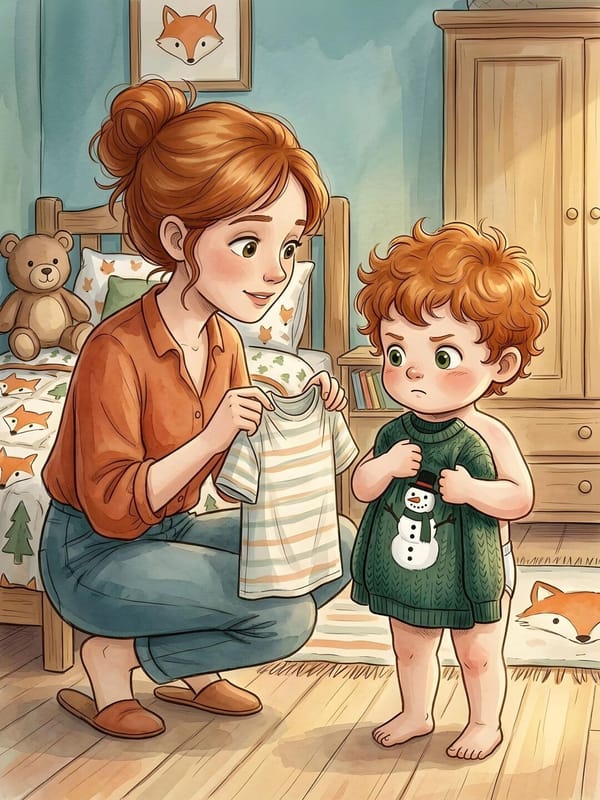
A red-haired toddler of about 2 years old hugging a green snowman sweater tightly, looking straight ahead with a serious and tender expression
Part of the STAR CollectionSee the STAR Collection

Not Without My Sweater

The Superpower of Choosing

Read this story in the app

Stories are only read in the mobile app. Scan the QR to open this same page on your phone.

Tap to open the story if you already have the app. Otherwise, install it first.

Download on the App StoreGet it on Google Play

How the story begins

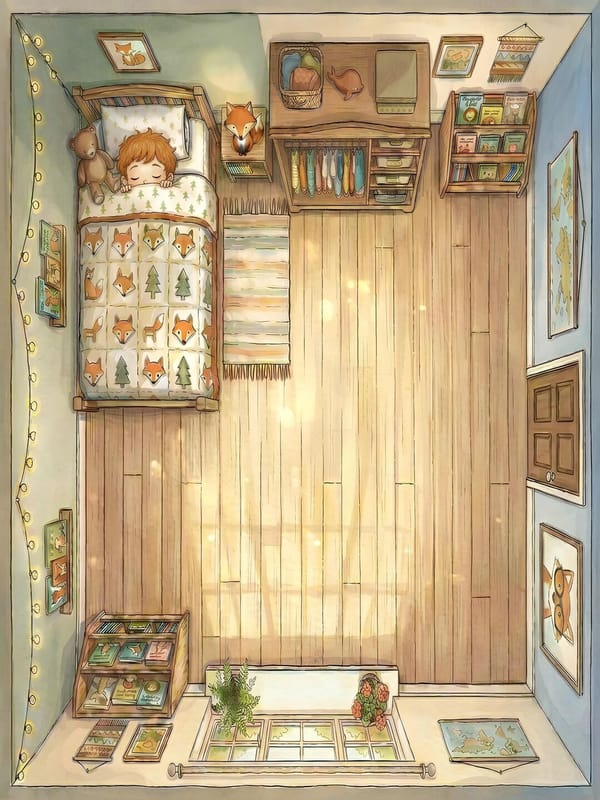
Leo's window is full of sunshine — a big, round sun that shines so warm. The fan spins round and round. It's summer, and in his bed, still tucked up to his nose, Leo is sleeping.

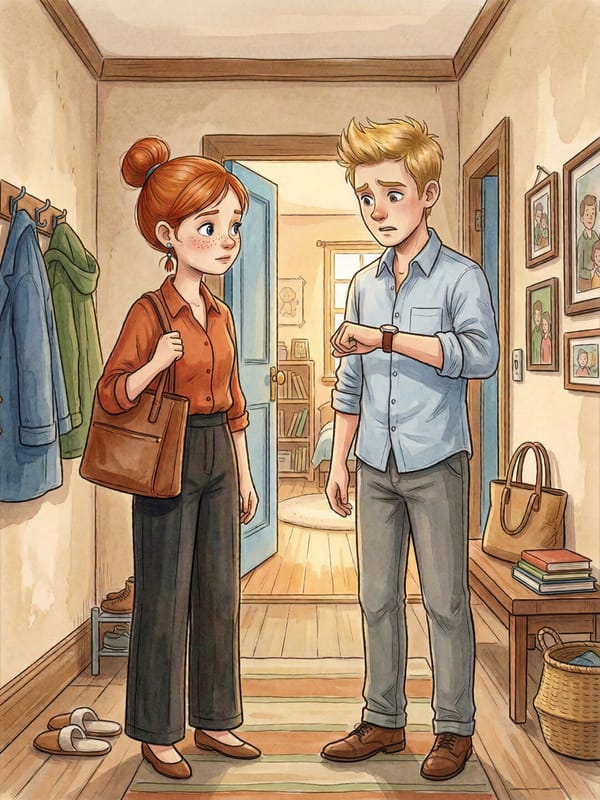
In the hallway, Mom already has her bag on her shoulder. Dad checks his watch. “We're going to be late,” he says. “I'll go wake Leo up,” says Mom, and heads to his room.

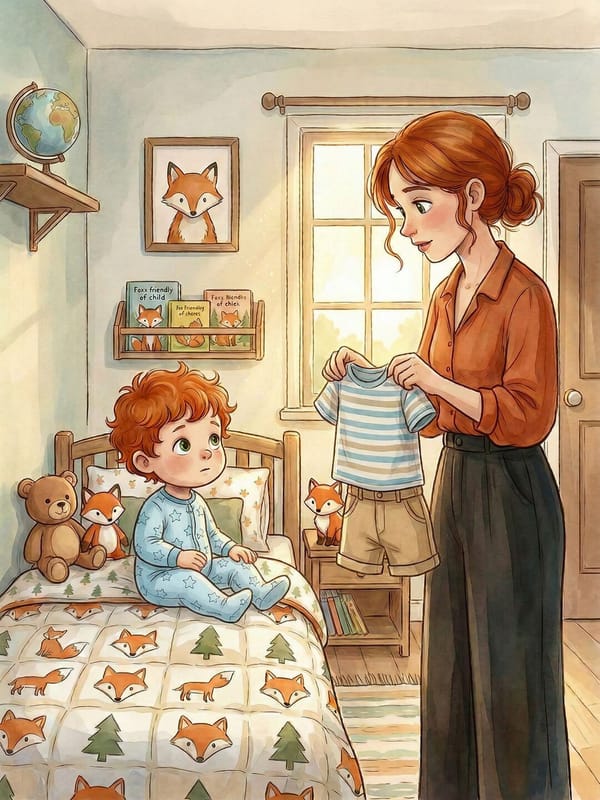
Mom comes in with summer clothes: a striped t-shirt and a pair of shorts. Leo opens one eye, then the other. He sees the clothes and sits up in bed.

Want to know what happens next? Read and listen to the full story in the free Semillita app — no ads.

Download on the App StoreGet it on Google Play
Illustration from Not Without My Sweater — 1
Illustration from Not Without My Sweater — 2
Illustration from Not Without My Sweater — 3
Illustration from Not Without My Sweater — 4
Illustration from Not Without My Sweater — 5

Guide for families

Content warnings

Scene of a child crying. Moment of family tension during a daily routine.

💭 What is this story about?

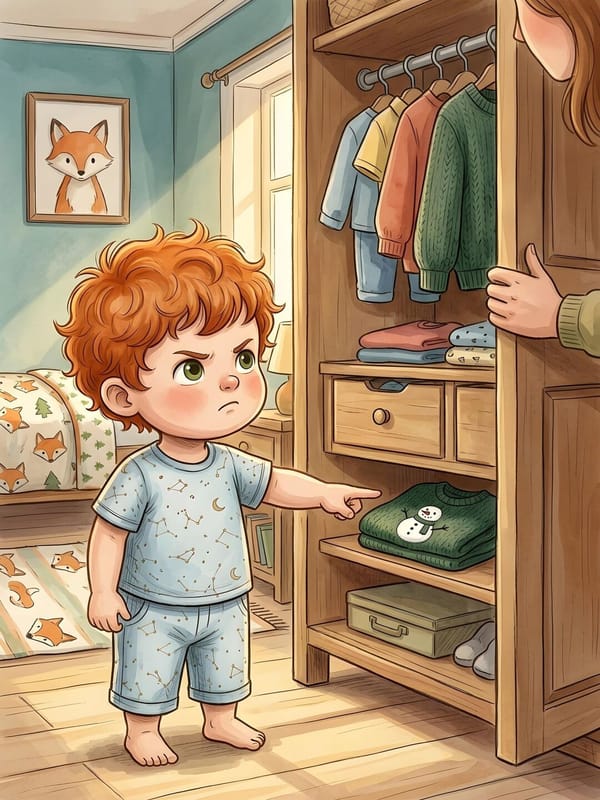
It's a rushed morning at Leo's house. His parents have picked out his clothes, but Leo doesn't want to put them on — he wants his favorite sweater, even though it's really hot outside. The more they explain and hurry him, the louder his “no” becomes. Until someone stops, gets down to his level, and truly sees him.

🧠 What does this story work on?

  • “No” as a need for autonomy: At ages 2–3, saying no isn't stubbornness — it's the first way children say “I get to decide about myself too.” This story shows that need with respect and without judgment.
  • Emotional validation before reasoning: When the emotional brain is activated, logical arguments don't land. Children need to feel seen before they can hear solutions.
  • Rushing and escalation: Adult urgency can turn a small conflict into a storm. The story shows what happens when rushing takes over… and what changes when someone decides to stop.
  • Repair as a model: Adults get dysregulated too. Recognizing it and starting again is one of the most powerful lessons children can witness.
  • Real agency as the solution: It's not about giving in or imposing — it's about finding a path that truly honors the child's desire, even in an unexpected way.
  • Identity objects: At this age, certain clothes or toys aren't just things — they're extensions of who children are. Understanding this completely changes how we handle these moments.

🤝 To talk about

  • “Is there a piece of clothing you love wearing? What makes it special?”
  • “How do you feel when someone tells you that you can't do something you really want to do?”
  • “What do you think Leo was feeling when his parents weren't listening to him?”
  • “When has someone asked you what you wanted, and how did that make you feel?”
  • “What can we do at home when everyone is rushing and someone feels really upset?”

🎯 Educational approach

The story doesn't resolve the conflict with a lecture or a moral — it resolves it with a gesture. An adult who crouches down, who asks, who listens. That sequence — stop, validate, offer real choices — is the foundation of positive discipline and respectful parenting for this stage of development. The story doesn't say “this is how you should do it” — it shows it, and lets children and the adults with them feel it. Before routines that tend to cause friction (getting dressed, leaving the house, bath time), offer two real choices: “Do you want to put on your shoes or your jacket first?” A small choice reduces big resistance. When you notice an escalation starting, try getting down to their level and naming what you see: “You really want that sweater, don't you?” You don't need to solve anything yet. Feeling seen is the first step. If the rush won and the moment was hard for everyone, that's okay. In a calm moment, you can come back to it: “This morning was really tough. How did you feel?”

More stories you might like

Mama bear, in a dark red coat and yellow scarf, kneels in front of her little bear cub and tenderly kisses the palm of his paw, where she has drawn a small red heart. The cub, in a navy blue sweater with slightly teary eyes, gazes at his paw. Behind them, the blurred school entrance on a cold morning. A warm, tender atmosphere.
A nighttime children's illustration of Grandma Squirrel and little Acorn sleeping peacefully.
Illustration of a young girl astronaut and a small alien looking out of a spaceship window towards a softly colored nebula.
A little elephant places both its hands on its tummy and listens carefully to what it feels inside.