

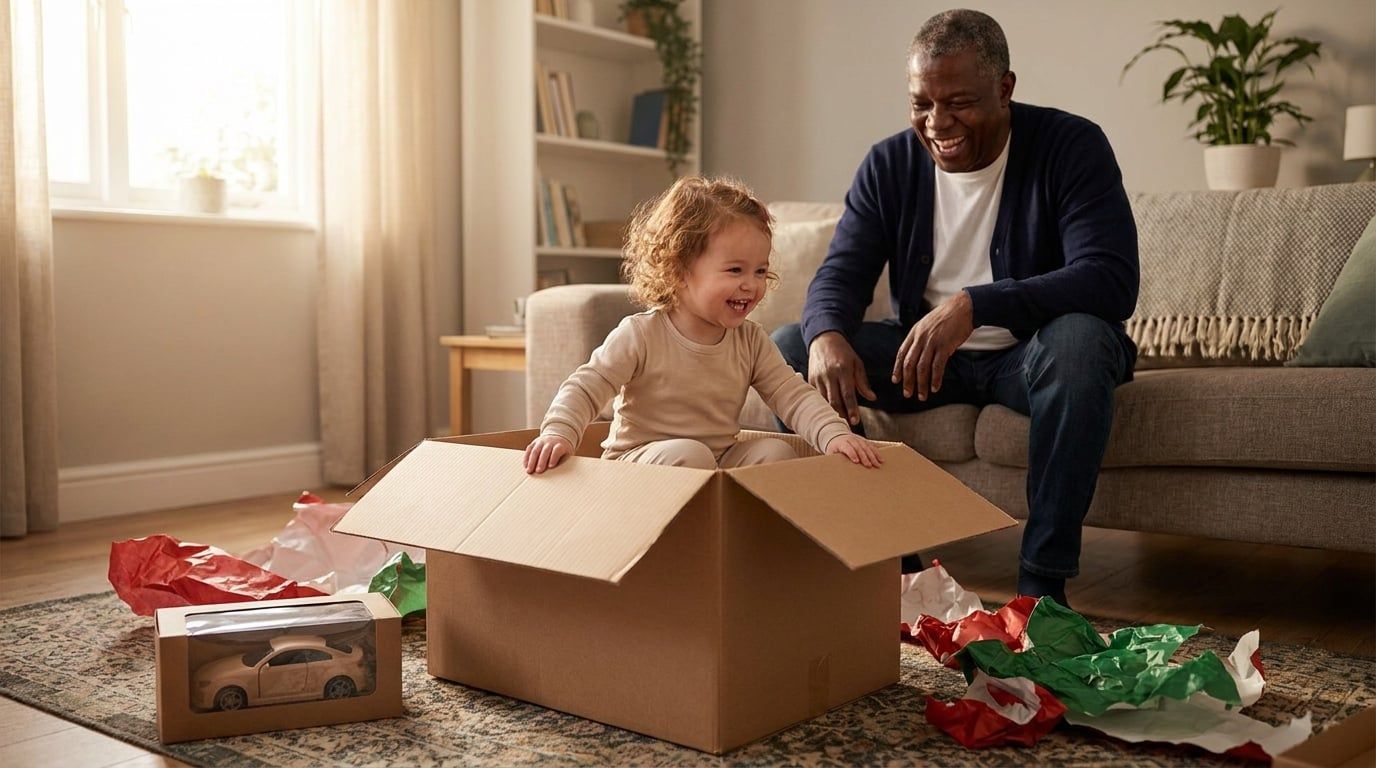
Christmas morning, or the morning of a birthday: twelve packages, wrapping paper all over the living room and, twenty minutes later, your two-year-old playing inside the box one of them came in. The new toys sit around them, half unwrapped. And you wonder if it all needed to be this much.
What the studies say, in brief
In one study, 36 children between a year and a half and two and a half years old played in a room twice, for a quarter of an hour each time: one day with 4 toys and another with 16. With 4, they switched toys less often, played longer with each one and in more ways. According to their university's press release, they went from stacking a toy or tipping it over to feeding it, hiding it or using it as a hammer (Dauch and colleagues, 2018). It's a small lab study with very young children. It doesn't say how many toys it's best to have at home, or whether the same thing happens at four or at seven, or that having lots of toys does harm.
The American Academy of Pediatrics (AAP) advises choosing toys that don't overstimulate children and that encourage them to use their imagination, though it doesn't define how much is too much. The lead author of its report on toys sums it up like this: the best ones aren't flashy or expensive, and they don't come with an app (AAP, on the best toys). And the AAP guide that explains the report points out that no toy is necessary for a child to reach the next milestone (AAP, on choosing toys).
On electronic toys, there's one specific finding. In a study of 26 families with babies aged 10 to 16 months, parents said fewer words while playing with electronic toys, and there were fewer conversational turns than with traditional toys or books (Sosa, 2016). It's a small sample, and it measures conversation during play, not language development. But it matches what the AAP and the American Speech-Language-Hearing Association report: when the toy talks, parents talk less (AAP, on tech-free gifts).
Ideas for this holiday season
Talk to family as early as you can. Grandparents, aunts, uncles and godparents give gifts out of love, and suggesting something usually goes over better than asking for less. For example: “This year we're trying not to let so many toys pile up at home. If you're up for it, we'd love it if, instead of another toy, you spent an afternoon with the kids or took them to the zoo, with a little something to unwrap that day. Or a book. There's always room for a book.” If the gift is already bought, it's welcomed just as gladly. It can always be opened later.
Don't bring it all out on the same day. Open some gifts and save others to open in a few weeks. After that, keep a few in sight and the rest in a box you swap in and out. That's what the study's researcher recommends, although the study didn't test it. If you have a 6-year-old who counts the packages, let them choose which ones get saved for later. And if the gifts arrive on two different days, the split is already done for you.
Make room for what's coming. Before the holidays, go through the toys your child no longer plays with, together. Some get put away, some get given away and some go back on the shelf. With a 6-year-old, let them decide. And use the chance to clear out anything broken: a cracked toy can release small parts or, if it's magnetic, a magnet.
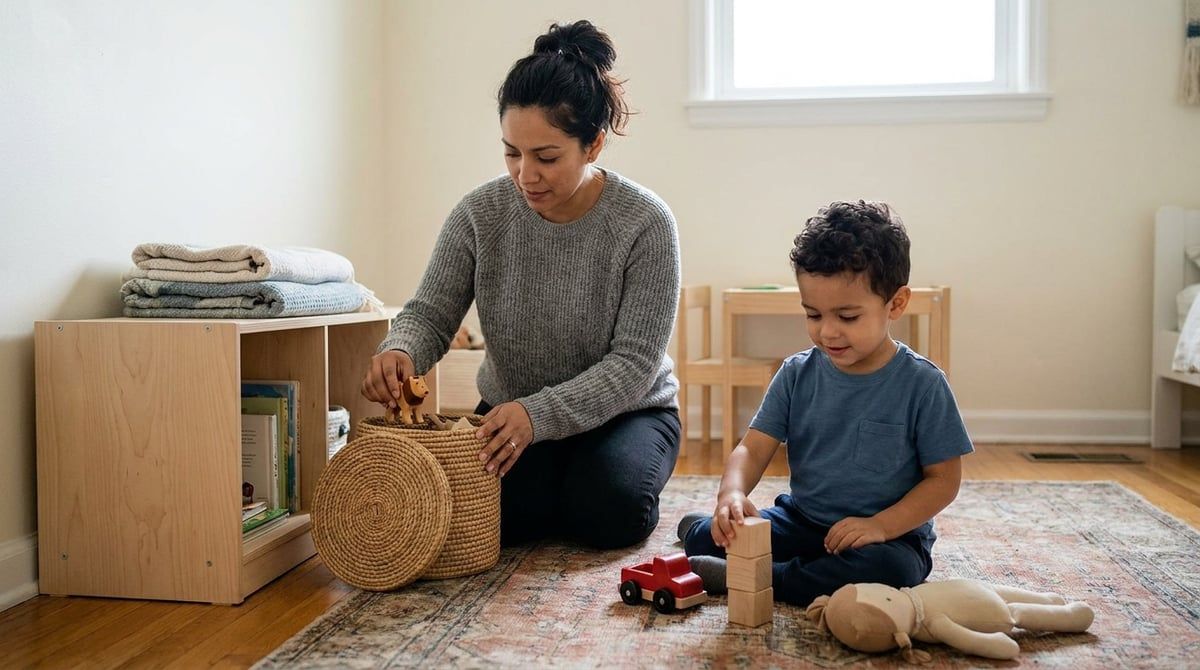
Toys where the play comes from the child. Blocks, dolls, a play kitchen, modeling clay, paper and crayons. The AAP notes that something as simple as a cardboard box or a pad of paper still makes little ones happy (AAP, on choosing toys). We talk about how to make room for that kind of play in “How to encourage creativity in children”.
If a toy with lights and sounds arrives, don't let it take the place of playing with you. You don't need to hide it. You can turn the volume down, save it for certain times or take the batteries out for a while. If they're button batteries, store them out of reach and close the cover securely. The AAP advises avoiding very loud toys to protect your child's hearing.
An experience, with something to hold. The AAP and the speech-language association also suggest giving experiences, like a pass to the zoo or a museum (AAP, on tech-free gifts). With one nuance: in four studies with children aged 3 to 17, those aged 3 to 12 enjoyed objects more than experiences, and experiences gain ground with age (Chaplin and colleagues, 2020). The authors link this to memory. Young children enjoy an experience a lot while it's happening, but the toy is still there the next day. For a 6-year-old, a ticket on its own may not feel like much. With a toy animal from the zoo and a few photos from that day, it may stay with them longer.
Safety, especially if there are children under 3 at home
Button batteries. They're in remote controls and many household devices, and also in some toys, shoes and clothing with lights. If a child swallows one, it can burn them on the inside in a short time, even if it's used up. Seal any covers that don't close securely with tape. Keep spare and used batteries out of reach, including on the day you change them. If you suspect your child has swallowed one, go to the emergency room without waiting for symptoms (AAP, on button batteries).
Magnets. Sets of a hundred or more small, powerful magnetic balls or cubes shouldn't be in a home with children, according to the AAP. If a child swallows more than one, they pull toward each other inside the intestine with enough force to cause serious injuries, and surgery may be needed. Toys with magnets inside, like magnetic building pieces, can stay: check them now and then in case one has cracked. If you think your child has swallowed a magnet, go to the pediatrician or the emergency room without waiting. Stomach pain or vomiting gets mistaken for a virus (AAP, on magnetic toys).
Small parts. The AAP advises that all toys and their parts be larger than the child's mouth (AAP, on buying safe toys). In the European Union, toys that may be dangerous for children under three carry the warning “Not suitable for children under 36 months” or a circle with a crossed-out baby face and “0-3”. The reason, almost always small parts, is on the box or in the instructions. The warning doesn't say whether the toy suits the child's level of maturity: it warns of a physical hazard. And it's often on older siblings' toys, so it's best not to leave those lying on the floor. Outside the European Union, labeling is different: look for the minimum age and the reason.
A truck and a bucket
In A Truck for Two, a story for children aged 2 and 3, Pom-Pom is pushing his red truck through the sand when Yarena arrives and puts her hand on it. “Mine!” Mommy Pig doesn't take the truck away. She sets a yellow bucket down in front of Yarena and goes to sit a little farther away.
Yarena fills the bucket, but it's too heavy to lift. Pom-Pom looks at the bucket, looks at his truck, looks at the bucket again… and pushes the truck toward her. They fill the bucket between them, tip it into the truck and push together. Two simple toys, an adult nearby who isn't directing, and there's play for both of them. We talk about why sharing is hard at that age in “My child won't share”.
The guide that comes with the story in the app suggests a question for afterward: “Have you ever played next to someone without doing exactly the same thing? What was that like?” With 2- and 3-year-olds, it's enough to ask what they did together with the bucket.

A Truck for Two
Playing together, little by little
Pom-Pom is in the sandbox with his red truck, going vroom-vroom as he loads and dumps sand again and again. His is a whole, calm, happy kind of play. Then Yarena arrives, with her green eyes, and puts her hand on the truck. Pom-Pom holds it tight: “Mine!” Mommy Pig appears for a moment, sets something yellow down in the sand, and steps away. From there, the two little ones are in the same sandbox, each busy with their own thing, watching each other sideways — until something unexpected gets them both pushing the truck together.
Read this children's story in the Semillita app