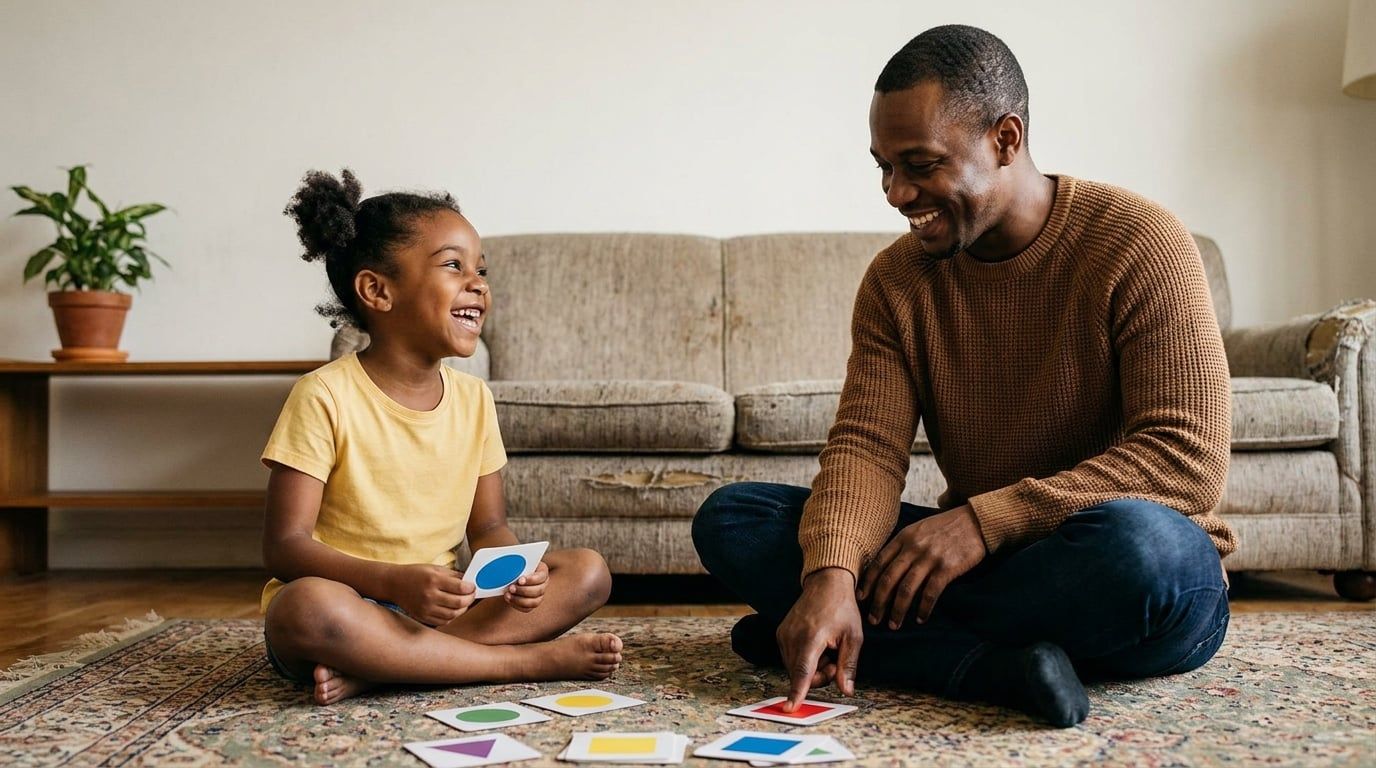


Your child is sitting on the floor with an empty cardboard box. “Why don’t you make a car?” you say, and you draw the wheels for him and show him where the steering wheel would go. Ten minutes later the car is finished, he’s already on to something else, and you’re left feeling like you were the one who played.
What happens when we teach them how something works
At a science museum, 85 children ages 4 to 6 played with a toy made of tubes that hid four functions, such as a squeak or a light. If the researcher first showed them one (“Look, this is how my toy works”), they played for less time, tried fewer things, and found fewer functions than if she showed them nothing or seemed to discover it by accident. The same thing happened if they only overheard it being explained to another child (Bonawitz et al., 2011).
The authors explain it as logical reasoning: if someone who knows shows them just one thing, the child infers there’s nothing more. They don’t conclude that teaching is bad; how much it pays off depends on what the person teaching knows and how easy it would be for the child to discover it on their own. And it’s best not to stretch it: the study measured how children explored a toy, not creativity. That something similar happens with a box or a sheet of paper is a reasonable assumption, not something that has been measured.
Rewards and praise
A meta-analysis of 128 experiments found that rewards announced in advance made people less likely to choose the activity afterward just for the enjoyment of it. With tangible rewards, like a sticker promised for every drawing, the effect tended to be worse in children than in university students. Positive feedback, on the other hand, increased interest, though less so in children than in university students (Deci et al., 1999).
There’s debate among researchers on this. For home, the difference that matters is this: a “That’s beautiful!” won’t take away their enthusiasm; promising them something in exchange for drawing might.
What about pretend play?
The American Academy of Pediatrics (AAP) recommends giving children simple objects, like blocks, empty containers, or wooden spoons, and time to act out imaginary scenes (AAP, on the power of play).
It’s worth it, though it’s best not to sell it as something it isn’t. A 2013 review concluded that there’s no solid evidence that pretend play is what makes children more creative. Some of the good studies point to things that tend to go along with that kind of play as what really counts: what the child is like, the adults around them, and their surroundings (Lillard et al., 2013). Pretend play may be one path among several, or it may not even be the one doing the work. If your child doesn’t play pretend much, there’s no evidence that it’s taking away anything essential.
How to make room for creativity at home
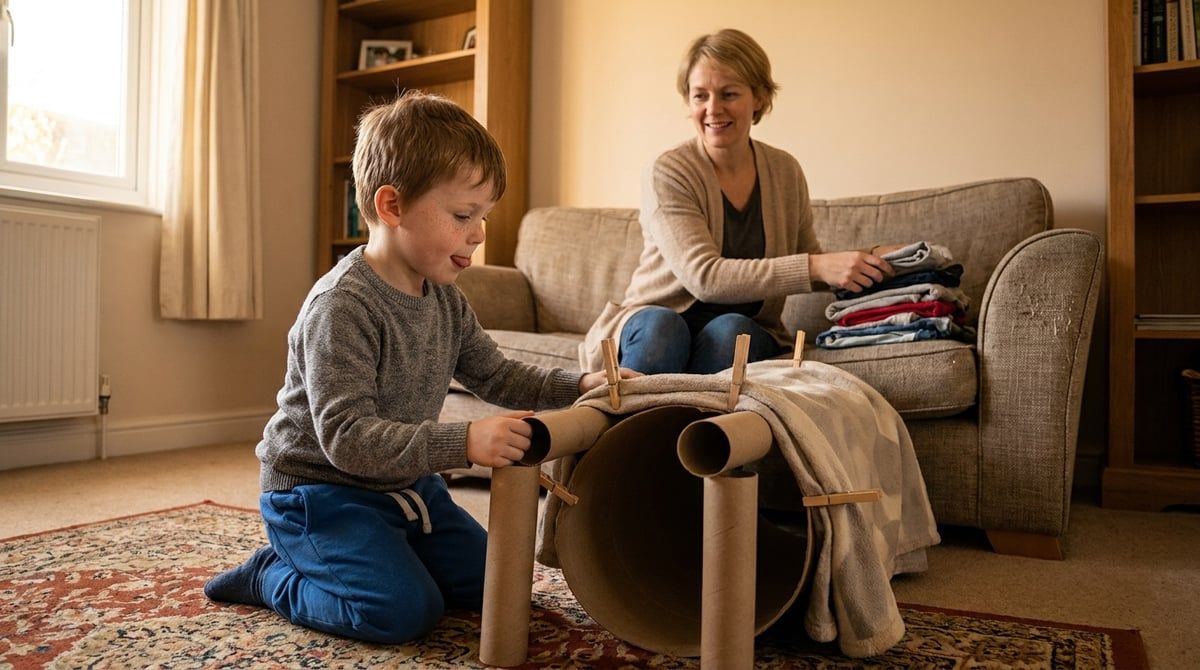
Keep things within reach that can be used in more than one way. Boxes, fabric, clothespins, cardboard tubes, blank paper, and something to paint with. A box can be a car, a cave, or a spaceship. Crafts with instructions and classes have their place too, because they teach technique; what they don’t give is the time to decide what to do.
Wait a bit before you teach, and teach as if you were discovering. If they get stuck, ask what they’re trying to do. In the museum study, when the adult seemed to find the squeak by accident, the children kept trying all sorts of things: a “Whoa! Did you see that? Let’s see if I can make it do that again” leaves the door open. If you do show them something, add, “This is one way. I bet you’ll find others.” And the study was with children ages 4 to 6: with children who are 1 or 2, watching you stack blocks or feed a doll is often what gives them the idea. Letting them discover doesn’t mean leaving them on their own, either; we talk about discovering with an adult alongside in “My child learns by doing”.
Comment on what they’re doing. A “That’s beautiful!” won’t take away their enthusiasm. But “Tell me about your drawing” opens more doors than “What is it?” because sometimes it isn’t anything yet, and “You used a lot of blue” or “How did you come up with the wings?” also tell them that you really looked.
Let the tree be purple, and help when they get frustrated. If the drawing is theirs, so are the colors and the proportions. But if your son says “I can’t draw” because the horse didn’t turn out the way he wanted, or because he’s comparing it with his older brother’s, don’t be afraid to teach him: show him a trick for drawing the body, and leave the rest up to him. If you’ve kept any drawings his brother made at the same age, showing him one puts the comparison in perspective.
Make room for mess, with limits. A corner where something they’ve built can stay standing until tomorrow offers more play than a craft that has to be cleared away before dinner. And clear limits (building on the rug, painting at the table covered with an old tablecloth) let them play without you having to keep an eye on them the whole time.
Leave some afternoons unplanned, and ride out the first stretch. Ideas take a while to come, and the start is often clumsy; we talk about that stretch, and about when “I’m bored” means something else, in “Boredom isn’t the enemy”.
If they invite you to play, step into their story. Take whatever role they give you and ask, “What happens next?” If you think of something, bring it into their game (an octopus, a storm) instead of changing the plot. As that same AAP page puts it, what enriches children is the presence and attention of adults, not fancy electronic gadgets.
A box that was a spaceship
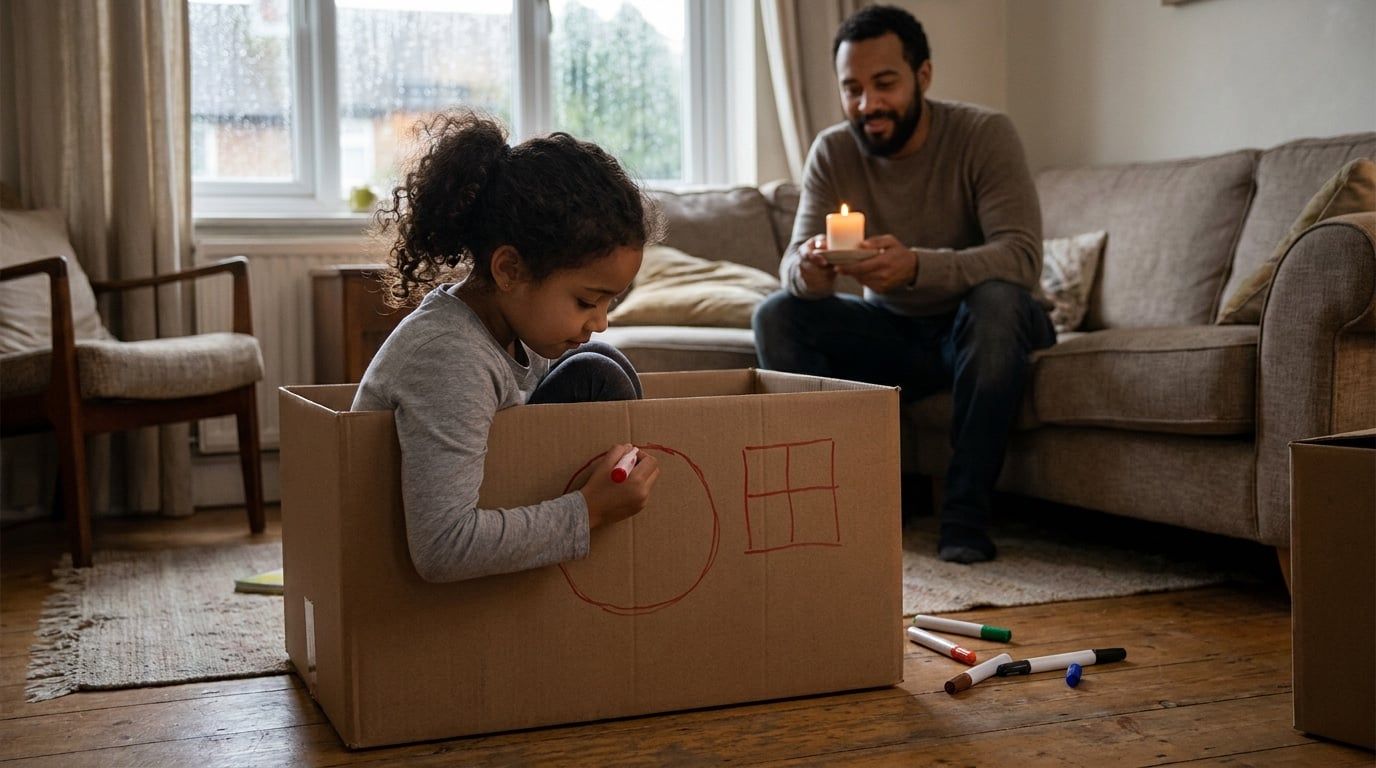
In The Boredom Portal, a story for children ages 6 to 8, Nora turns a cardboard box and some markers into a spaceship on a stormy afternoon when the power goes out. Her first line comes out red and crooked: “Not much to it.” The box doesn’t move an inch, but Nora travels to space and to the bottom of the sea: “It was Nora going up inside, which is the best way to go up.”
What matters here is what she does when Tomás, the boy next door, shows up, bored too. Nora doesn’t explain the rules to him: she brings him along on the journey. “We’re going to the bottom of the sea,” she tells him. “There’s an octopus. Grab a marker.” Tomás uncaps a green one and climbs in behind her.
The guide that comes with the story in the app suggests a question for afterward: “The spaceship — was it inside the box, or inside Nora?”

The Boredom Portal
A Screen-Free Adventure
One rainy afternoon, a storm leaves Nora with no power and no internet. Her screen goes dark all at once and, for the first time all afternoon, there is nothing to entertain her from the outside. Nora wanders around, complains, counts floor tiles, hangs upside down off the couch… until, in a corner, her eyes land on an old cardboard box and some markers she hadn't touched in ages.
Read this children's story in the Semillita app