

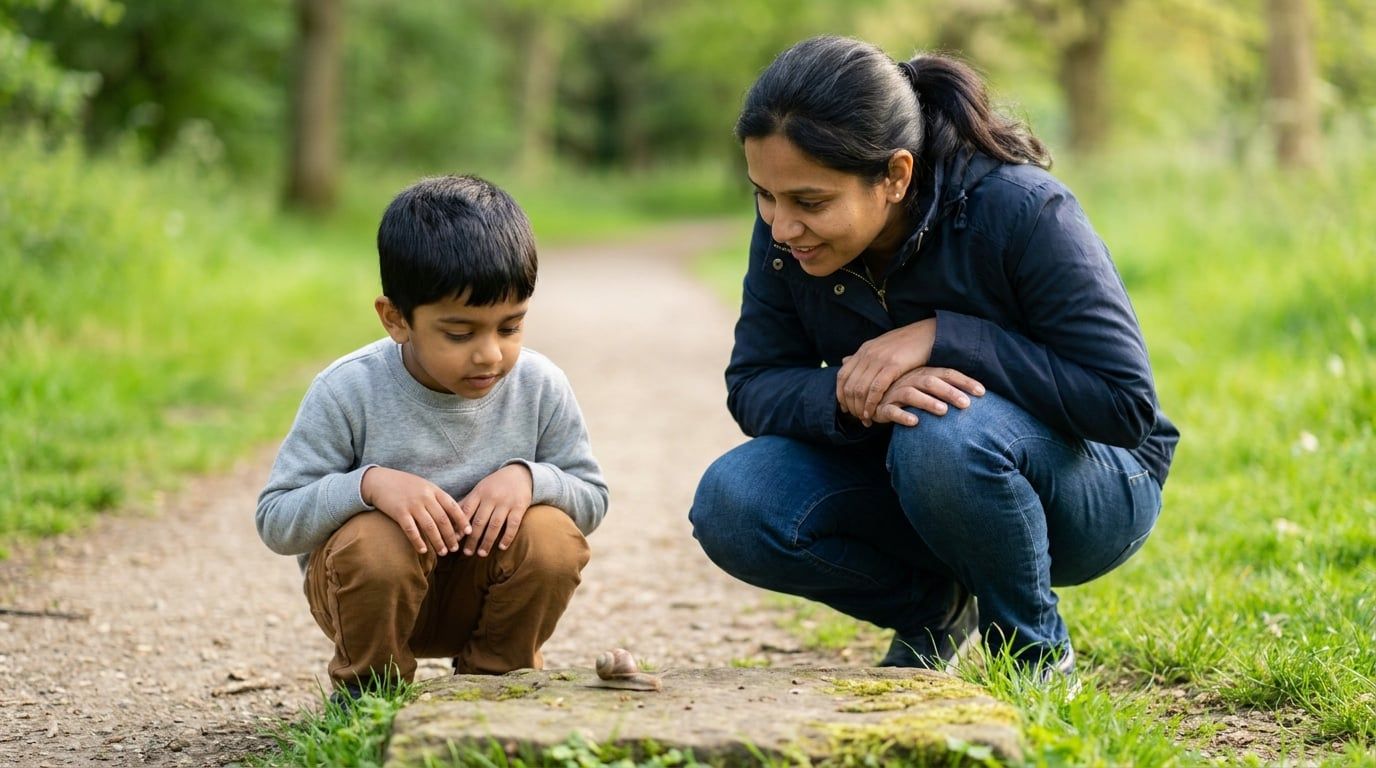
You’re hurrying to get to school when your child stops dead on the sidewalk: a snail is crossing. They crouch down, follow it with their eyes without touching it, and want to see where it’s going. You take their hand and tug a little, because you’re running late. That night, an ad for an app pops up on your phone: “Mindfulness for kids, five minutes a day.”
And what the ad promises to teach them looks a lot like what they were doing in front of that snail. At this age, learning a technique matters less than letting that attention stay for a while when it shows up. And, every now and then, looking for it together.
What mindfulness means with a young child
The definition used in studies talks about paying attention, on purpose, to what’s happening right now, with curiosity and without judging it.
With a four- or five-year-old, that doesn’t have to look like a meditation class. It can be watching a snail until you see where it’s headed, noticing whether the bath water is warm or hot, or counting how many different birds you can hear from a park bench.
What the studies say, which is less than the ads promise
The largest analysis we know of brings together 66 trials with more than 20,000 children and adolescents. Compared with doing nothing, mindfulness programs reduced anxiety and stress a little and improved attention and behavior somewhat. Compared with another activity, the small improvement in anxiety and stress held up, but the one in attention and behavior disappeared. And where things were measured again some time later, there was no sign that the effects lasted. The authors themselves write that the enthusiasm has arguably run ahead of the evidence (Dunning et al., 2022). These are programs with guided sessions, so they point the way, but they don’t carry over as-is to a moment at home with a four-year-old.
On its website for families, the American Academy of Pediatrics (AAP) publishes an article that encourages parents to share these moments with their children and, for preschoolers, talks about a few minutes a day. It also acknowledges that some children find it hard to sit still, and suggests starting with something that involves movement (AAP, on meditation breaks for kids).
And the app from the ad? A child this age doesn’t need it. The minutes it promises match the short stretches that are usually suggested; what it’s selling on top of that is the idea that there’s a technique to learn, and everything below can be done without a screen.
How to practice it without it feeling like a lesson
These are simple ideas, with no study behind them.
Go at their pace once in a while. It doesn’t have to be on the way to school, or every day. A walk with nowhere to be, where they decide when to stop, is enough. You stop too, and look at what they’re looking at. If you say anything, make it a comment on what they’re seeing, without steering them, as we described in “My child learns by doing”. With siblings, let each one pick a stop.
Make a game of looking for things. Before you start, agree on what you’re going to look for: something you can hear, something you can smell, something rough, and something that moves slowly. It works at the park and it works at home, because there are smells in the kitchen and the sound of rain on the window. With siblings, you can take turns.
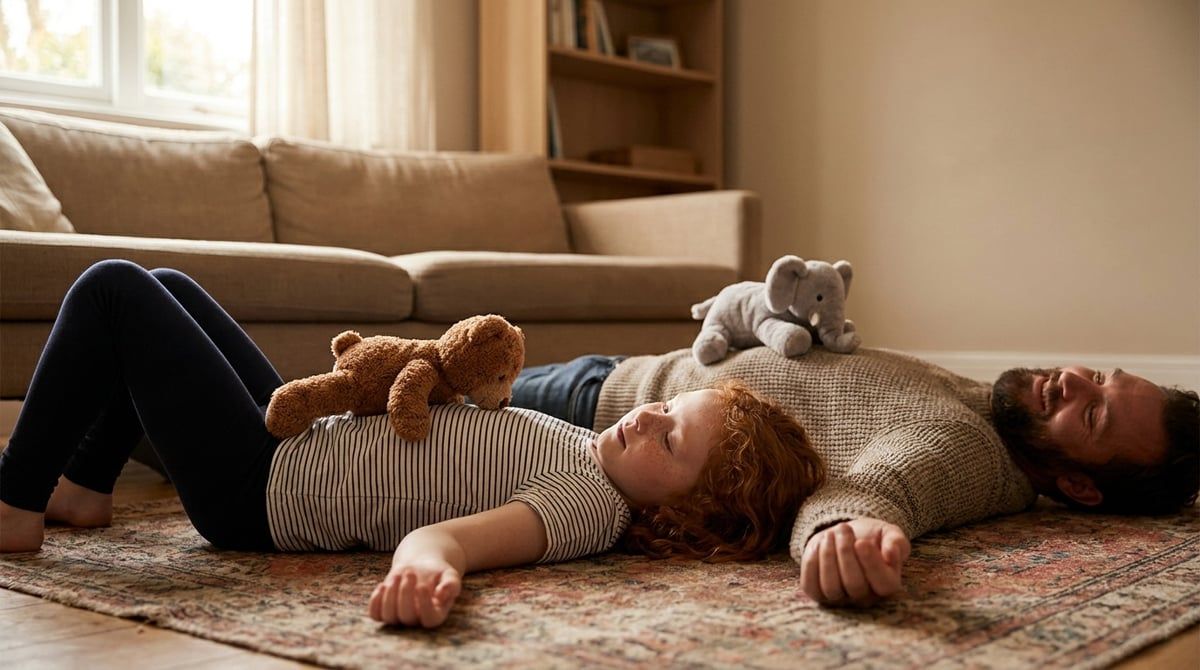
Breathe with something you can see. Lie on the floor together, with a stuffed animal on their tummy rising and falling as they breathe. Or blow slowly on a paper pinwheel. A couple of minutes and that’s it, before they get bored.
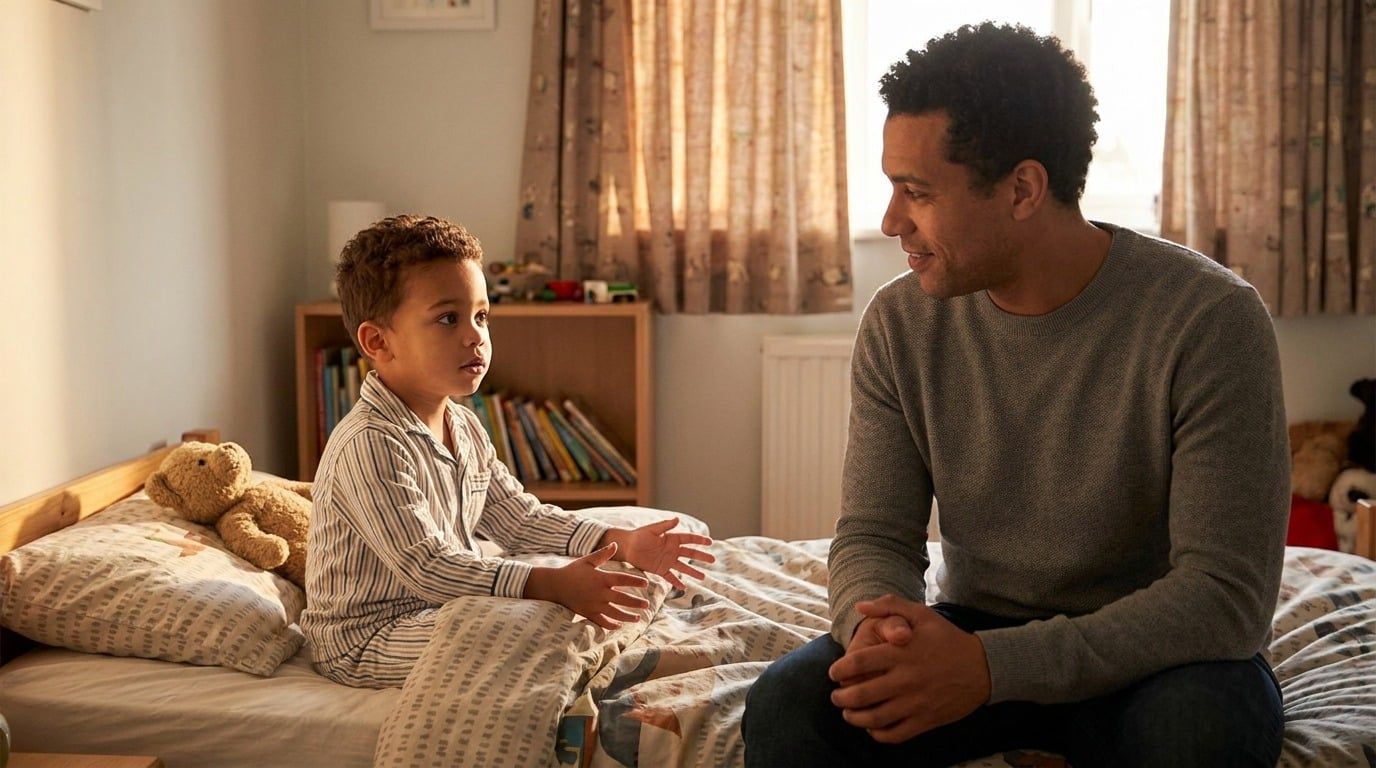
At night, in bed. Many children this age have a hard time winding down before sleep. With the lights low, you can do the stuffed animal breathing again or listen together to the sounds of the house in the dark: a car going by, water running through a pipe. The AAP article, in fact, suggests building breathing into the bedtime routine. It can help bring the day to a close, though it’s not a sleeping pill.
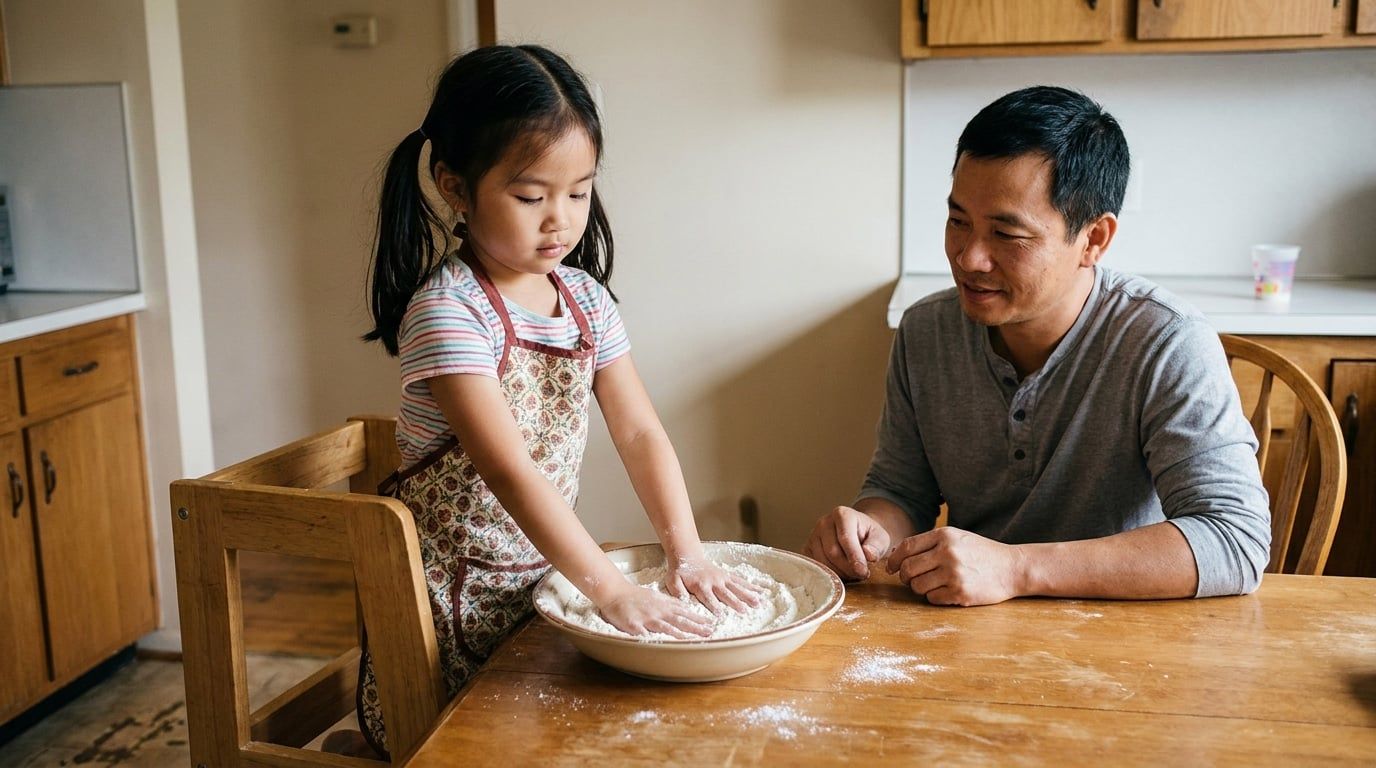
Put words to what the body feels. “Are your hands cold or warm?” “How do your legs feel after running?” Noticing the body and being able to say what you feel are connected; we wrote about the latter in “How a child learns to say what they feel”. If they already complain a lot about tummy aches, it’s better to ask about their hands or feet, so you don’t make them pay even more attention to the pain.
Not in the middle of a tantrum. “Take a deep breath” during a meltdown usually comes too late. What helps more then is having you beside them, as calm as you can be, as we explain in “5 Co-regulation Techniques”. Breathing is something to practice in the good moments.
Don’t make it a punishment or a way to quiet them down. At the end of the day, it’s tempting to say “breathe” to get them to calm down once and for all. If “let’s breathe” ends up meaning “sit still,” it stops being a nice moment.
If they’d rather not, leave it for another day. Some children feel uncomfortable staying still or quiet. You can do it while walking, and you can also just let it go.
When to ask for help
It’s normal for a four-year-old to have trouble calming down at night or sitting still. It’s worth talking to the pediatrician if, for weeks, they have an extremely hard time separating from you, refuse to go to school, start wetting themselves again after they’d stopped, stop talking outside the home, or have fears that keep them from doing what they used to do. The same goes if they can’t concentrate or sit still and it’s causing problems at home and at school: these games aren’t a treatment for that.
Frequent tummy aches or headaches should be seen by the pediatrician first, and without waiting if the pain wakes them up at night or comes with vomiting, fever, or weight loss. And if it turns out to be anxiety, it can be treated at this age, and the work is usually done mainly with the parents.
A story about walking the same path twice
In The Little Mountain Explorer, a story for children ages 4 to 7, the roles are the reverse of the snail scene: here, the little one is the one who isn’t paying attention, and it’s his cousin who teaches him to look. Daniel is a little city dog who goes up to the mountains to visit his cousin Nina. He makes the whole trip with music in his ears, staring at a screen, and misses the waterfall, the animals along the path, and a very old tree. When he arrives, Nina asks him about all of it, and he doesn’t remember a thing.
Nina doesn’t scold him. She suggests he make the trip back a different way, with his phone and music put away and a different kind of map, made of things to feel. On the way back, Daniel walks slowly. This time he really does see the waterfall, stands still watching the animals, and finds a little flower that smells like honey. And only after looking at it does he take out his phone to take a photo of it. In the letter he writes to Nina when he gets home, he tells her: “The mountain was always there, but I wasn't.”
If you enjoy it, the next day you can make your own map: an eye, an ear, a nose, and a hand drawn on a piece of paper. Then head outside to find something for each one.

The Little Mountain Explorer
Adventures on the highest peaks
Daniel is a young puppy who travels from the city to the mountain village where his cousin Nina lives. During the trip there, he's absorbed with headphones and distractions, and completely misses the beauty of the route: waterfalls, animals, ancient trees. When he arrives, Nina realizes that her cousin wasn't really there. Nina proposes a challenge for the return trip: put away the distractions and use a different map, one made of things to find with your senses. Daniel accepts and discovers that the same path, traveled with presence and attention, becomes an amazing adventure. He learns that first you need to BE present, and then, if you want, you can capture the moment.
Read this children's story in the Semillita app