

Your five-year-old daughter comes back from the park convinced that if you swallow gum, it stays stuck in your stomach for seven years. An older kid told her. Last week it was some shoes in a video that make you run faster. And you wonder how to teach her not to believe everything without her ending up believing nothing.
Why they believe everything
At age 3, believing what they're told is to be expected. In one experiment, a researcher told children that age which cup a sticker was under, and she always named the wrong cup. More than half (9 of 16) didn't find the sticker a single time in eight tries, even though, halfway through the game, another adult said to them: “She's really tricky, isn't she?” But when the researcher marked the wrong cup with an arrow instead of saying it, the children quickly learned to look under the other one (Jaswal and colleagues, 2010).
The authors see this as useful rather than as a flaw: almost everything we tell them is true, and checking everything would be impossible. With age, they become less gullible. The goal isn't for them to distrust everything, either. According to one review, children who expect everyone to be honest and children who trust almost no one have a higher risk of adjustment problems and of being left out of the group. What you're aiming for is that they learn when it makes sense to doubt (Mills, 2013).
What they can already do, and under what conditions
They can do some of it, though under specific conditions. In the lab, children aged 3 to 5 can tell good reasons for believing something (having seen it, being told by someone who knows, having worked it out) from bad ones (guessing, pretending, or wanting it to be true), and 3- and 4-year-olds prefer to learn from someone who gave good reasons before (Koenig, 2012). The difference from the sticker experiment is that here they can compare two people. With just one adult who sounds very sure, at 3, what that adult says usually wins.
In another study, an adult hid a toy in front of them and then told them it was somewhere else. The 4- and 5-year-olds looked where they had seen it hidden; most of the 3-year-olds went with what the adult said. The difference from the stickers is that here they had seen it with their own eyes, and it took just one time when that adult got it wrong for the 3-year-olds, too, to start trusting what they had seen (Ma and Ganea, 2010). That was within a single session, not a change for good, but it shows how much experience counts.
Realizing that someone says something because it serves them comes later. In a small study, children of about 8 were more wary of someone who claimed something that benefited that person; the 6-year-olds did the opposite: they believed it more (Mills and Keil, 2005). Something similar happens with ads. At 3 or 4, they already sense that someone wants to sell them something, but understanding how ads try to persuade them comes at around 6 to 8, and even then they don't always apply it when the ad is right in front of them (according to the same review by Mills).
How to help your child think for themselves
Ask “How do they know?” If someone told your child, ask about that person: “And how does Max know? Did he see it, did someone tell him, or is he imagining it?” Judging someone else's reasons is exactly what children between 3 and 5 already do well in studies. If you ask about what your child believes, don't be surprised if they get mixed up: at these ages, it's hard for them to remember whether they saw something or were told about it (Robinson and Whitcombe, 2003). Nobody has measured whether asking this at home makes them think more critically, but it's a simple way to practice.
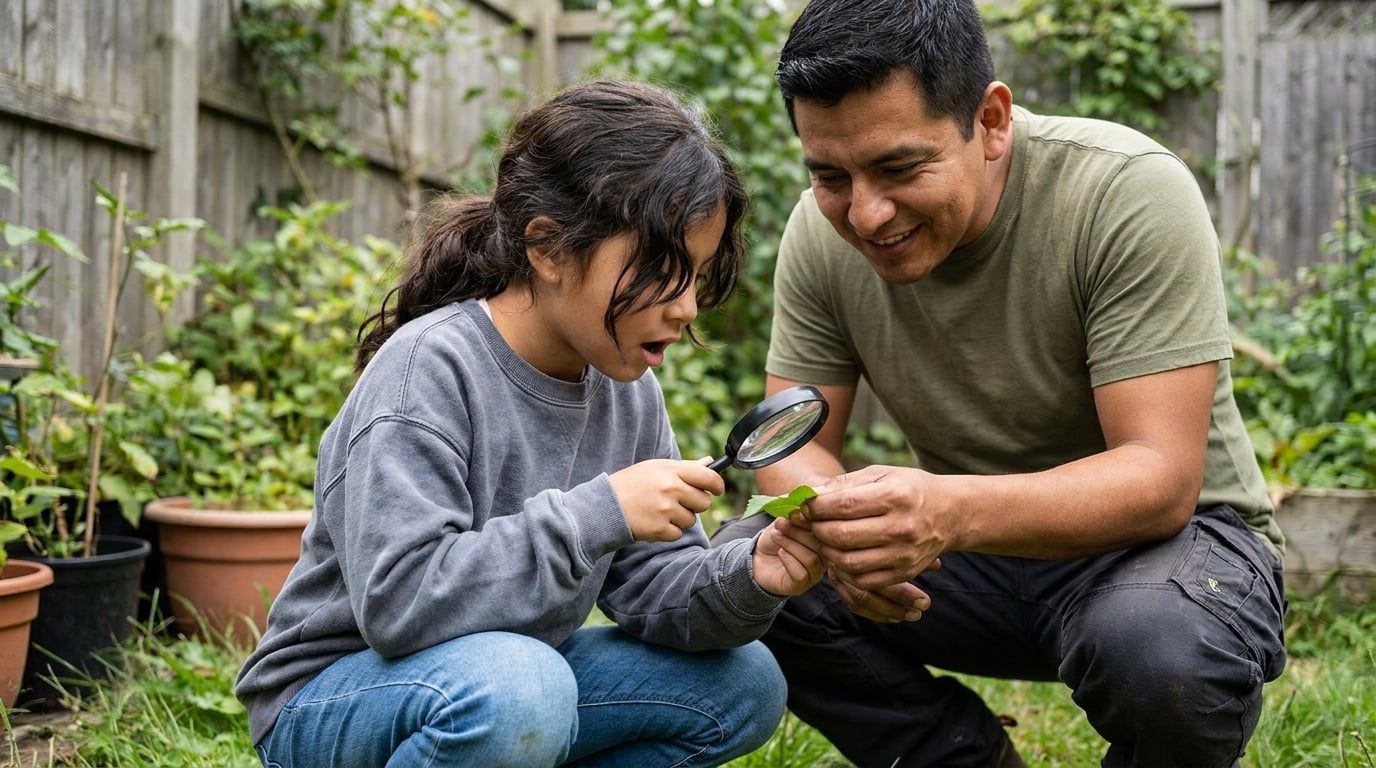
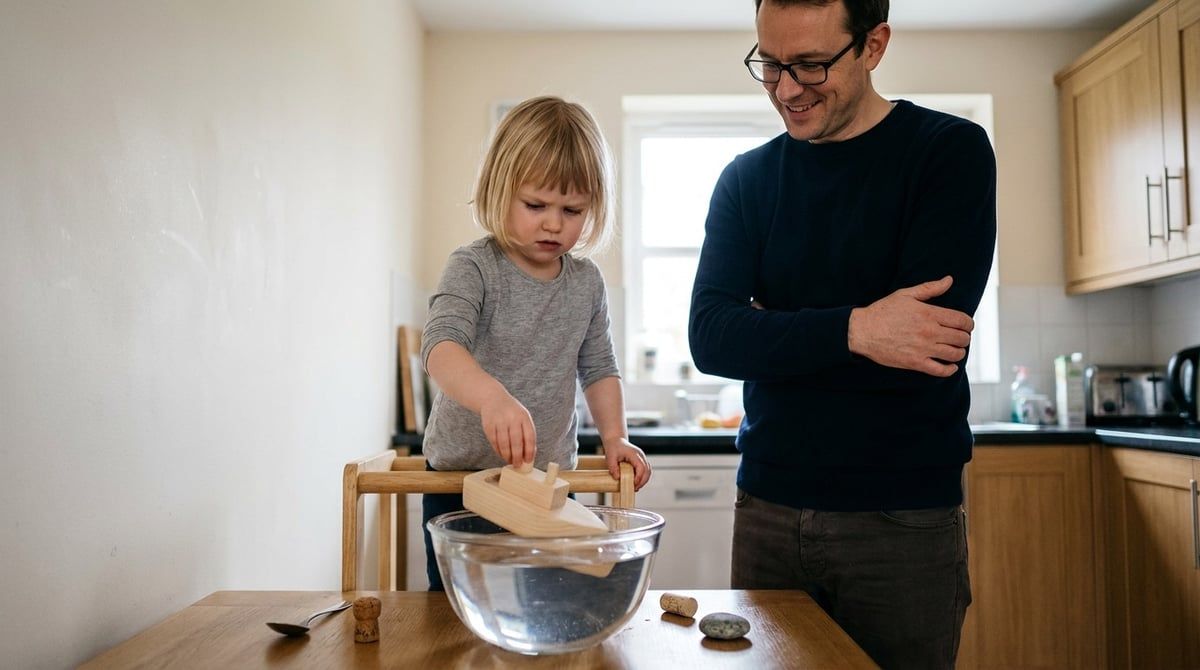
Check it together, or find someone who knows. “Let's take a look” works for lots of things: whether something floats or sinks, whether the plant grows more in the sun. Other things can't be checked that way, like the gum. Then the question is “Who would really know?” At 3 and 4, children already prefer to learn from someone who knows rather than from someone who doesn't (Koenig and Harris, 2005), and looking it up together in a book or asking the pediatrician is practice for exactly that. We talk about learning by trying things out in “My child learns by doing”.
A video is someone telling them. Even if they see it on a screen, they haven't checked it, so the same question works: “And how does that guy know?” Seeing a face is more convincing than hearing a voice: in the same sticker study, 3-year-olds were fooled more often when they saw the researcher on video than when they only heard her. As for whether he's being paid to show the toy, at 5, you're the one who says it out loud (“Maybe someone's paying him to show it”); figuring it out on their own comes later. And even when they're older, according to the American Academy of Pediatrics (AAP), they often recognize an ad and still don't resist it when it comes from someone they follow or sits right next to what they like to watch (Radesky and colleagues, 2020).
With ads, think together about what they're after. The AAP suggests that when children ask for something specific, you think together about what made them want it. It also calls for a ban on advertising aimed at children under 7: defending themselves can't be left to them alone (AAP, on digital advertising aimed at children). Around 7 or 8, when they start to pick up on it themselves, it helps to ask: “Who benefits if you believe it?” Before that, you can start planting the seed, without expecting them to get it.
Answer their whys. In recordings of conversations at home, when children didn't get an explanation, they were more likely to repeat the question or come up with one of their own; when they did get one, they tended to be satisfied (Frazier and colleagues, 2009). They ask in order to understand. A short explanation is enough, and “I don't know, want to look it up?” is a good answer too.
Say when you're not sure. Even at 3, children sometimes learn less from someone who says “I think…” than from someone who says “I know…”, so they notice the difference to some degree. The flip side is that confidence is convincing, and someone who sounds very sure doesn't always know more. Hearing it from you (“I think that's how it is, but I don't know for sure”) gives your child examples of the degrees between knowing something and guessing it.
Don't treat doubt as disrespect. If your child catches you in a mistake or asks why something is the way it is, a “Good question, let's see” tells them that at home, asking is allowed. Using “Why?” to get out of a shower is another matter. Then give the short reason once (“Because you got sweaty at the park”), and the rule stays as it is: asking is fine; negotiating every night isn't.
One limit worth being clear about: telling what they see from what they're told in a game doesn't mean they'll notice when someone is deceiving them on purpose. Spotting a lie, or what someone is after, is hard for them until 6 or 7, and even after that it isn't foolproof. Mills's review warns that overestimating this ability can put them in danger. So when it comes to their safety (who they go with, what they see on a screen), you decide. What you ask of your child is simpler: if something a grown-up tells them doesn't add up, they tell you. Not getting swept along by what everyone else is doing is a different topic, and we cover it in “When everyone else is doing it”.
A little goat who took a closer look
In A Retelling of The Emperor's New Clothes, a story for children aged 6 to 8, two magpies sell the Emperor a cloth that, they say, only really smart people can see. On the day of the parade, the whole square applauds the new cloak. Brita, a little goat, gets up onto the low wall around the fountain and sees the Emperor in his undershirt and underpants.
She doesn't think she's the fool. She thinks maybe she's missing something. So she goes up close, moves her hoof where the cloak should be, and touches nothing. She says it out loud: “But there's nothing there!” A gentleman in the front row very patiently explains that the cloth is so light it's like he isn't wearing anything at all, and everyone agrees with him. Brita doesn't argue. She trusts what she has seen, and also what she sees in the sky: rain clouds are coming. While the magpies sell invisible cloaks for real money (there's your “Who benefits?”), she takes out a real umbrella.
The guide that comes with the story in the app suggests a question for afterward: “What can you do when a grown-up explains something to you very confidently and it still doesn't add up for you?”

A Retelling of The Emperor's New Clothes
Did You See It?
The Emperor of this kingdom is a vain peacock who one fine day sets out on parade in a cloak that doesn't exist. A herald walks ahead announcing that only really smart people can see it, and the whole square applauds colors that nobody is actually seeing. In the crowd is a little goat, Brita, who can't get a spot in the front row, so she climbs up onto the low wall of the fountain and looks. What she sees from up there doesn't match what everyone is saying, so she climbs down to check it out up close. 💡 An interesting fact: this tale is best known from the version the Danish writer Hans Christian Andersen wrote in 1837, but it was already being told five hundred years earlier, in Spanish: it appears in Count Lucanor, the book Don Juan Manuel finished in 1335. What Andersen did add was the idea of having someone small say out loud what the whole square is keeping quiet. Here, that part goes to Brita, who couldn't even find a spot where she could see properly.
Read this children's story in the Semillita app