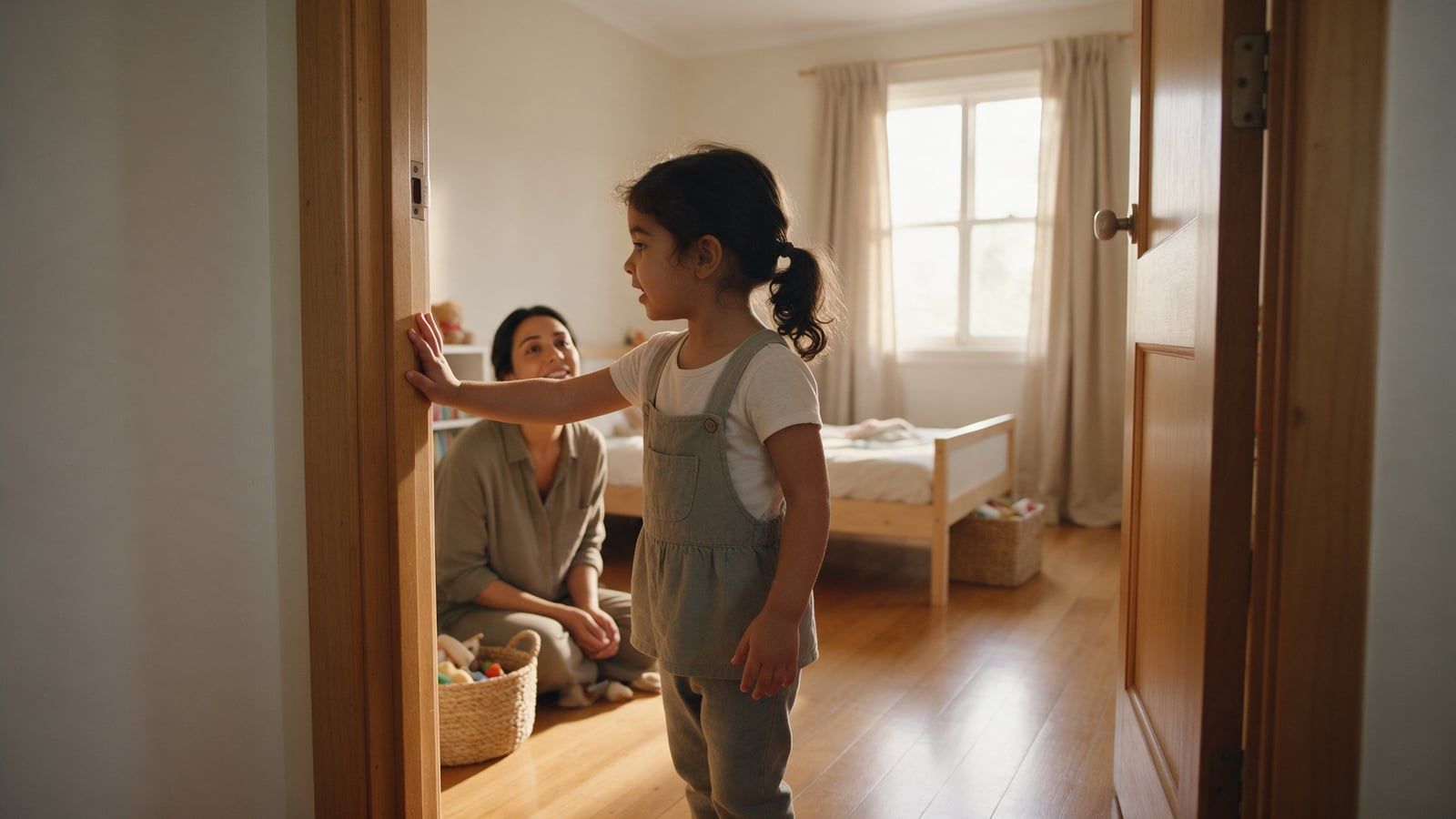


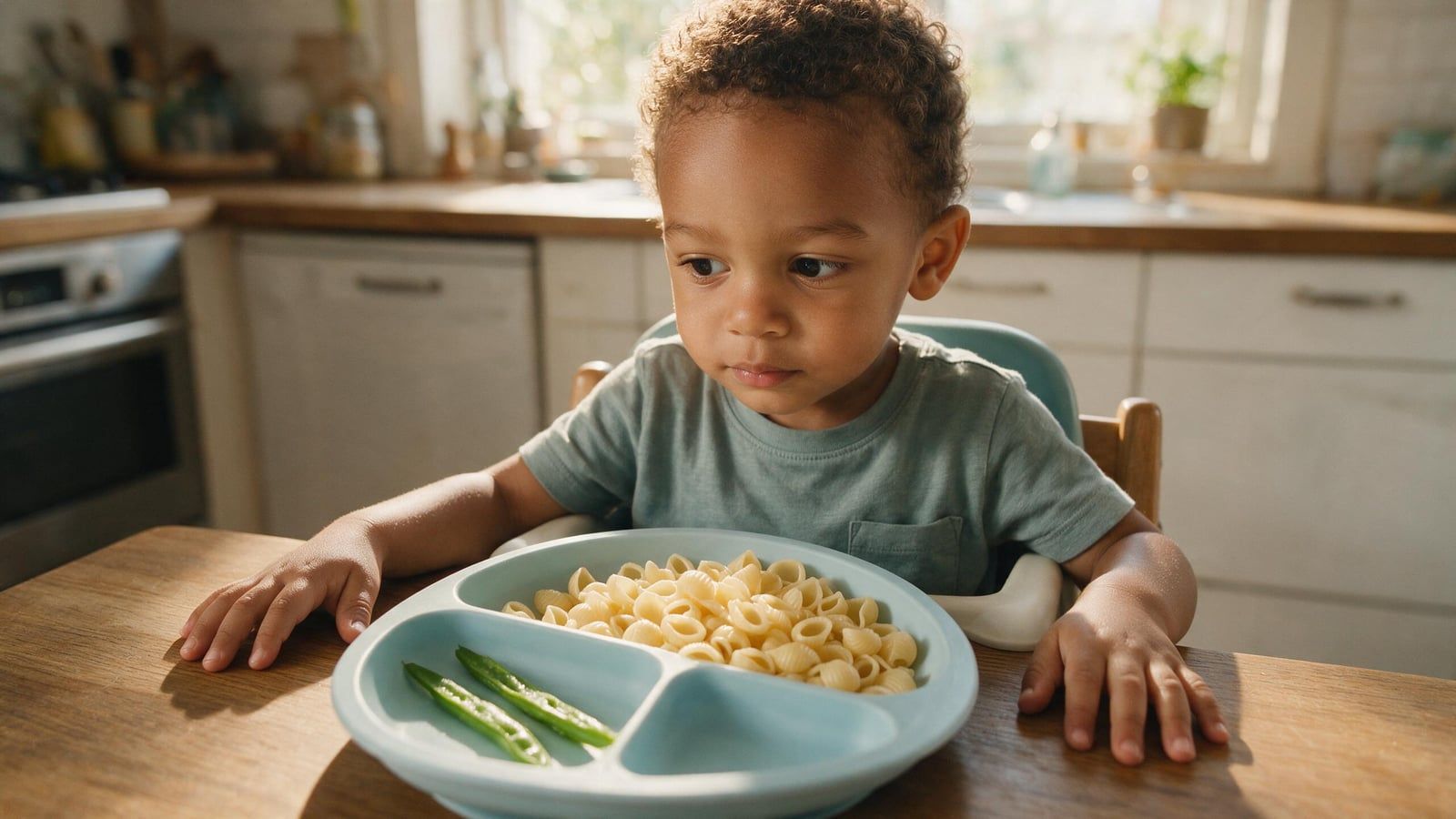
A few months ago your child ate whatever you put down. Now the plate gets pushed away the moment something unfamiliar turns up, and it gets pushed away before it's been touched, sometimes before it's even been smelled. And you end up cooking two dinners: the family's, and the four things they'll actually eat.
And on top of that, someone has told you that if you make them something else, you're spoiling them.
This is mostly about children between two and six, which is when it bites hardest.
It happens to almost every child, and it has a name
It's called food neophobia: the refusal of new foods, the ones your child doesn't recognize. That word is worth pausing on, because it changes the picture quite a bit. Your child hasn't stopped eating: they're still eating, sometimes plenty, from the short list they already trust. What they're turning down is the unknown.
It usually shows up around eighteen months or two years, bites hardest between two and five or six, and eases off after that. It happens to a great many children, and it lands at exactly the age when a child starts moving around the house alone and putting things in their mouth, so it's often read as a caution filter that turns up right when it's needed. It's a reading that fits well; it isn't proven, and for what you have to do tomorrow it changes nothing either way.
On top of the stage there's another layer, which is personality. Some children arrive more open to what's new and some arrive more careful, with food and with everything else, and that was already there before you did anything at all. That's why two siblings raised in the same kitchen can turn out completely different.
Put the two together and you have the answer to the spoiling line: the stage will pass on its own, and the personality isn't something you gave them. What you can do is be alongside them while it lasts, which is what the rest of this article is about. What doesn't work is trying to speed it up by pushing.
Trying isn't the same as eating
This is where the table really relaxes. We assume the goal is getting it swallowed, and that skips everything that comes before.
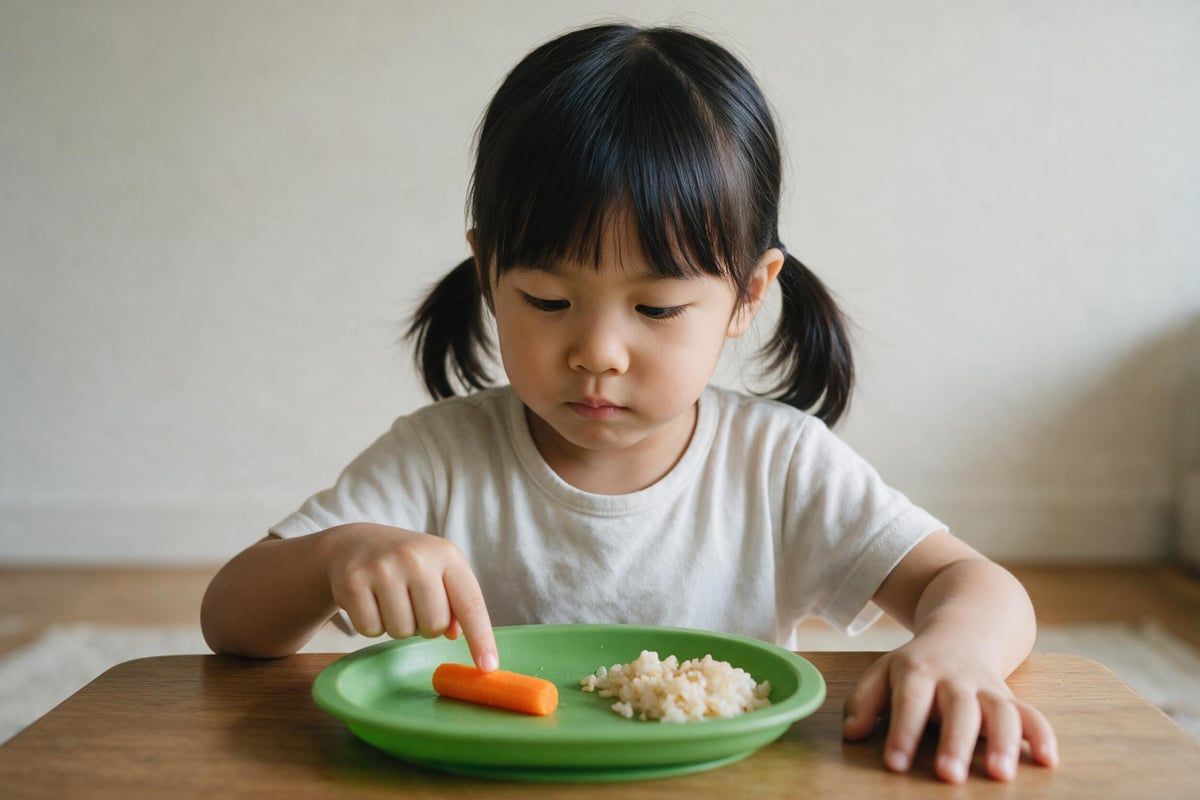
Seeing it on the table a few times. Watching you eat it. Tolerating it on their own plate without pushing it away. Touching it, smelling it, licking it, biting it and spitting it out. All of that is already getting closer. It isn't a ladder you have to climb in order, and children skip rungs and go back down all the time. Watching only for the bite leaves out almost everything that is actually happening, as if we gave a language up for lost because the child isn't saying sentences yet.
What to put on the table tonight
The new thing small, and next to what they do eat. A whole plate of unfamiliar food is a trap; a plate of the usual with one small new thing in a corner isn't. Knowing for certain that there's something they will eat is what frees them up to go near the rest.
Don't announce it and don't watch out of the corner of your eye. No "just try a little", no "see how good it is?", no expectant face. It's simply there, again, the way it was on Tuesday. This is harder than it sounds, because watching is exactly what you'll want to do.
Two dinners, one table. If you cook them something separate, at least let it coincide: their pasta and your lentils out at the same time and in plain sight. What's expensive isn't cooking two things, it's their dinner living at a different hour and in a different room, because then they stop seeing new food in front of them. Cooking separately still works as long as the table is shared.
If they've barely touched dinner, dinner ends anyway. No second plate cooked at half past nine and no negotiating a yogurt, but no drama either. The next meal comes at its usual time, not five minutes later as a consolation prize. You decide what goes on the table and when; how much of it goes in is theirs to decide. And if your child is small, eats very little or you're worried about their weight, that's one of the first things to talk over with your pediatrician before you hold this line.
And be realistic about the leftovers. Offering something many times gets expensive if you throw out a full plate every night. Serve a ridiculous amount: one small piece, half a spoonful. What counts is that it's there in front of them, not how much of it there is, and that way the waste is bearable.
What usually makes it worse
One thing before the list, because it's easy to walk away from this carrying the guilt: almost nobody does these things for the fun of it. They happen because the child isn't eating and you get desperate, so in a lot of homes the pressure is as much a consequence of the problem as a cause of it. That said, these are the ones that dig it in deepest.
Dessert as currency. "Three bites and you get yogurt." It works that night, and over time it tends to reinforce the idea that the green stuff is the toll and the yogurt is the prize. With a caveat: rewarding with something that isn't food, a sticker or a game, for trying with no obligation to swallow, does seem to work for some children. What goes badly is paying for food with food.
Eating to please someone. "One for me, one for Grandma." It stops being about their body and becomes a test of affection.
Pushing after they've already said no. Every fresh attempt raises the tension at the table, and the tension ends up sticking to the food you argued over. It looks a lot like what happens with potty training: rushing from the outside tends to delay exactly the thing you were trying to bring forward.
The whole table weighing in. You can hold your tongue, but if three adults are commenting on what the child eats, the effect is the same. This one gets sorted beforehand, with the adults and not in front of the child, because it's the part that doesn't depend on your technique but on an agreement.
What helps over time
Let them see you eat it. No ceremony, no glancing over for a reaction. It's about the slowest thing there is, and the one that comes up most often in the homes where the list ends up growing.
Take it off the table. Washing, peeling, snapping, carrying the dish over. That's a weekend plan, not a Tuesday at nine, and a food they've handled in the kitchen arrives on the plate less strange than it was.
Let them serve themselves. Even if it's two peas. Serving is a decision of theirs, and what they decide they don't have to defend.
Repeat without keeping score. You'll need to offer it many times, more than anyone would guess: think in weeks, not in attempts. The exact number that gets passed around doesn't mean much, because it changes with every child and every food.
Watch the label. "This one doesn't eat anything", said in front of them, ends up becoming how they describe themselves, and that's hard to shift later.
When to take a closer look
Typical neophobia is dramatic and has a mind of its own, but the child eats enough and grows well. It's worth mentioning to your pediatrician if you see any of these:
- The list of what they accept is getting shorter month by month instead of longer. If you write it out counting generously (every fruit, every pasta shape) and it still comes out very short, tell your pediatrician.
- Whole groups have dropped out: no fruit at all, no meat, fish, egg or beans.
- They aren't gaining weight, they've stopped growing at the rate they were, or you notice tiredness, paleness or ongoing constipation.
- They gag repeatedly with a lot of foods, they choke, or eating hurts.
- The refusal started all at once after one specific choking episode or one specific vomit.
- Food causes real distress, or mealtimes are a daily battle that has changed family life.
- It coincides with language that isn't taking off, with little interest in other children, or with strong sensitivities away from the table.
These things are on the list because some of them really can mean there's something else going on. Making an appointment doesn't mean there is: it means there are things you only see by weighing, measuring and examining, and that isn't something you can do from home.
A story where nobody asks the child to eat
One of our stories is about exactly this. In The Green Crunch, Cloud is eating her usual purée when Mama Rabbit sets a little green stick down beside her that she has never seen before. Cloud pushes it away with a paw and turns her face.
The interesting part is what Mama Rabbit does, which is almost nothing. She doesn't insist, she doesn't explain how healthy it is, and she doesn't ask her to taste it. She picks up the little stick, looks at it as if it were a rare find, and suggests something else: touching it, smelling it, listening to it. The usual purée stays right there beside her, still warm, the whole time.
And one warning, because it's the trap of reading this in a story: five minutes there hold what takes months in a real kitchen. Turning the food into a game works when nothing is riding on it; the day you suggest it hoping they'll end up eating, your child will notice and we're back to negotiating.
It's for two- and three-year-olds. Read it without turning it into a message about dinner.

The Green Crunch
Adventures on the Plate
Cloud is a curious little bunny who loves her usual white mash: soft, warm, familiar. One day a long, thin green stick she has never seen before turns up next to her bowl, and she pushes it away with suspicion. Then Mama Rabbit suggests something other than eating: playing explorers and getting to know that stick with their senses, with no rush and no pressure.
Read this children's story in the Semillita appComing up next: what to do when the tower falls right before the last piece goes on and they sweep the whole thing off the floor.