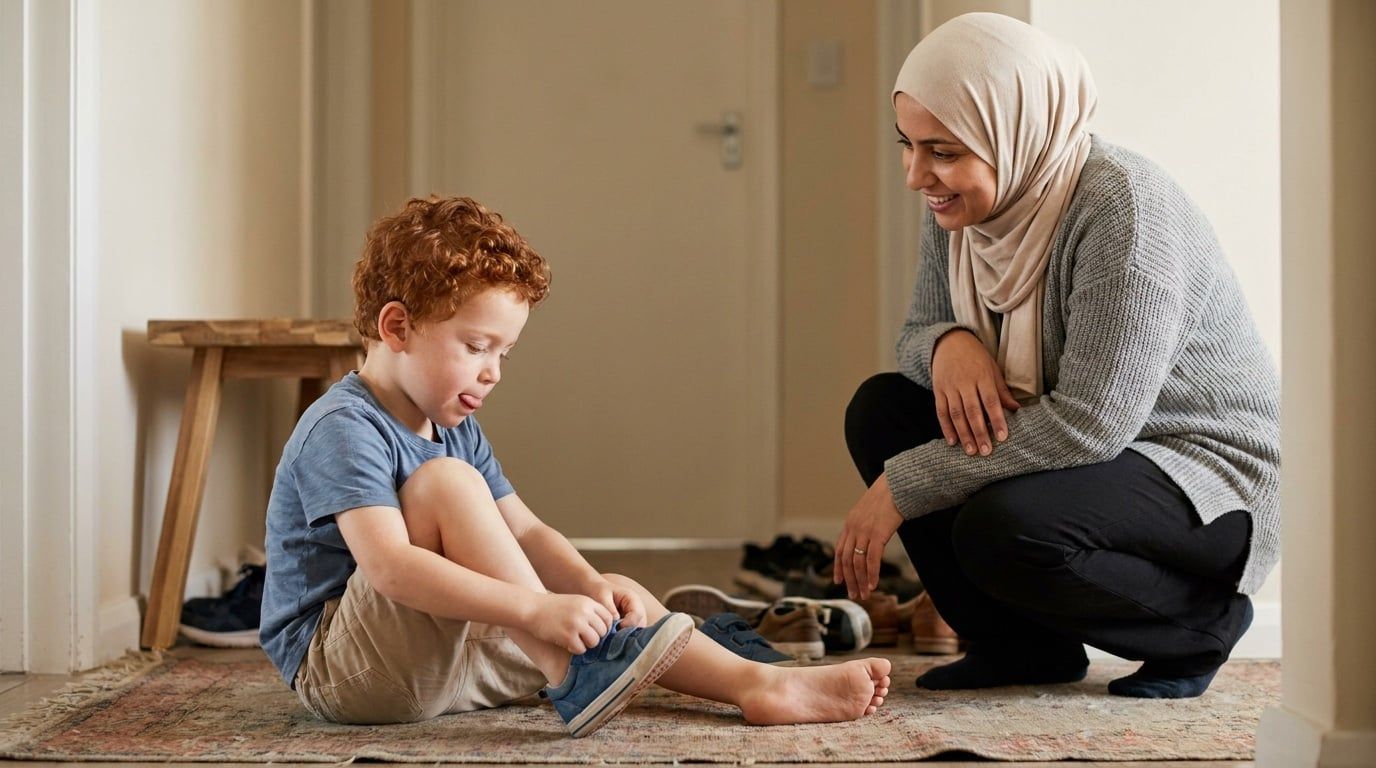


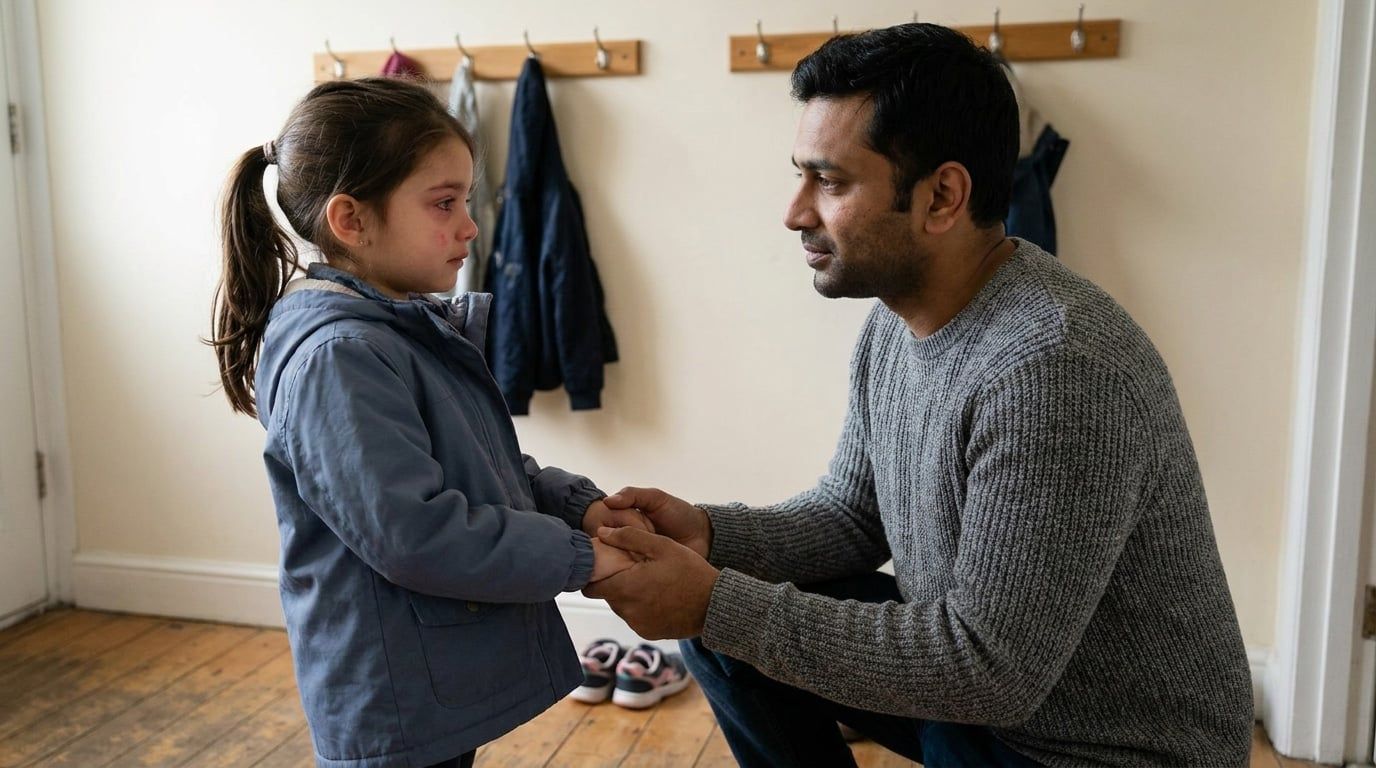
It’s 7:50, the coat is still on the floor, and for the third time you ask your child to put their shoes on. A yell comes out, louder than you meant. They freeze, eyes wide, and then burst into tears. You’re late anyway, and you spend the morning with a knot in your stomach.
Losing your temper now and then is very common. What concerns researchers is yelling as a habit, and what’s in your hands now is what you do afterward.
What to do afterward

The American Academy of Pediatrics (AAP) sums it up like this: calm down, apologize, tell your child how you’ll handle it next time, and follow through (AAP, on discipline). Nobody has studied how parents should apologize to children of these ages, so what follows brings together that recommendation, a study or two with older children, and common sense.
First, calm yourself down. If you notice you’re about to yell again, stop and breathe. If you can, step out of the room for a moment with your child somewhere safe. Never leave a child alone in the bath, so there it’s enough to go quiet, breathe, and lower your voice. An apology said in a voice that’s still tense sounds like another scolding.
Go to them; don’t wait for them to come to you. A young child can’t be expected to know how to approach someone who has just scared them. Get down to their level and start the conversation yourself. It works in the car, at school drop-off, or in bed at night. If they’ve already fallen asleep, don’t wake them: tell them the next day at a calm moment, when you wake them up or at breakfast, not in the middle of the rush to get out the door. “Yesterday at bath time, I yelled at you. That wasn’t okay. I’m sorry.” If your child is little and doesn’t seem to remember or changes the subject, don’t push it.
Say what happened, in simple words. “I yelled at you really loudly and you got scared. That wasn’t okay. I’m sorry.” At age 4, children already understand an apology put into words, although until age 5 they find it hard to read remorse from a face alone (Vaish et al., 2011). For children under 4 there’s no data; the exact words probably matter less than your tone, coming close, and a hug if they want one.
Skip the “but.” “Sorry, but we were running late,” “it was for your own good,” or “you were being impossible” turn the apology into an excuse, or into their fault. You can tell them what was going on for you: “I was stressed about the time and I lost my temper. It’s not your fault.” In a study of 288 teenagers, parents’ apologies that focused on the child were associated with more forgiveness than ones that justified, blamed the child, or downplayed what happened (Robichaud et al., 2025). You don’t need to give a speech: naming what happened and saying you’re sorry is enough, as in the example above.
Don’t ask them to forgive you right away. “Please forgive me, tell me you’re not angry” puts your child in charge of taking care of you. They may stay angry for a while: give them that time, close to you if they want. Studies don’t agree on whether an apology brings relief in the moment: in one with children ages 4 to 7 it did (Smith and Harris, 2012), and in another with 6- and 7-year-olds it didn’t (Drell and Jaswal, 2016). In both, though, the children afterward viewed the person who had apologized more favorably or treated them better. The one apologizing was another child or someone from the experiment, not their parents.
The limit still stands. You’re apologizing for the yelling, not for what you asked. “I’m sorry I yelled at you. You still have to put your shoes on, and I’ll help you.” The AAP stresses sticking to consequences calmly, and in the teen study, apologizing didn’t take away from parents’ authority.
Say what you’ll do differently, and follow through. Something concrete and doable: “When I notice I’m getting really angry, I’m going to stop and breathe before I talk.” If a sibling saw the whole thing, make sure they also know you apologized.
What we know, and what we don’t
With babies, the connection with their parents is out of sync a good part of the time, and normally they find each other again quickly. The researchers who study this put forward, as a hypothesis, that from these repairs babies learn that what breaks can be fixed (Tronick and Beeghly, 2011). In a study of 96 mothers and their children, aged about 3, the pairs got back to working together roughly half the times something went wrong during a lab play task. And the children in the pairs who managed it most during a difficult puzzle were better at regulating their emotions months later (Kemp et al., 2016). There, repairing meant getting back to working together, not apologizing.
The only study on this list that measures yelling followed 976 families with 13-year-olds. The more parents yelled at, insulted, or swore at their teen to correct them (the study measured all three together), the more the teen’s behavior problems and symptoms of depression increased the following year, and warmth at other times didn’t make up for it (Wang and Kenny, 2014). The effects were small, and the relationship went both ways: bad behavior also led to more yelling. The AAP draws on that same study to advise against yelling at or shaming children to correct them.
We haven’t found any studies comparing a one-off yell with yelling every day, or measuring whether apologizing after yelling changes anything. That reconnecting helps is a reasonable idea, consistent with what’s been seen in babies and 3-year-olds, but nobody has measured it with yelling.
If you yell almost every day
If you recognize yourself here, this is the section that matters most: yelling almost every day is exactly the pattern that’s concerning, and apologizing each time doesn’t make up for it. What helps is yelling less, and that starts with noticing when you snap. Often there’s a time of day that keeps repeating, like getting out the door in the morning or bath and dinner in the evening, and you can prepare for it: lay out clothes the night before, start bath time ten minutes earlier, lower the bar for what has to go right at that hour. We talk about how adult hurry fuels tantrums in “The adult’s hurry and the child’s tantrum”, and about what to do in the middle of a meltdown in “5 Co-regulation Techniques”.
If you’re ever afraid of what you might do, in that moment put your child somewhere safe (never in the bath: in their crib or their room), leave the room, and call someone. If you have shaken your child, especially if they’re a baby or under two, contact their doctor as soon as possible, even if they seem fine. Go to the emergency room if they’re sleepier than usual or hard to wake, are vomiting, cry inconsolably or, in a baby, won’t feed. Call emergency services if they have seizures, have trouble breathing, or don’t respond. And if you have shaken your child, often lose control, find yourself calling them names, or feel exhausted or irritable most of the day, get help for yourself too: from your family doctor, your child’s doctor, a psychologist, or family support services in your area.
What doesn’t count as repair
Making up for it instead of talking about it. An afternoon of treats, or a yes to what used to be a no, covers up the bad moment and mixes the apology up with the limit. Helping fix what got damaged, once you’ve acknowledged it, is something else, as the grandpa does in the story we tell below.
Beating yourself up for days. The AAP puts it clearly: if you didn’t handle a situation well, try not to worry too much, think about what you’d do differently, and try it next time.
An elephant with eight legs
In Eight Legs for an Elephant, a story for children ages 4 to 6, Astrid draws an elephant with eight legs and leaves it with her grandpa for a moment. He sees too many legs and erases four without asking her. When she comes back and sees the drawing, she bursts into tears: “The elephant was dancing!”
There’s no yelling in the story: the rupture is quieter, the kind that comes from correcting without listening. But Grandpa repairs it the way we’ve described. He goes to find her himself, tells her he changed her drawing without asking and that he didn’t listen to her, and says he’s sorry without justifying himself or asking her to stop crying. He leaves her the watercolors that were her mother’s and steps out of the room. That same afternoon, just as he’s about to tell her how to get rid of the extra water on the brush, he stops in the doorway and says nothing.
It can be a good story to read together at night after a rough day, once you’ve apologized yourself, not instead of doing it. If what happened at home comes up, good; if not, the conversation can stay with Astrid and her grandpa. The guide that comes with it in the app suggests a question for afterward: “How could he be there for Astrid while she still feels hurt?”

Eight Legs for an Elephant
Five-year-old Astrid wants to show her grandpa a drawing. He thinks something needs fixing and changes it without asking her. An afternoon together becomes a story about the hurt of not being heard and caring for a relationship after causing harm.
Read this children's story in the Semillita app