

I first shared this reflection with my newsletter subscribers on 14 May 2026. If you'd like to receive them before anyone else, subscribe here.
Until he was two and a half, my little boy never slept more than two or three hours at a stretch. And I don't mean a rough patch. I mean two and a half years.
When he woke, he wanted contact: he had to be walked around in arms. If I tried to sit down, he cried. And if he cried for a long time, he sometimes ended up throwing up on himself. Once he weaned, getting him to sleep was my job, and in the end nobody in the house slept — except his big brother, who sleeps like a log. I ended up with my own sleep cycle in pieces. There came a point when I simply couldn't take any more.
I'm telling you this because today he's three and a half and he's been sleeping through the night for a couple of months. If anyone is reading me from where I once was: there's a way out. Probably not the one you picture, but there is one.
A ritual isn't designed: it settles out
Along the way I learned something I didn't expect: the sleep routine that really works is almost never the one you pick in the cold light of day, but the one that survives the bad nights, your own exhaustion and the months when nothing seems to help. What's left after all that is your real routine.
And underneath any routine there's a mechanism that isn't the one we usually imagine. A child doesn't fall asleep just because they're tired: the tiredness is there, but if their body is still on alert it won't let go. What gives them permission to let go is repetition, the signal that the day is over. When the same gestures happen in the same order every night, the body recognises the sequence and starts to loosen even before reaching the bed.
For a small nervous system, the predictable is the safe. And only from safety does a child drop their guard and let themselves fall into sleep.
How we sleep at home, no frills
What was left of the whole ordeal is a not-very-photogenic routine. You won't see it recommended in any manual. But it works for us, and now we all sleep. It goes more or less like this, and not always in this order:
- Early dinner. If dinner runs late, the night falls apart. It's the one non-negotiable.
- Go to the room. He plays for a while on the rug, almost always on his own, while I'm nearby without making much noise.
- Tidy up before lights out. I tell him it's time, let him put things away himself, and sometimes lend a hand. It's our signal that the day is ending.
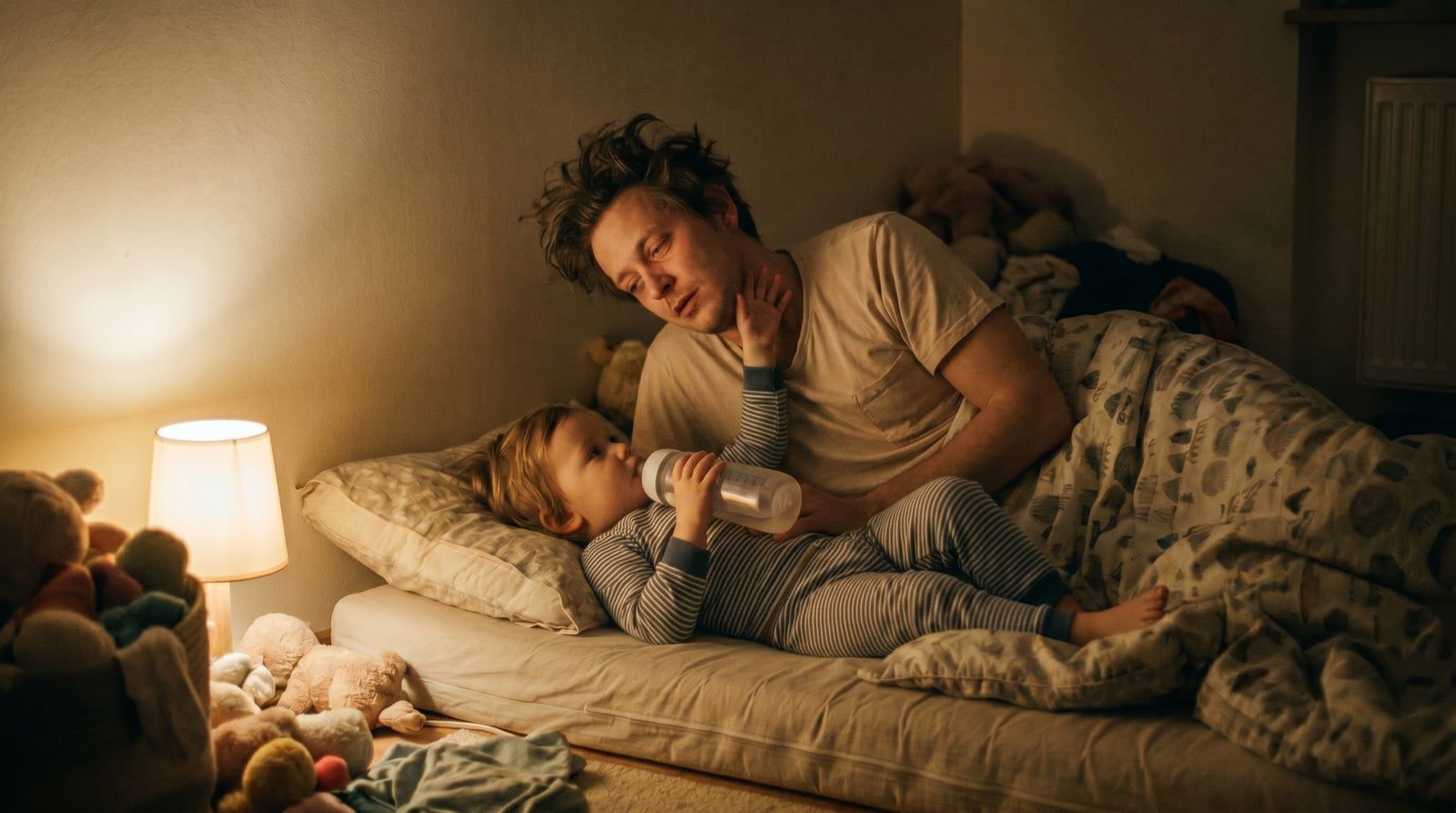
- Bottle in bed and my neck within reach. He falls asleep pinching it. Yes, still on a bottle at three and a half.
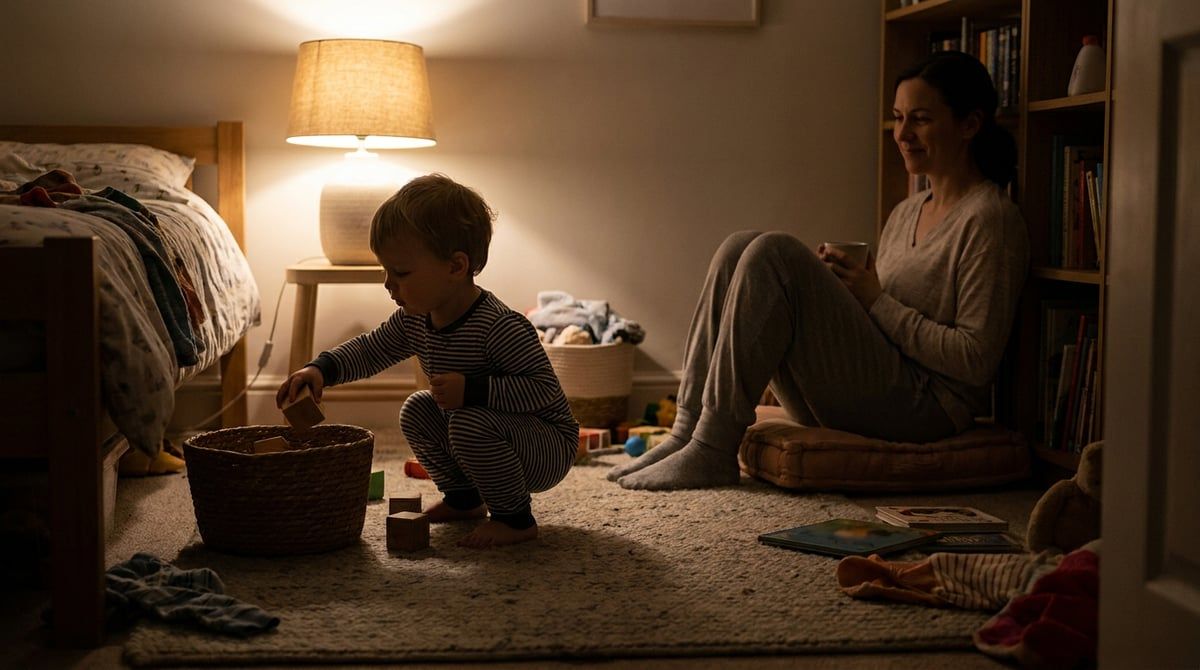
About that last one I'll be honest, because it's easy to feel judged here: the bottle at this age isn't what's recommended, and I know it. But real parenting solves things in order of urgency, not in the order of the manual. Sleep was the battle; that other one can wait its turn. I tell the whole routine, imperfect part included, precisely so as not to add to the collection of idealised routines that do so much harm when you're in the middle of the storm.
Every routine is somebody's routine
I'm telling you mine precisely so you won't copy it. Yours will have other pieces: a stuffed toy, a song, a rocking chair, a hand on the back. It doesn't matter which. What matters is that it repeats, and that you're calm while it happens.
That last part weighs more than it seems. It doesn't matter whether you're their mother, their father, their grandmother or their grandfather: to fall asleep, it isn't enough for the child that you're present. They also need you to be calm, because their nervous system tunes itself to yours. The nights I walked into his room at the end of my rope were, as it happens, the worst. It was no coincidence.
And one more thing, in case it's any comfort: a child needing contact to fall asleep is not a flaw to be corrected in a hurry. In much of the world sleeping close, in contact, is the norm and nobody experiences it as a problem. Your child asking for it doesn't mean there's something left to fix. It means, almost always, that they're little.
When he asks for a story
Sometimes, bottle already in hand and the light off, he asks for a story. Not always; it isn't a fixed part of the ritual either. When he asks, we read it together with the little lamp on. There's one that seems made for that exact moment: The Star Fairy. Its subtitle says it better than I can: "The magic of being together". It's about exactly that: a fairy who loses her wand and discovers that the stars light up all the same, because what really mattered was the time spent all together each night. Which is, more or less, what it took me two and a half years to understand.

The Star Fairy
The Magic of Being Together
Starla is a young fairy who gathers the forest animals each night to tell them a bedtime story. When she loses her magic wand and cannot light the stars, she discovers that the true magic was never in an object, but in the ritual of being together each night, in her words, and in the love she shares with her community.
Read this children's story in the Semillita appIf you want to go deeper into the why of all this, I tell it more calmly in why what you do matters more than what you use and in what to do when the ritual breaks.
A hug, and lots of courage if tonight is one of the hard ones.
— Adrián, from Semillita