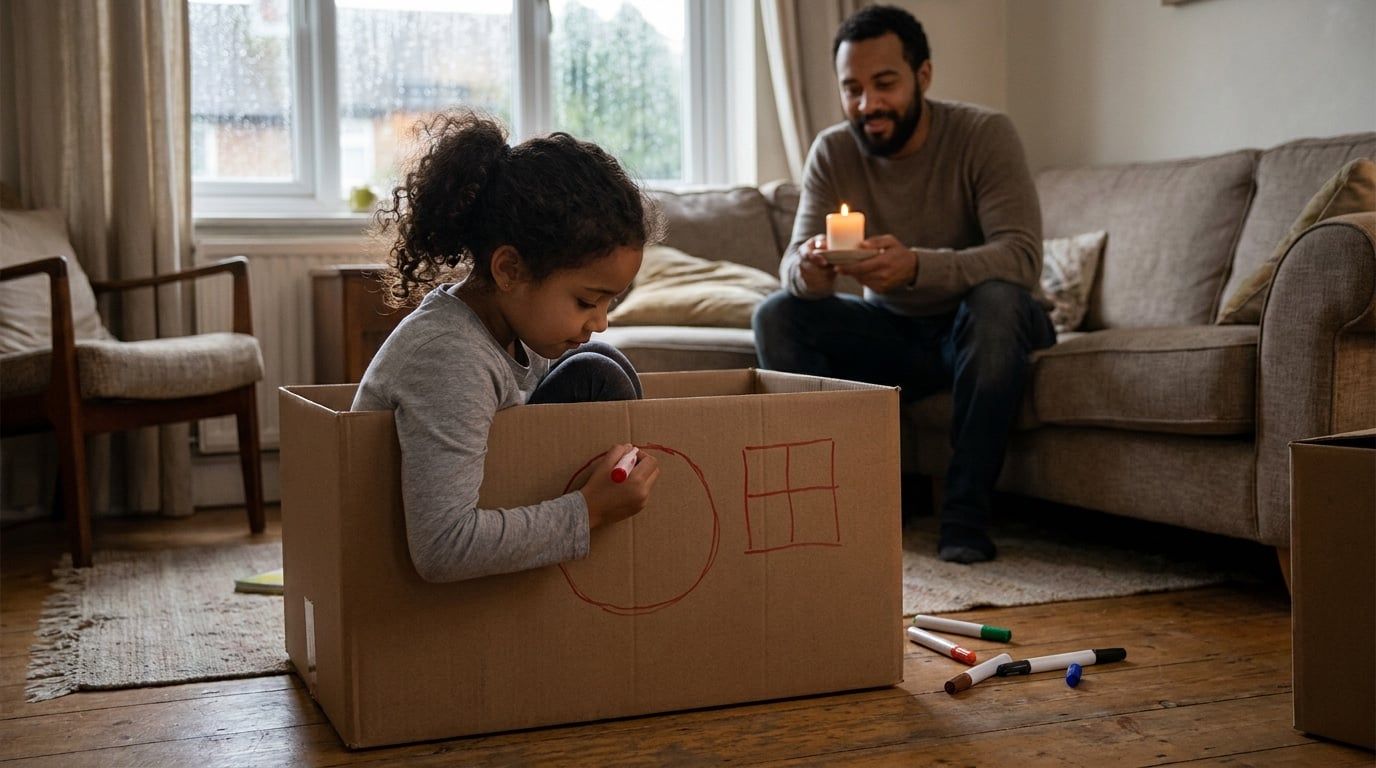



It’s seven in the evening. In the space of a minute, your four-year-old son has climbed onto the sofa, jumped off, run around the table three times, and asked you why fish don’t drown. You ask him to sit down for dinner and he lasts thirty seconds in his chair. And you wonder whether this is normal or whether you should be worried.
What’s normal
Moving a lot is, in large part, temperament. The American Academy of Pediatrics (AAP) counts activity level among the traits children are born with. It has a good side: these are energetic children who explore and stay active even when something bores them. And it has a hard side: they’re restless, sometimes impulsive, and easily distracted. For these children, the AAP advises a safe environment and time to burn off energy. It also points out that understanding that, to some extent, this isn’t something the child chooses helps you be more patient (AAP, on temperament).
In the preschool years, the AAP describes it as normal for a child to run in circles, not stop to rest, bump into things or people, and ask questions nonstop. And it separates that from what’s worth looking into: often bumping into things or knocking them over while playing, getting hurt frequently, not wanting to sit down even for a story, or jumping and climbing on the furniture and not sitting down even to eat (AAP, on hyperactivity). One afternoon like that is normal at age four. If it’s the usual pattern, even if it’s only at home or only at school, or if your child gets hurt often, bring it up with the pediatrician. Further down, we explain what the pediatrician looks at.
Also look at how much they sleep: the World Health Organization (WHO) recommends between 10 and 13 hours at ages 3 and 4, naps included. And the AAP points out that a child may be more restless because of a stressful stretch at home or at school, because they’re bored, or because they’re going through a hard phase, and that this, on its own, doesn’t mean they have attention-deficit/hyperactivity disorder (ADHD) (AAP, on ADHD).
How much they need to move
The AAP gives an easy rule of thumb for children aged 3 to 5: about 15 minutes of movement for every hour they’re awake. For children aged 1 to 4, the WHO recommends at least 180 minutes a day, spread throughout the day and at any intensity. From age 3, at least 60 of those minutes should be moderate or vigorous activity, the kind that makes them breathe faster. And they shouldn’t spend more than an hour at a time strapped into a stroller or a seat (WHO, on physical activity for children under 5).
Almost everything counts toward those 180 minutes: walking to school, recess, climbing the stairs, time at the park. From age 5 on, the WHO recommends an average of 60 minutes a day of moderate or vigorous activity (Bull and colleagues, 2020).
Moving before asking them to sit still
At a preschool with 118 children aged 3 and 4, on days when the class had a 10-minute movement break, the children paid more attention to their task afterward than on days with no break (Webster and colleagues, 2015). It was a single school, over four days, with no separate control group. In elementary school, the results point the same way, though it isn’t known whether what helps is moving or simply stopping, and the effect seems to be short-lived.
What does add up over time is moving every day. A meta-analysis of children aged 2 to 6 didn’t find that a single exercise session improved their performance on attention or memory tests; what improved it was moving regularly over a period of weeks (Song and colleagues, 2023). So a race before dinner is cheap to try, though it doesn’t guarantee a calm dinner. What has better support is moving every day.
Ideas for home
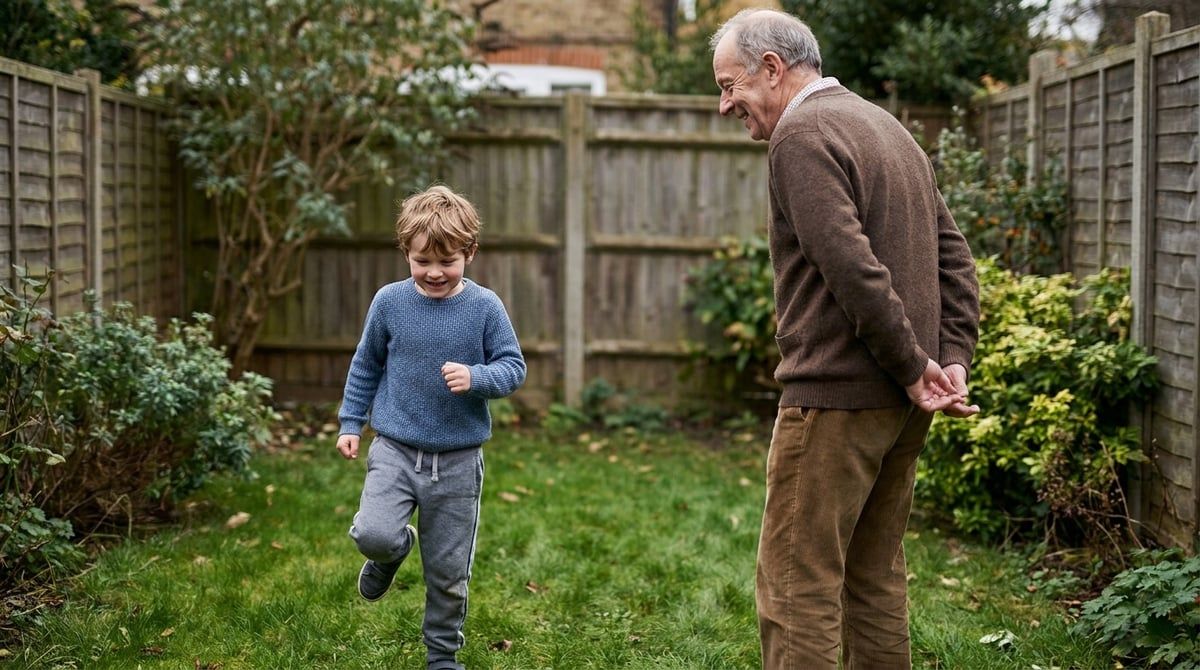
Let them move every day, ideally before you ask them to be still. Ten minutes of something that gets them running or jumping before dinner or homework won’t work miracles, but it costs little. Before bed, something calm is better.
It works in a small apartment, too. Walk like a bear on all fours, hop like a frog on a rug or on a mattress on the floor, dance barefoot to two songs, or set up a pillow obstacle course down the hallway. If the downstairs neighbor complains, crawling and balance games make less noise than jumping.
Stop-and-go games. The traffic light game (on green you run, on yellow you go slowly, on red you freeze), “Simon Says,” or walking on your heels instead of on tiptoe. In a review of trials, the games that make children think while they move came out best, although these were school programs that ran for several weeks, and the studies were low quality.
Adjust what you ask of them. For a 3-year-old, a long dinner feels endless. Short stretches with a heads-up (“When you finish your soup, you can get up”) work better than a long stay at the table full of battles.
Don’t take away their time to move as a punishment. The AAP asks that recess not be taken away as a punishment, and at home it makes sense to do the same with time at the park.
Notice what their energy gives them. They’re eager for everything and they explore the world around them. If, on top of that, their week has no gaps left for free play, in “Is your child doing too many activities?” we talk about how to review it.
When to bring it up with the pediatrician
According to the AAP, almost all preschool children sometimes show restlessness, impulsivity, or inattention as part of normal development, and that on its own doesn’t mean they have ADHD. The difference is that in children with ADHD, these behaviors don’t gradually ease with age the way they do in other children, and they make life harder for them (AAP, on early warning signs of ADHD).
To assess ADHD, the pediatrician looks at whether it happens in more than one setting, whether it has lasted more than six months, whether it’s clearly more than in other children the same age, and whether it causes real problems. All of that doesn’t have to be true for you to make an appointment: if something worries you, bring it up. Seeing the pediatrician is just asking. The pediatrician can also help you tell an intense temperament apart from other problems. Before age 4, it’s difficult to diagnose ADHD, because children change very quickly at those ages, but that doesn’t stop you from asking sooner.
If the school has already told you your child is “very active,” ask what exactly they see: whether your child gets hurt, how things go with other kids, whether they can keep up with the activities. And keep their age within the class in mind. In a study of more than 400,000 children in the United States, the youngest in their grade were diagnosed with ADHD 34% more often than the oldest (about 2 more children for every 1,000), and the authors caution that they can’t know whether those diagnoses were correct (Layton and colleagues, 2018). If your child is one of the youngest in their class, tell the pediatrician: a child almost a year younger than their classmates can seem “too active” for that reason alone.
A hare who couldn’t keep still
In Another Tale of “The Hare and the Tortoise”, a story for children aged 4 to 6, Vinca, a hare, races onto the beach and piles up dry sand, running up and down without stopping. She tries to make a castle, but the dry sand won’t hold any shape, so she shrugs and keeps on running. Serena, a tortoise, slowly builds a small, perfect castle by the water, until a wave washes it away.
Then Serena looks at Vinca’s mountain: “Your mountain reaches where the water can’t.” Vinca runs buckets of wet sand up to the top, Serena shapes them, and the castle ends up high above the water, safe.
The guide that comes with the story in the app suggests a question for afterward: “Is there something you do very fast, and something you like to do slowly, taking all the time you want, with no one rushing you?”

Another Tale of “The Hare and the Tortoise”
Each in Her Own Way
Vinca is a hare who loves to run, and Serena is a patient tortoise who works slowly and with great care. One afternoon at the beach, each builds in her own way: Vinca races back and forth and heaps up a towering mountain of dry sand, far from the water, while Serena molds a beautiful castle from damp sand, right by the shore. But dry sand won’t hold a shape, and the waves reach all the way to the shore: each one runs into a problem her own way of doing things hadn’t foreseen.
Read this children's story in the Semillita app