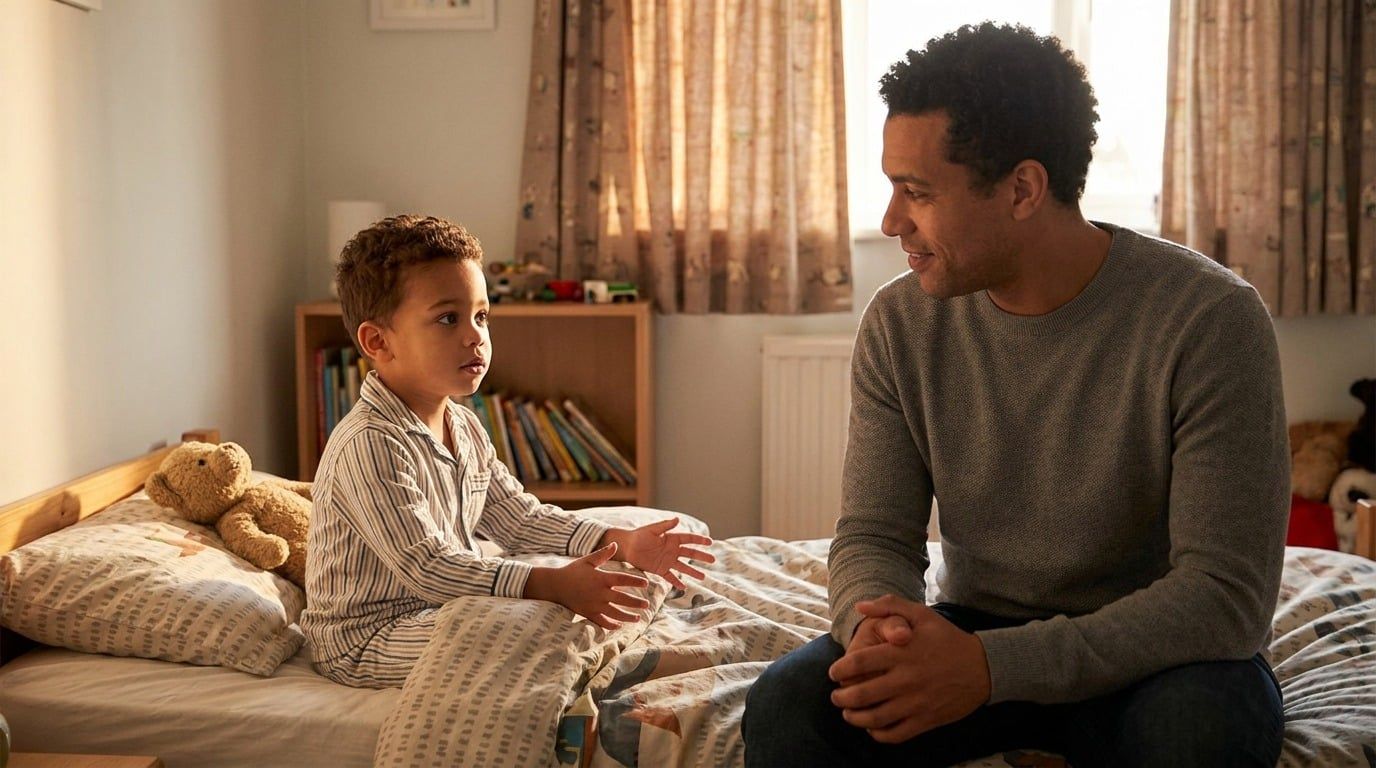


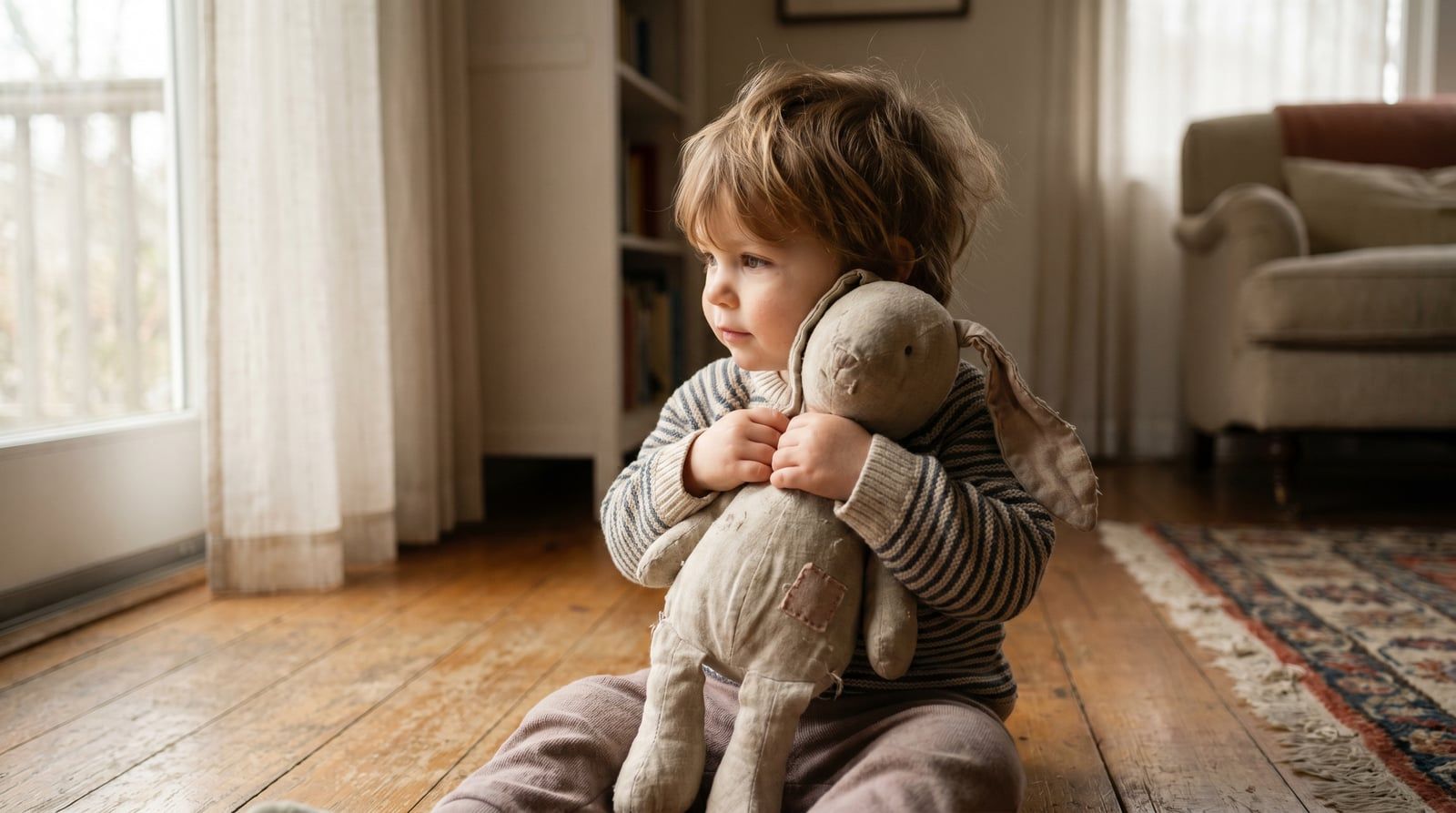
It goes everywhere with them. It's coming apart at one corner, an ear has been missing for months, the fabric has lost its color in the most-gripped spots. You try to wash it and the hours it's drying are unbearable. You leave it at home by mistake and the whole morning falls apart. To adults it usually looks like just an object. To them, it isn't.
In the previous article we talked about separation anxiety at daycare and mentioned something many families use without thinking much about it: a bridge object. The technical term is "transitional object", coined by the British pediatrician and psychoanalyst Donald Winnicott in the early 1950s, observing exactly that: the teddy, the blanket, mom's bracelet that goes everywhere.
What they are
A transitional object is something —it doesn't really matter what— that the child chooses (we don't choose it for them) and begins to use to hold the bond when the person they're attached to isn't in sight. It's not exactly a toy: with a toy they play for a while and then leave it. This gets carried. It tends to appear between six months and two years, and often stays until three or four.
It's worth dispelling two ideas early on that circulate a lot in parenting forums. The first is that the fetish-teddy is a sign of a poorly built attachment or of insecurity: the available research doesn't support that reading. The second, opposite and also too sharp, is that it would be a feature of secure attachment: studies find transitional objects in both secure and less secure bonds, and the presence or absence of the teddy doesn't work well as an indicator of the quality of the relationship. It's more useful to see it as a tool that some children use and others simply don't need.
And before going on, one thing worth mentioning because it's sometimes taken for granted: transitional objects are far more frequent in cultures with separate cribs and individual sleep routines than in cultures with extended co-sleeping and continuous-proximity parenting. In parts of Asia, Latin America or Africa with those patterns, observed rates are markedly lower. If your daughter or son doesn't get attached to one, it doesn't mean something is missing: it means, almost always, that they don't need it.
Why they work
At this age, between "you're here with me" and "you're not" there isn't yet a clear cognitive bridge. Holding mentally, for ten minutes, that mom or dad will come back, requires a representational capacity that is being built just now. In the meantime, something else needs to help hold that function. Something concrete, that can be touched, smelled and squeezed.
That's why the objects that work best tend to have a recognizable texture and smell. "Mom comes back after lunch" is a correct explanation, but at that age the weight of the teddy on their arm does more than the sentence. Smell, additionally, has direct connections to the limbic system that help explain why a piece of clothing with mom's or dad's smell calms so quickly, though the fine neuroscience of this is less clean than what you usually read online.
Which ones work, which ones work less
At this age almost anything can end up turned into a transitional object if the presence of a loved adult has charged it with meaning. But some formats work more smoothly than others:
- Stuffed animals. The classics, and for a reason. They combine soft texture, a recognisable shape, the possibility of carrying them, hugging them or putting them in different positions. It helps if they have a name from early on.
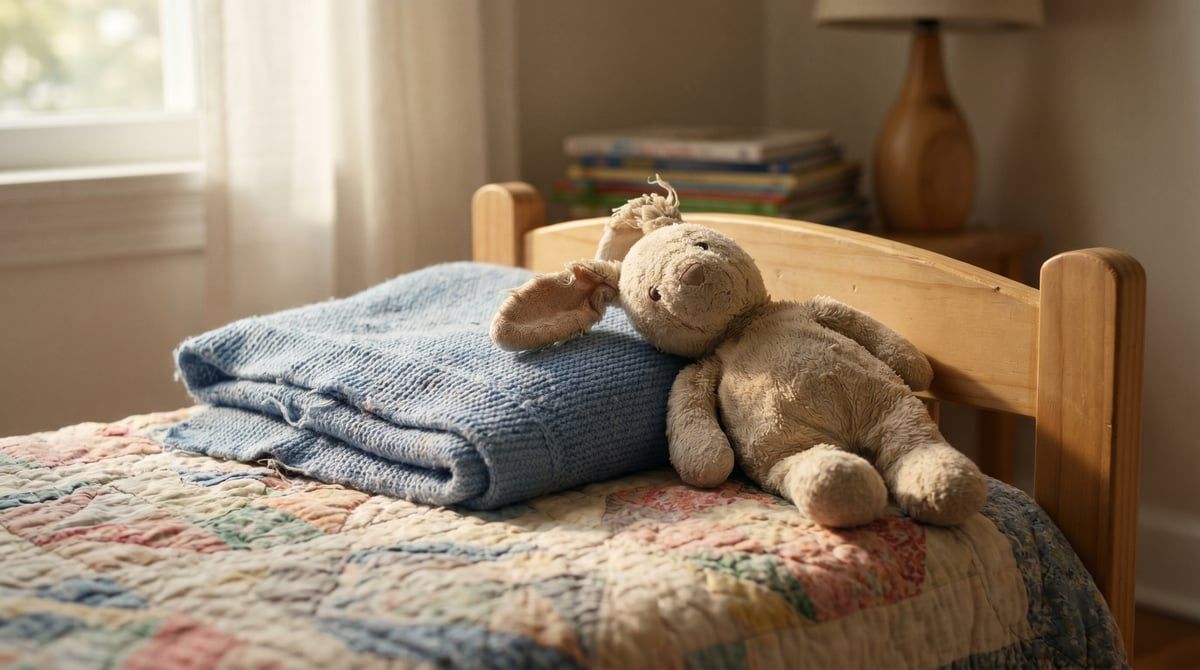
- Blankets, cloths, "tags". For many children the material matters more than the shape: a fine cotton blanket, a piece of fabric from the crib, the sewn-on tags of a specific stuffed animal. The texture is the anchor.
- A piece of clothing with a parent's smell. A slept-in T-shirt, a scarf, a worn sweater. They tend to work especially well for the start of daycare and for hard nights.
- A shared bracelet or string. A bracelet that mom wears identically during the day, or a small string the two of them knot together in the morning. Small, portable, low-key for daycare.
- The pacifier. It serves many of the functions of a transitional object, especially for falling asleep. It's a special case because of its effects on the mouth and teeth from two or three years onwards: if it's in all day, it's worth reviewing with the pediatrician or pediatric dentist.
The ones that work less well tend to be the ones that are too big, too fragile or loaded with electronics. A stuffed animal that doesn't fit in the backpack ends up always staying home and loses its function. An object with lights and sounds saturates instead of calming. A book or a tablet isn't a transitional object; it's entertainment.
What the ones that work well have in common
Three traits almost always present:
- The child chooses it, not us. We can put candidates within reach, but they make the choice. If we push one they didn't choose, in general it doesn't end up carrying the function.
- It's accessible and portable. It fits in a backpack, survives a trip to the park, can be held with one hand while the other does something else.
- It's theirs. It doesn't get taken to give to a cousin who's visiting, it doesn't get replaced "with a nicer new one". Undisputed ownership is part of what turns it into that.
And there's a fourth trait that only shows over time: it stands up to wear. A stuffed animal visibly worn out is doing its job, and when we try to replace it with an identical new one, the child often rejects it for good reason. It's not the same one.
Washing it, losing it, duplicating it: the frequent questions
Three situations that come up in almost every home:
How do you wash it without a drama? With the right frequency, no more. Take advantage of moments when you know they won't look for it (while they're out with the grandparents, for example). Cold or hand wash if the fabric is fragile. Quick drying, and return it when they come back without making a ceremony. If they ask, tell the simple truth: "it was dirty, I washed it, here it is".
Is it worth having a "double" in case it gets lost? Yes, if you can. Buy it early (before the first is already very different) and rotate it occasionally so they age in parallel. Having two doesn't mean fooling the child: most children can perfectly tell "the more used one", but they accept both as theirs if they've grown up together. Not an absolute guarantee, but it saves many crises.
And if we lose it without a double? It happens. The initial reaction can be strong, especially if the object was central for sleep. What helps: not minimizing the loss ("don't worry, I'll buy you another" doesn't work in that moment), allowing the grief, and offering a new bridge object —not as a substitute for the old one, but as something different that can accompany while the loss is processed. Often, weeks later, the new one has charged itself with its own history.
When the object stops helping and starts getting in the way
Most relationships with transitional objects are healthy and resolve themselves with time. But there are signals worth not normalizing, especially from four or five years old. Some overlap with recognized criteria for separation anxiety; others are clinical common sense:
- Dependence is increasing rather than decreasing. At four, they need the object in moments when at two they didn't (eating, playing with other children, talking to a familiar adult).
- It regularly interferes with daily life: they don't eat unless they have it in hand, they don't take part in a new activity without it, they can't bear short separations.
- The use is very anxious, not calming: they clutch it tightly, their breathing speeds up when they can't find it, they don't get easily distracted by something else when they're fine.
- It appears alongside other signs of more general distress: new sleep problems, intense fear of separation beyond what's expected at their age, social withdrawal.
On their own, none of these things means anything. Combined and sustained over time, they do call for a conversation with the pediatrician or with a child mental health professional. It's not about alarm: it's useful information about how the child is held together on the inside.
How to accompany the moment when it's no longer needed
Most transitional objects withdraw themselves, without ceremony. At three, four or five years old the child starts forgetting it on the sofa, not looking for it before sleep, taking it only to specific moments. That gradual withdrawal is the healthy one. It's not worth rushing.
The main thing is not to withdraw it on our decision. Taking it away from one day to the next "because they're a big kid now" usually has the opposite effect and reactivates the need. Withdrawal decided by the adult tends to cost more than the spontaneous one.
If at four the stuffed animal is clearly for sleeping and for hard moments, it's enough to leave it there. There's no need to moralise it or ask them to "drop it". Let it live on the bed peacefully.
And, when the moment comes, it helps to allow a closing. For many children, when they stop needing the object, it feels good to have it "kept in a nice spot" rather than thrown out or given away. A box in the wardrobe, a high shelf. Knowing where it is, even if they no longer use it, is part of the closing.
What Teddy's mom does
In The Heart Mama Drew for Me, Mommabear does something very similar to giving Teddy a transitional object, but with a twist: instead of a stuffed animal, she leaves him a small red heart drawn on the palm of his hand. No teddy, no blanket, no cloth.
The heart works for the same reasons as a good transitional object. It's concrete: he can look at it. It's always available: it can't be lost. It's portable: it goes with him everywhere. And it carries the meaning of the bond, because she drew it. It even has an advantage over the teddy: it doesn't get left behind on the sofa. When Teddy needs it, he opens his hand.
It's not a substitute for the teddy. It's another form of the same thing. For some children a gesture on the body works better than a physical object; for others, both.

The Heart Mama Drew for Me
A gift that fits in your hand
Teddy and Mommabear arrive at preschool on a cold day. The noise and the new surroundings feel overwhelming for Teddy, who becomes anxious at the separation and clings tight to Mommabear's soft coat. With great tenderness, Mommabear draws a red heart on the palm of his hand and gives it a gentle kiss. That small gesture becomes a tool that Teddy uses throughout the day to find calm and feel ready to play.
Read this children's story in the Semillita appAfter the daily rituals —goodbye at the door, bridge object in the pocket— there's a moment in the year that brings all the above together at once: going back to school. In the next article we look at the emotional backpack they arrive with in September, what falls within expected and what helps make those first days weigh less for everyone.