
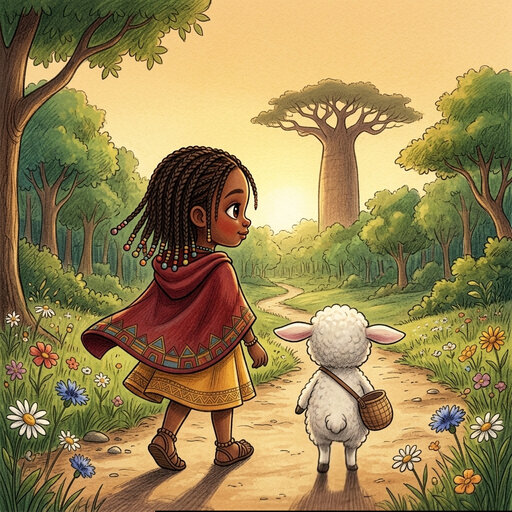
Little Red Riding Hood Adaptation
The warning pinch · When the body speaks, we must listen
⚠️ Content warnings
🎯 What is this story about?
Amara is a brave girl who learns to listen to her own body's signals. On her way to the forest, she meets a little lamb who seems sad and needs help, putting her faced with the great challenge of trusting her somatic instinct above social compassion. But the story doesn't end with the decision: it ends with the telling, with the trust of telling someone.
💭 What does this story work on?
- Bodily autonomy: each person is the sovereign of their own body and its sensations.
- Somatic intuition: identifying real physical signals—the “pinch in the belly”—as an internal compass against discomfort.
- Consent and boundaries: saying “no” firmly even to kind requests if they make you feel unsafe.
- Internal validation: instinct is valid in itself, without needing to wait for something bad to happen to confirm it.
- Management of empathetic guilt: someone else's sadness does not oblige you to break your own safety rules.
- The power of telling: talking to a trusted adult about what was felt is the second part of the superpower.
🧠 Educational focus
The story works on two complementary layers: listening to somatic instinct as a valid signal without external proof, and a secure bond with a trusted adult as a space where that signal can be verbalized and reflected upon. It takes special care not to generate empathetic guilt: the pinch “doesn't judge the little lamb, it just takes care of you.”
🤔 For conversation
- “Have you ever felt your belly squeeze a little? What was happening?”
- “If someone seems very sad but asks you to do something you don't like, what do you think your pinch would say?”
- “Amara told Nana everything even though she wasn't sure she had done right. Why do you think she told her?”
- “Who are the people, like Nana Yewande, you can always tell your secrets or doubts to?”
- “What parts of your body help you know if you are calm or if you don't like something?”
🎯 In daily life
- Practice the “belly self-check” together: before leaving or a new situation, stop for a moment, put your hands on your belly and ask “how is your belly today?”.
- When a child expresses discomfort, validate it before explaining: “your body has told you something, what do you feel?” rather than “it's nothing”.
- Name the trusted adults in their life together, creating a “network of Nanas”: people they can always tell what they feel.
Cultivate your garden with more stories like this in the Semillita app.
Get the App