
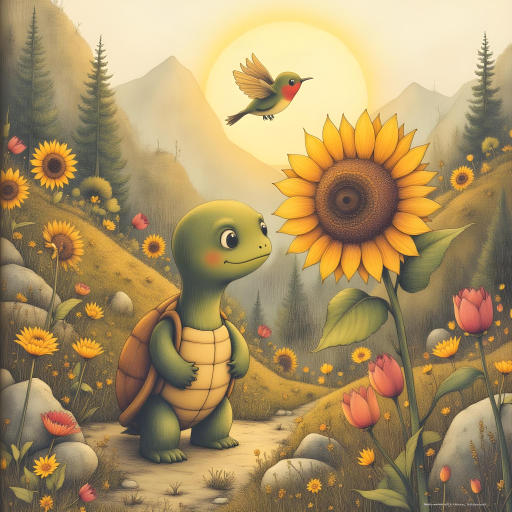
The Turtle and the Hummingbird
One festival, two ways to experience it
🎯 Educator Guide: "The Turtle and the Hummingbird"
💭 What is this story about?
Serena the turtle and Ray the hummingbird are great friends who go together to the Golden Flower Festival. While Ray frantically tries to visit everything, Serena dedicates all her time to deeply getting to know just one flower, Pistil the sunflower. Days later, when Serena goes to visit her new friend, Ray realizes that although he saw many flowers, he doesn't clearly remember any of them and didn't make any new friends. This story teaches about the difference between quantity and quality, between superficial experiences and deep connections, and how to consciously choose where to invest our attention.
🧠 What will children learn?
- Distinguishing between urgent and important: not everything that demands our attention deserves our time
- The value of depth over quantity: knowing a few things well can be more valuable than superficially knowing many
- Immediate gratification vs lasting rewards: the excitement of the moment passes, deep relationships remain
- Mindful attention: being fully present with something creates connection and meaning
- Relationships require time and emotional investment to flourish
- We can all learn and adjust our priorities when we discover what truly fulfills us
🤝 How to continue this conversation?
- "Have you ever done many things but at the end of the day didn't remember any of them well?"
- "What do you prefer: trying many new games or playing your favorite for a long time? Why?"
- "Do you have a friend you know really well? What do you know about them?"
- "How do you feel when you do things very quickly? What about when you take your time?"
- "If you could choose between visiting ten places quickly or spending a whole day in your favorite place, what would you choose?"
- "Is there something you've cared for patiently (a plant, a project, a friendship)? How does it make you feel?"
🎯 Educational Approach
This story uses the natural metaphor of two animals with radically different life rhythms (hummingbird: fast metabolism, short life; turtle: slow metabolism, long life) to introduce sophisticated concepts about attention management, quality versus quantity, and building meaningful relationships.
The story is inspired by principles of positive psychology and mindfulness adapted for 5-6 year old children: the importance of consciously choosing where we invest our limited attention, the value of depth over breadth, and how experiences that require more emotional investment generate more lasting rewards. However, the story avoids moralizing sermons: children learn through Ray's emotional experience, who discovers for himself the natural consequences of his choices, and through Serena, who obtains the tangible reward of true friendship.
The message is not that "slow is better than fast," but that different situations require different approaches, and that it's worth reflecting on what kind of experiences we want to create in our lives.
⚠️ Important Note
This story may resonate especially in today's digital age, where children are exposed to constant stimuli and fragmented experiences. Parents can use this story as a starting point for conversations about screen use, the importance of deepening interests, and the difference between passively consuming content versus actively creating relationships. The story doesn't judge Ray (nor should children who identify with him be judged), but rather offers an invitation to explore a different way of being in the world.
Cultivate your garden with more stories like this in the Semillita app.
Get the App