
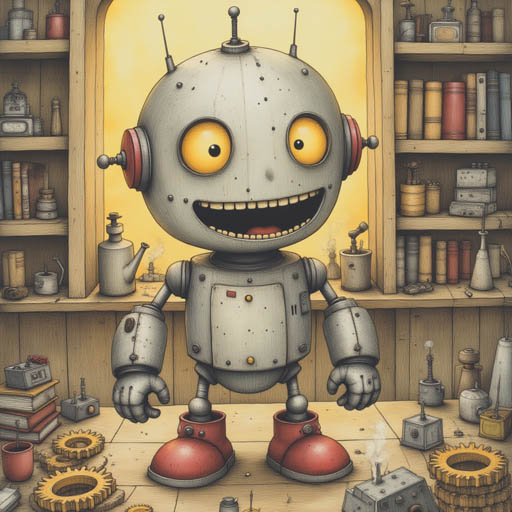
The Curious Robot
Discovering the world through metal eyes
💭 What is this story about?
Chip is a young robot who lives in a laboratory full of books and tools. He has access to all the knowledge in the world and can remember thousands of facts without forgetting anything, but he has never felt true curiosity to experiment with his own hands. One day, Spark, a hungry and tremendously curious mouse, asks him for help making chocolate chip cookies. Although Chip knows the recipe by heart, he has never cooked. Together they discover that knowing the theory is not the same as living the experience, and that the most interesting questions arise when you touch, mix, and observe the world with your own senses. Through this culinary experiment, Chip learns that curiosity is not about having answers, but about daring to ask "why?" and "how?" while you do things.
🧠 What will children learn?
- Difference between knowing and experiencing: That reading about something is not the same as doing it with your hands, and that true understanding comes from direct experience.
- Value of practical curiosity: That the most interesting questions arise when we observe, touch, and experiment, not just when we read or are told things.
- Complementarity of skills: That we all have different strengths and when we combine them (like Spark's motivation and Chip's knowledge) we achieve wonderful things.
- Importance of following instructions: That rules and steps in processes like cooking have important reasons, even if they're not always fun to follow.
- Learning through play: That making mistakes, getting messy, and trying things is a natural and fun part of learning something new.
- Science in everyday life: That simple activities like cooking are full of fascinating phenomena (temperature changes, textures, chemical reactions) that we can observe and wonder about.
🤔 How to continue this conversation?
- "At first, Chip knew many things but wasn't interested in them. Have you ever known something but didn't care until you tried it yourself?"
- "Spark was hungry and that made him want to cook. What things motivate you to want to learn or do something new?"
- "When they mixed the butter and sugar, Chip was amazed at how they changed. Have you noticed something surprising when you cook or do crafts? What did you see that seemed magical?"
- "Spark dumped all the flour at once and there was a white explosion. Have you ever done something 'wrong' that turned out to be fun? What did you learn from that mistake?"
- "If you could do a cooking experiment like Chip and Spark, what would you like to make? What questions would you ask while doing it?"
- "Chip didn't let Spark eat the hot cookies because the instructions said to wait. Why do you think it was important to follow that rule? Are there rules that are hard for you to follow but you understand why they exist?"
- "Spark brought the hunger and excitement, Chip brought the knowledge and precision. What do you bring when you do something with a friend or family member?"
- "Do you prefer learning by reading about something or doing it with your own hands? Why?"
🎯 Educational Approach
This story addresses a fundamental educational concept: the difference between theoretical knowledge and hands-on learning. Chip represents those kids (or adults) who can recite information but haven't developed an emotional connection with learning. Spark, on the other hand, embodies the natural curiosity and inner motivation that drives real discovery. The story avoids the stereotype that "knowing a lot" equals "being curious," showing that genuine curiosity is born from hands-on experience and allowing yourself to ask questions while experimenting. The cookie-baking context is perfect because it combines accessible science (state changes, textures, chemical reactions) with a tangible and rewarding result.
From an educational standpoint, the story works from constructivism: knowledge isn't passively transmitted but actively built through exploration. By showing Chip transforming from a data repository to a curious explorer, children internalize that it's okay not to have all the answers right away, that making mistakes is part of the process (the flour explosion), and that the best questions arise while we do things. The dynamic between Chip and Spark also teaches that different types of intelligence are valuable: Chip's systematic knowledge and Spark's spontaneous curiosity complement each other perfectly. Finally, the story respects rules without preaching: Chip insists on following the cooling instructions not as a spoilsport, but because he understands the "why" behind the rule, teaching children that well-designed rules have purpose.
Cultivate your garden with more stories like this in the Semillita app.
Get the App